Not automatically. If you are ordering logo stickers for reusable bottles, ask for explicit dishwasher guidance for the finished sticker—not just the word “waterproof” on the material description. Then check the bottle’s own care instructions. A sticker approved for machine washing does not make a hand-wash-only bottle dishwasher-safe.
For a campus welcome pack, conference giveaway or employee kit, the useful buying question is: will this exact printed sticker work on the intended surface under the care instructions we plan to give recipients? A laptop sticker and a regularly washed bottle sticker may need different specifications even when the artwork is identical.
Three claims to keep separate
Avery’s material guidance distinguishes resistance to splashes from waterproof labels that can be submerged without smearing. It also says its Durable White Film’s performance depends on the printer: pigment-based inkjet or laser printing produces waterproof labels, while standard dye-based inkjet printing provides resistance to accidental splashes. That is a useful reminder that the blank material alone is not the finished product.
- Water-resistant: ask what exposure is covered. Do not rewrite splash resistance as suitability for soaking or machine washing.
- Waterproof: ask whether the statement covers the print, adhesive and finished construction, and on which surfaces. Water exposure is not a complete set of dishwasher instructions.
- Dishwasher-safe: request the manufacturer’s explicit approval and any application, waiting-time, rack-position or wash restrictions for the exact sticker being quoted.
Manufacturers do offer qualified options. Avery identifies its WePrint UltraDuty White Film labels as dishwasher-safe. Sticker Mule says its custom stickers can go through a dishwasher, but specifically excludes its transfer stickers, vinyl lettering, window clings and front-adhesive stickers, which lack laminate. Those are manufacturer-specific examples, not a Brand Sauce catalog shortlist or a claim that every laminated sticker will perform the same way.
A bottle-sticker approval card
Copy this original decision aid into the order record. Keep the answers tied to a supplier item number and finished print specification; “same design” is not enough if the construction changes.
- Destination and use: [countries], [quantity], [bottle giveaway / loose sticker pack / another use]. If recipients choose their own bottles, say so—there is no single known surface to approve.
- Surface and shape: [bottle model or finish], [available placement area], [sticker dimensions]. Ask the supplier about textured, coated or curved surfaces instead of assuming suitability. Keep stickers away from drinking openings and existing care markings.
- Finished sticker: [material], [printing process], [protective finish], [adhesive], [supplier item number]. Confirm the quote describes the printed item, not only an unprinted sheet.
- Care evidence: [manufacturer instruction link or document], [covered washing method], [exceptions], [application and waiting instructions]. Record “not supplied” where an answer is missing.
- Sample review: [exact sample received], [fit and edge check], [reviewer], [date]. If you conduct a wash trial, document the bottle, application, waiting time, cycle and observations. A small internal trial is not a lifetime durability certification.
- Order release: [approved care wording], [country availability confirmed], [lead time], [quote-needed costs], [substitution approval owner]. Require another review if material, adhesive, finish or print process changes.
Get the logo file and artwork requirements settled alongside the physical specification. A beautiful proof confirms the design; it does not establish adhesive or washing performance.
What to do with incomplete answers
Known bottle, matching instructions: proceed only when the supplier confirms the sticker is suitable for that surface and its care requirements are compatible with the bottle’s. Include the approved instructions with the giveaway.
Sticker approved, bottle hand-wash-only: keep the bottle’s stricter care instructions. Do not promote the combined gift as dishwasher-safe.
Only “waterproof vinyl” supplied: pause the dishwasher claim. Request the missing evidence, choose a documented alternative or use the sticker for a different application that the supplier supports.
Loose stickers for unknown bottles: avoid a universal promise. Explain the sticker’s supported uses and tell recipients to follow their bottle’s care instructions too. Do not suggest that the sticker is suitable for every finish or removable without residue unless the supplier supports those claims.
Worked example: a welcome-week bottle and sticker pack
Illustrative purchasing scenario—not a customer result or product test: a university department selects a reusable bottle and a separate logo sticker. The bottle’s instructions require hand washing; the sticker supplier permits dishwasher use. The order owner approves the artwork and surface compatibility, but prints hand-wash instructions for the combined gift. The sticker’s more permissive instructions do not override the bottle’s restriction.
If the department later replaces the bottle with a different finish, it rechecks sticker compatibility rather than carrying the approval forward automatically. This is a small specification change with a real recipient-facing consequence.
When stickers are part of a larger pack, also decide whether kit components should arrive together or separately. For recurring orders, store the approved construction and care wording in your company-store product-selection record. Reorders should preserve the specification, not merely the image on the proof.
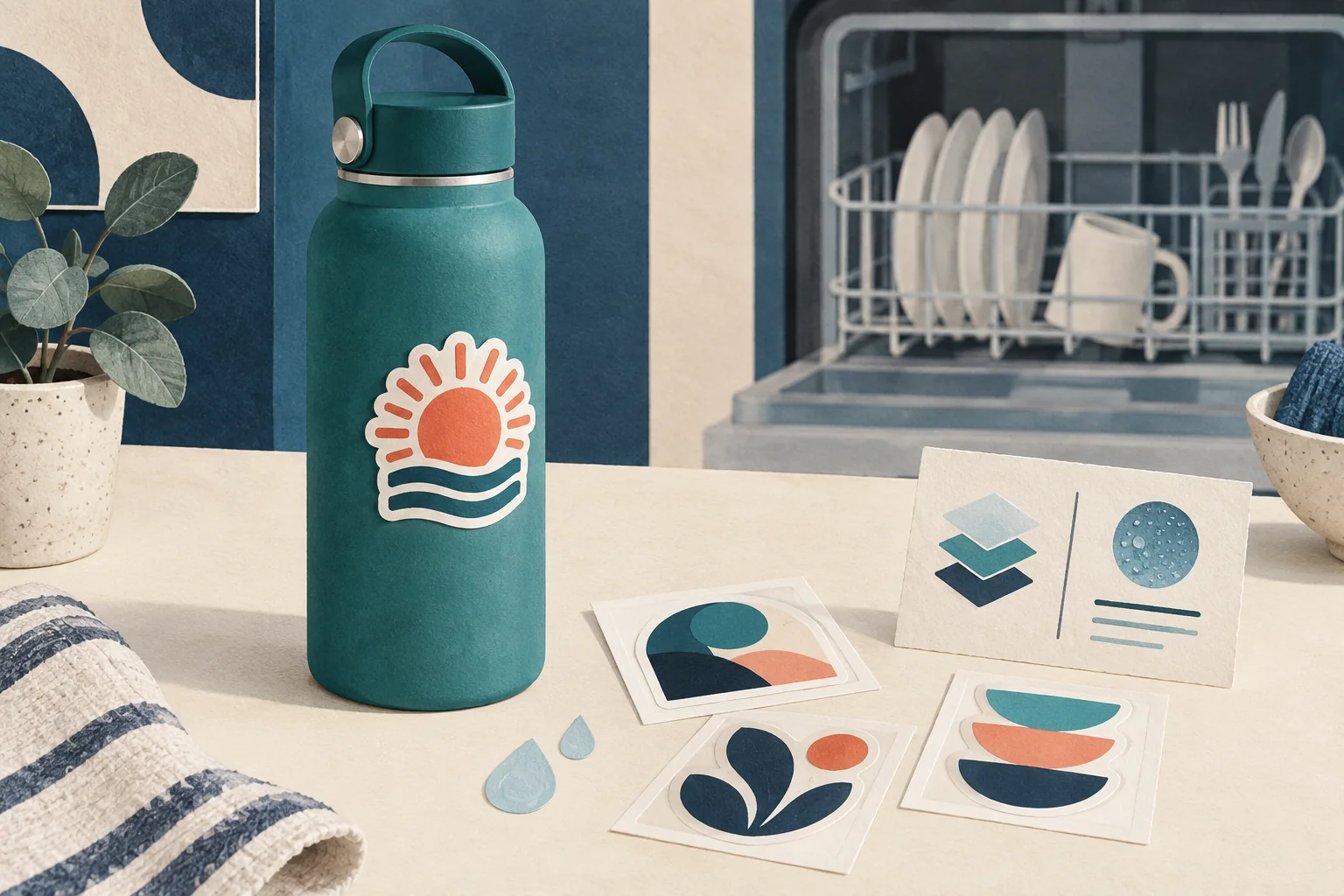
The hero is an AI-generated editorial illustration, not a catalog item, customer photograph or durability-test result. Availability and pricing for a specific sticker order require confirmation.