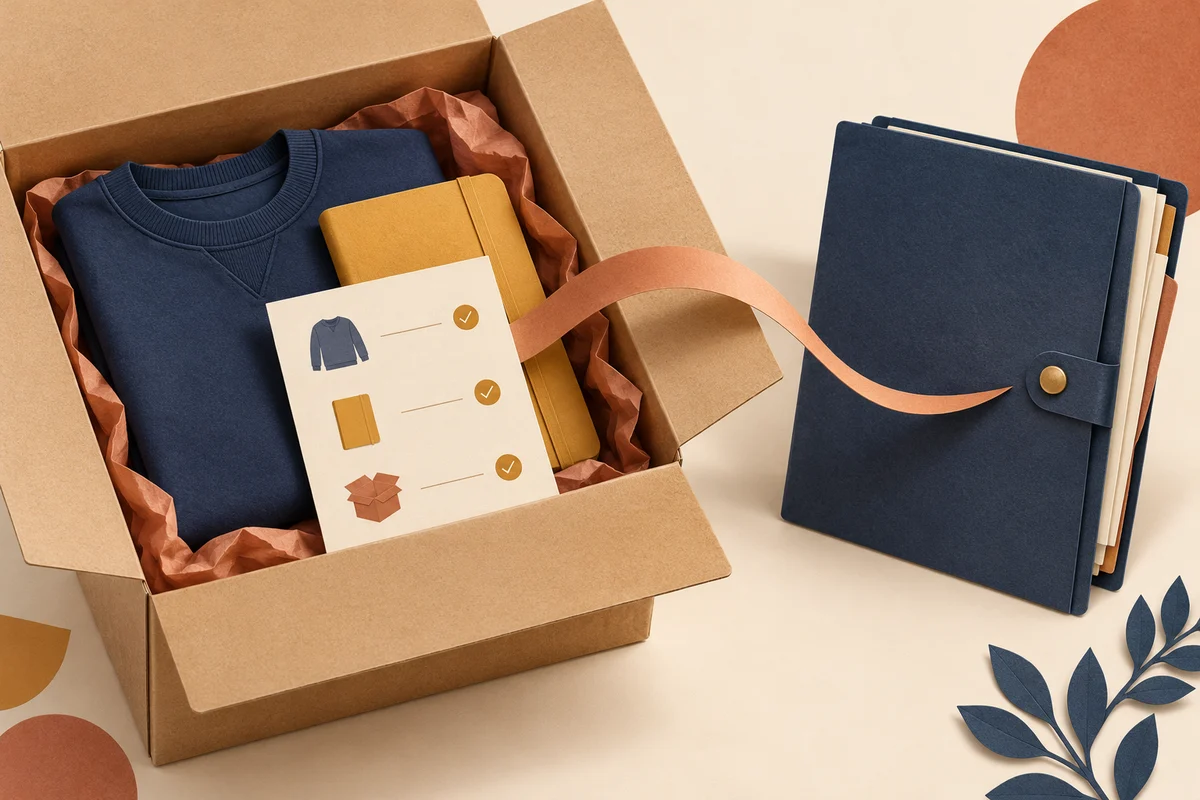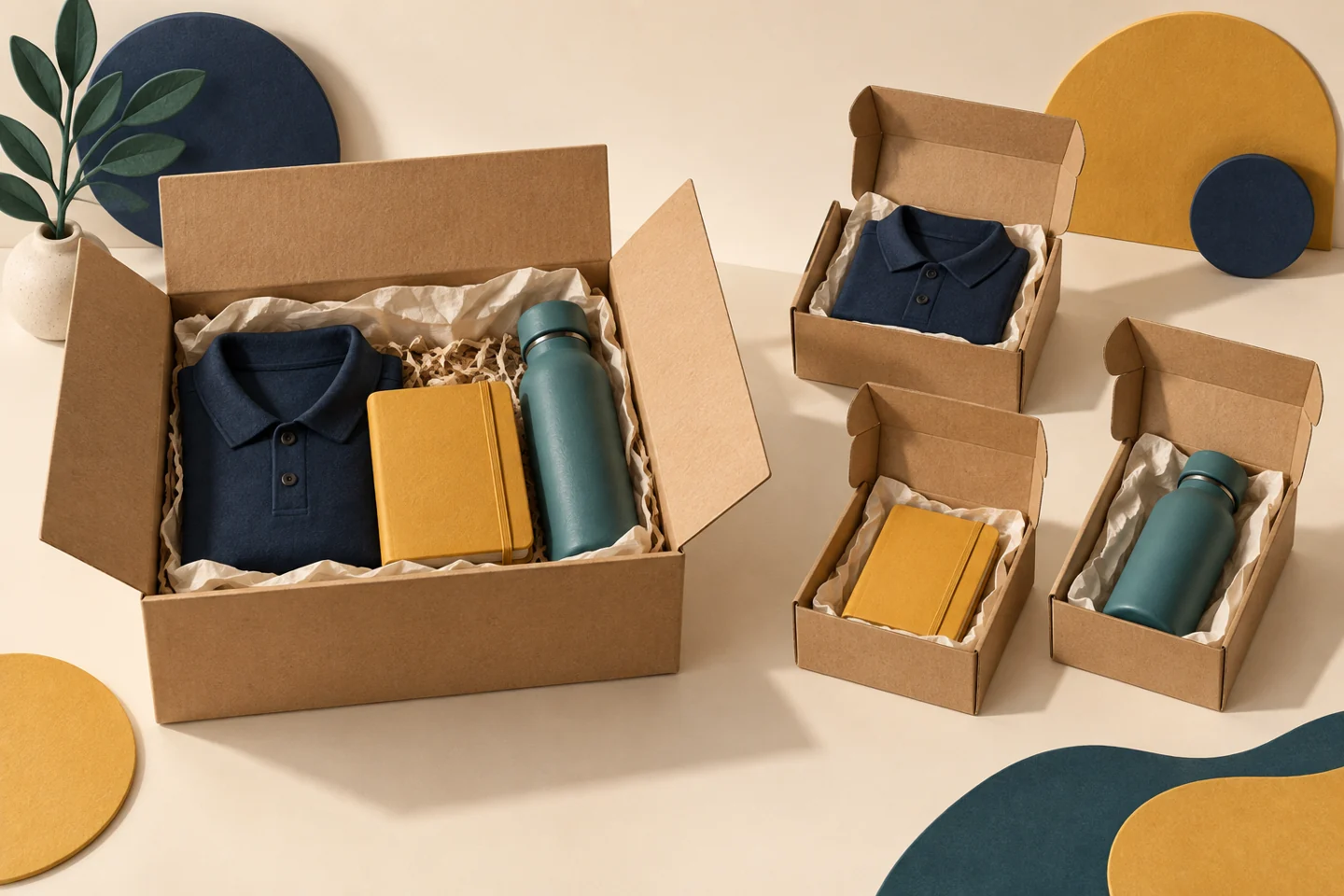
Ship an employee welcome kit in one box when the shared arrival and presentation are part of the promise—and you can have every component ready at one packing location. Allow separate shipments when recipient choice, different production locations or staggered availability matter more. Use a hybrid when a small ready-to-ship welcome package can arrive first and chosen apparel can follow. The right decision is not simply “one box looks nicer.” It is which delivery promise your program can reliably keep.
This guide addresses the physical fulfillment decision after you have chosen a kit concept. For the wider program, see our employee onboarding swag guide. Here, the output is a packing rule, a release rule and a way to know when each employee’s order is actually complete.
Publisher perspective: Brand Sauce provides company-store and employee gifting programs. The framework below is our editorial guidance, not an independent vendor ranking or a claim that one fulfillment model always costs less. Product combinations, country availability, timing and prices need written confirmation for your program.
One order is not necessarily one box
A storefront can present a shirt, notebook and bottle as one welcome collection without those items sharing a production site or parcel. Distinguish three things in a proposal: a merchandising bundle groups products for selection; a fulfillment kit groups physical items for packing; and a recipient order records what one person should receive. They may align, but the word “kit” alone does not establish that they do.
For a concrete supplier example, Printful’s official shipping explanation says orders can be separated because of protective packaging or different fulfillment centers. Its examples include drinkware, notebooks and backpacks. That is a statement about Printful’s workflow, not proof that every supplier uses the same rules.
Ask the provider to map the exact combination before you approve the employee-facing page. “These products can be ordered together” answers a checkout question. “These decorated items will be packed together at this facility for these destinations” answers the fulfillment question.
Choose the model around the welcome moment
| Program priority | Starting model | Main condition to confirm |
|---|---|---|
| Everyone opens the same kit during orientation | Consolidated, preassembled kits | All components and recipient details ready before the release deadline |
| New hires choose different apparel throughout the year | Separate direct shipments | Item-level status and clear expectations before ordering |
| A welcome gesture is needed quickly, but apparel choice matters | Small core kit plus later chosen item | Two deliberate delivery promises, each with an owner |
| A predictable cohort has confirmed quantities and sizes | Bulk production with kitting | Approved sample, receiving capacity and allocation plan |
| Recipients are in multiple countries | Country-specific decision | Exact product, decoration, packing and delivery route in each country |
These are starting points, not automatic recommendations. A small domestic program might consolidate efficiently through one supplier; a much larger distributed program might need several routes. Headcount alone does not tell you whether consolidation is useful.
Do not make optional merchandise a dependency for work equipment or required workplace gear. Keep those operational deliveries on their own approved timelines. A missing branded notebook should not hold up a laptop managed by IT.
Build a kit bill of materials before comparing quotes
Create one line per physical component, including the box and insert. Record the exact product, color, size variant, decoration, quantity per recipient, production origin, intended packing site and expected ready date. Then assign each line one of three roles: mandatory for release, allowed to follow separately, or removable with approval.
That last distinction prevents a small optional item from silently determining the whole schedule. A welcome note may be essential to the experience while a sticker is optional. The program owner should decide that before stock runs short—not leave the packing team to guess.
- Product approval: Who confirms the decorated version and packaging fit?
- Variant matching: How does a selected size stay associated with the correct recipient?
- Receiving: Who counts and checks inbound components before they become available to pack?
- Release: Who authorizes incomplete kits, substitutions or separate sends?
- Exceptions: Who funds and arranges a missing or damaged component’s replacement?
For a hypothetical kit containing a bottle, notebook and chosen shirt, the bottle and notebook might be common stock while shirts vary by employee. A provider could assemble the common components in advance and add a shirt after selection. Alternatively, it could send the common package first. Both are valid proposals; they have different storage, handling and communication requirements.
Set a release rule that survives a late component
A consolidated kit cannot leave complete until its last required component is available at the packing site. Working backward from an arrival goal therefore needs more than carrier transit time: allow for production, inbound movement, receiving, matching, packing and final dispatch. Request dated milestones and distinguish estimates from commitments.
Write a hold-until-complete rule with an exception deadline. For example: “Hold the core kit until its required components pass receiving checks. If the shirt is not ready by the agreed release date, the program owner chooses between delaying the full kit and approving a separate shirt shipment.” This is a sample policy, not a fulfillment-time guarantee.
Also define what happens when an employee orders late or changes a size after production begins. A packing instruction cannot reverse completed decoration. Record the supplier’s cancellation and change conditions rather than assuming the store’s edit button controls every downstream stage.
For rolling onboarding, examine whether the promise should be relative to selection instead of the employment start date. “Your selected gift is produced after you order” can be accurate where “your complete box arrives on day one” cannot. The invitation should reflect the actual arrangement.
Compare complete delivered kits, not just postage
Consolidation can replace several outbound parcels with one, but it may introduce inbound freight, receiving, storage, assembly and packaging costs. Separate shipments can avoid a central assembly step but add multiple delivery charges. Neither model is inherently the cheaper one.
Box dimensions matter as well as weight. UPS explains dimensional weight as a way of accounting for package size relative to actual weight. Ask for a quote using the packed dimensions, not a guess based on the combined product weight. A generous presentation box can change the shipping calculation.
Illustrative arithmetic only—not supplier pricing or measured savings: suppose the same three decorated items cost $55 per recipient under both proposals. Separate shipping costs $8, $7 and $6. Consolidation adds $5 allocated inbound freight, $4 receiving and assembly, $3 packaging and $9 outbound shipping.
| Illustrative cost per recipient | Separate parcels | Consolidated box |
|---|---|---|
| Decorated products | $55 | $55 |
| Outbound shipping | $21 | $9 |
| Allocated inbound freight | $0 assumed | $5 |
| Receiving and assembly | $0 assumed | $4 |
| Additional kit packaging | $0 assumed | $3 |
| Subtotal before other costs | $76 | $76 |
The zeroes mean those costs are assumed included elsewhere or absent in this example; they are not a promise of free service. This deliberately simplified comparison excludes tax, storage, rush work, reships and unused stock. Request those lines separately, and avoid counting packaging twice if it is already included in fulfillment.
The useful result is that lower outbound postage did not produce a lower subtotal. Replace every assumption with your quotes, then assess any difference against the experience you need. For inventory and production tradeoffs beyond packing, use our on-demand versus bulk decision guide.
Preserve employee choice without hiding inventory commitments
Bulk kits make sense when the assortment is stable, the cohort is known and a coordinated presentation is important. They become harder to manage when headcount changes or a box contains apparel sizes selected by forecast rather than recipients. Ask what stock you own, what can be reused in another program and what happens if hiring slows.
On-demand products can reduce the need to buy every variant ahead of time, but a one-box promise may still require a consolidation service. “Produced after ordering” and “assembled without any storage or extra handling” are different claims. Verify both rather than assuming one implies the other.
A hybrid can be intentionally modest: stock only the common welcome components and let employees choose a separate apparel item. Tell them that two deliveries are planned. If the second parcel is presented as a surprise correction, the same operational model will feel much less organized.
Where a kit has international recipients, do this analysis country by country. A product available for local direct delivery is not necessarily available for local kit assembly. Do not extrapolate one successful domestic configuration into a worldwide promise.
Track completion at the recipient and component level
For split fulfillment, an order should not be considered complete merely because its first parcel was delivered. Maintain a component-to-parcel record: recipient order, expected item, parcel reference, dispatch status, delivery status and open exception. A small program can use a controlled worksheet; a larger one should ask the provider to demonstrate its actual reporting.
UPS’s tracking support guidance directs users to package tracking for current shipment status. The program still needs its own record of what belongs in each parcel. A carrier delivery event does not establish that the recipient received every promised component.
Use a simple message such as: “Your welcome gift will arrive in two deliveries. The notebook and bottle travel together; your selected shirt follows separately. We will share tracking for each parcel. Contact the program support team if a delivered parcel is missing an expected item.” Adapt this only to a confirmed shipping plan.
Give employees one support entry point even when several suppliers are involved. Behind it, distinguish a late parcel, a missing packed item, a decoration defect and a wrong size: each may require a different investigation. Do not make the employee diagnose the supply chain before someone takes ownership.
Pilot the packing arrangement, not just the products
Approve a packed sample or pilot order that uses the intended products, decoration, inserts, protective materials and box. An attractive product mockup cannot show whether a bottle presses against a notebook or whether the packing list identifies the correct shirt size.
- Confirm the exact contents and approved variants against the bill of materials.
- Review protective packing, movement inside the box and actual packed dimensions.
- Follow the recipient messages and every tracking link.
- Check whether the system distinguishes partial delivery from complete delivery.
- Walk through one hypothetical missing-component case and document who responds.
- Record approval and the changes that would trigger another review.
A successful pilot is evidence about that configuration, not every future product or destination. Recheck the plan when you change a rigid item, packing site or major component. If the core uncertainty is where parcels should go, our home-versus-office delivery guide covers that separate decision.
Frequently asked questions
Can employees choose products and still receive one box?
Potentially, if the selected items can be brought to one packing location and matched to the recipient. Ask about supported combinations, timing and consolidation charges. Product choice alone does not establish a one-box capability.
Should we hold the whole welcome kit for one late item?
Only if that item is essential to the agreed experience and the delay is acceptable. Set the release policy before launch, with a named owner who can authorize a split shipment or a changed date.
Does fewer parcels mean a more sustainable kit?
Not by itself. Parcel count omits inbound movements, packaging materials, transport routes and unused products. Compare the actual designs before making environmental claims; do not label consolidation or on-demand automatically greener.
What should we ask Brand Sauce to quote?
Bring the recipient countries, expected hiring pattern, exact kit concept, choice requirements and arrival goal. Our employee onboarding kits solution describes both welcome-kit stores and prebuilt bundles. Ask for the specific packing arrangement, release policy, support ownership and itemized price in writing. Those details—not the word “kit”—define the service you are buying.
Sources checked September 28, 2026. The decision framework, sample policy and arithmetic are editorial planning tools, not reported client results.