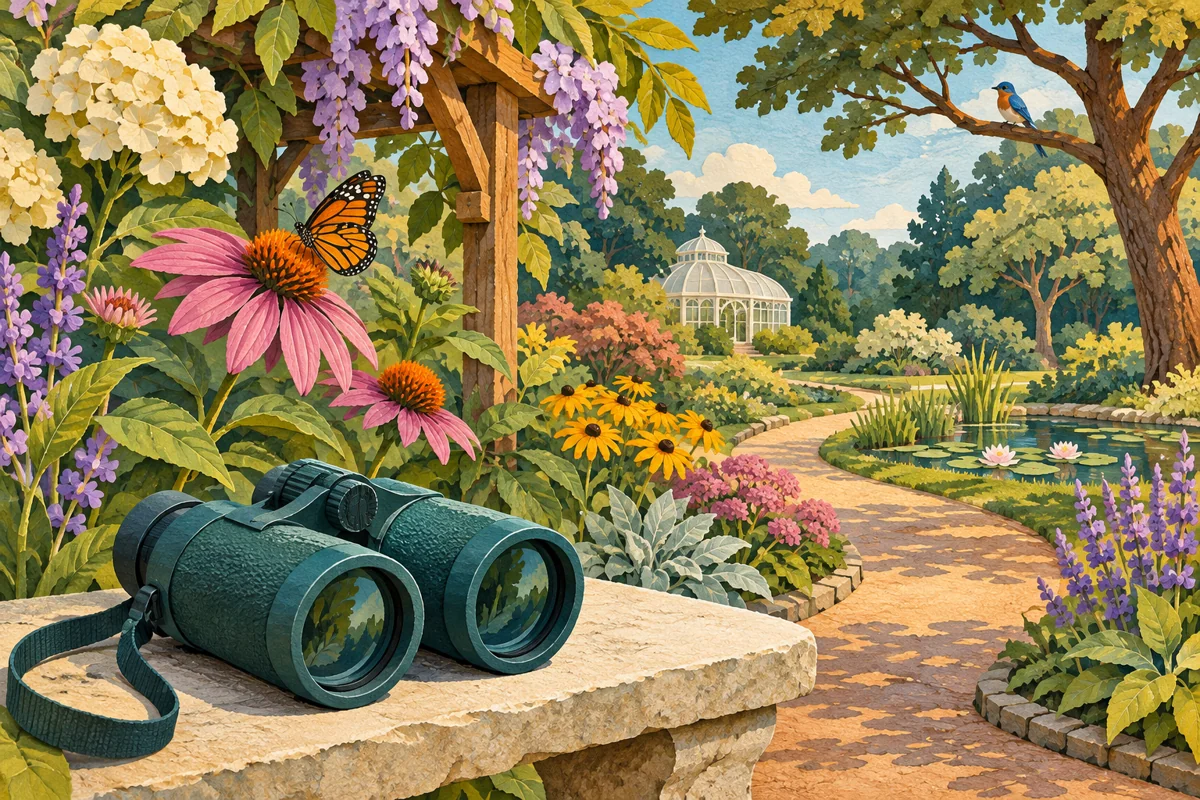
For a botanical-garden outing, check the binoculars’ minimum focusing distance before choosing magnification or decoration. A model that works for birds across a pond may not focus on a flower beside the path. “8×” tells you magnification; it does not tell you how close the subject can be.
This matters when a nature center selects member gifts or an employer buys take-home binoculars for a guided garden walk. Start with the nearest planned subject and the place participants can actually stand—not the largest number on the gift box.
Two published specifications show the difference
Nikon’s MONARCH M5 specification table lists a close-focusing distance of 2.5 m (8.2 ft) for its 8×42, 10×42 and 12×42 models. In that family, choosing higher magnification does not move the near-focus limit closer.
Ricoh’s current Papilio table lists a 0.5 m minimum focusing distance for the Papilio II and III models shown. The table also distinguishes weather resistance: the III WR models have it marked; the II models do not. A shared close-focus specification is not evidence that two generations have identical outdoor suitability.
These are manufacturer specification examples, not a ranked shortlist, hands-on results or confirmation of Brand Sauce catalog stock. Exact model, destination-country supply, branding feasibility and price remain quote-needed. Do not accept “Papilio-type” or “equivalent 8× binoculars” as a complete substitution description.
Walk the route before requesting samples
Make a three-stop viewing brief. The organizer can do this without selecting a product first:
- Nearest detail: identify a stationary plant, specimen or display that the guide genuinely wants people to study. Measure the approximate viewing distance from the allowed standing position.
- Restricted viewpoint: record any railing, narrow path or seating position that prevents the viewer from stepping backward. A near-focus mismatch cannot always be solved by moving.
- Far subject: include the pond, tree line or other distant feature in the same outing. Close focus is one requirement, not the entire experience.
Then filter candidates: the published minimum focusing distance should be shorter than the nearest required viewing distance. Avoid building the activity exactly around a stated minimum; allow practical room for where different participants stand and verify a sample. If the specification is missing, keep that model unapproved until the supplier provides it.
For a route consisting only of distant subjects, unusually close focus need not drive the purchase. If the route mixes near and far subjects, require the sample to handle both. If no suitable sample fits the budget, change the activity or use separate viewing equipment rather than describing an unsuitable gift as ready for the walk.
A one-meter flower: worked selection example
Illustrative planning example, not a product test: a guide plans a flower observation from a fixed position approximately 1 m away. A quoted model with a published 2.5 m minimum focusing distance fails the paper specification check for that stop. Buying a higher-magnification version with the same 2.5 m limit does not fix the mismatch.
A model specified to focus at 0.5 m passes this initial distance filter. It still needs sample review for comfortable viewing, handling and the rest of the route. Alternatively, the guide could relocate the observation to a genuinely usable position farther away. That is a change to the activity, not proof that the original model focused at 1 m.
Sample check: switch between near and far
This is a proposed acceptance exercise; Brand Sauce has not performed it on the referenced products.
- Record the exact sample model and its instruction link. Set up eyecups, eyepiece spacing and diopter as the manufacturer directs.
- At the planned near stop, focus on a stationary detail and record whether the reviewer can obtain a clear, comfortable single view. Do not use the sun as a target.
- Switch to the far stop, then back to the near stop. Note whether the reviewer can find the subject and operate the focus control without help after the initial explanation.
- Repeat with willing reviewers using their normal viewing eyewear. Near-focus capability does not replace the separate eyeglass and eye-relief fit check.
- Confirm the exact supplied model, weather-use instructions, decoration location and destination before approval. A different generation or magnification needs a fresh specification check; follow the same discipline as other gift substitutions.
Copy this into the buying brief
Use: guided garden walk plus take-home gift. Nearest required subject and viewing position: ____. Approximate distance: ____. Far subject: ____. Proposed model and manufacturer minimum-focus specification: ____. Sample near/far observations: ____. Eyewear-fit observations: ____. Weather-use limits: ____. Destination-country supply and decoration approval: ____. Price: quote-needed. Substitution requires a new model-specific distance and sample check.
Buying rule: approve the viewing task first, the exact binocular model second, and the branding after that. A gift is useful when recipients can see the thing the outing asks them to notice.
Illustration: AI-generated editorial concept, not a catalog product or optical test result. Manufacturer specifications checked November 10, 2026.