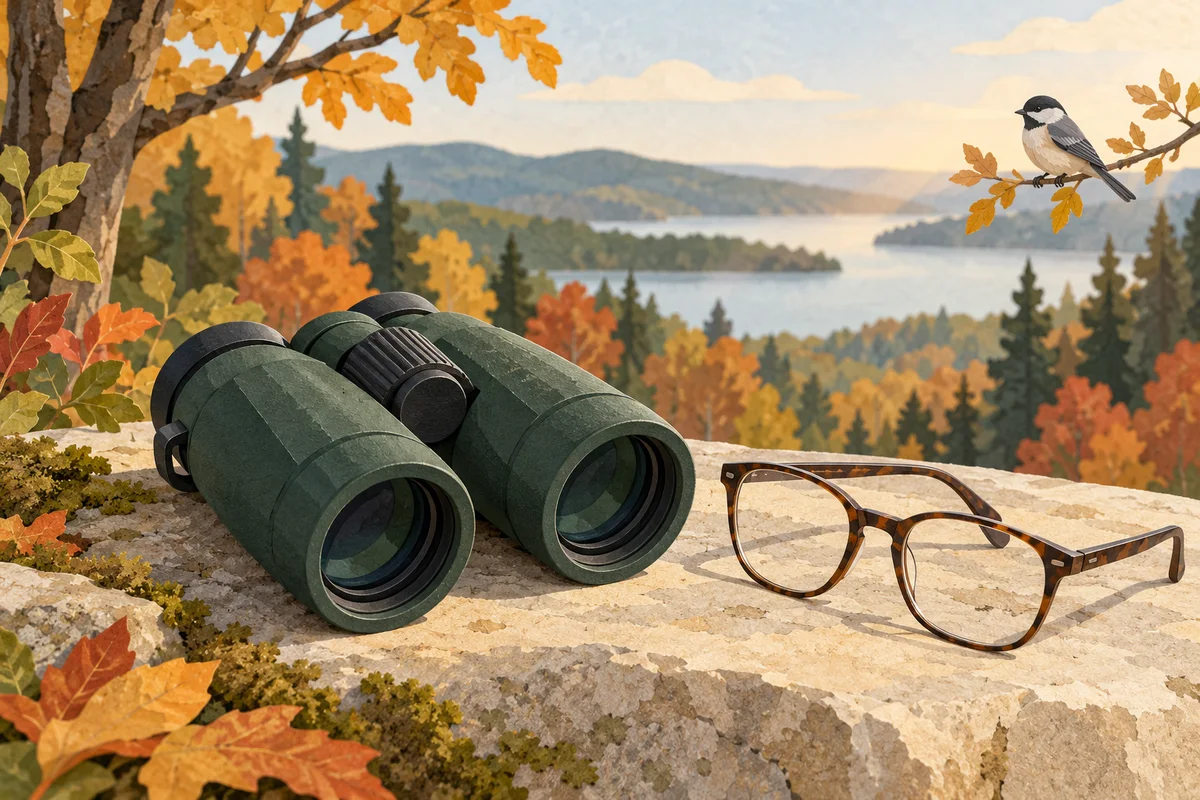
Yes, binoculars can work with eyeglasses—but a compact body or an impressive magnification number does not establish a comfortable fit. For a nature-center member gift or a company birdwatching outing, ask for the exact model’s eye relief and eyecup instructions before approving the logo.
The practical question is whether a recipient can see the complete viewing circle with their usual glasses on, without pressing the binoculars into the lenses. That deserves a sample check, not an “eyeglass-friendly” promise applied to an entire product category.
Ask for eye relief, not just magnification
Nikon explains eye relief as the distance between the eyepiece lens’s outer surface and the viewing position where the whole field is visible. It recommends longer eye relief for people wearing glasses. Glasses make the position of your eye relative to the eyepiece an important part of selection.
As an initial specification filter, Nikon’s first-time buyer guide recommends 15 mm or longer eye relief for eyeglass wearers. Use that as a shortlist starting point, not our guarantee that every frame and wearer will fit. The same guide recommends 6–10× magnification for handheld outdoor use; a larger magnification number is not automatically a better outing gift.
Request a model-specific specification sheet. If the quote gives magnification but omits eye relief, mark the optical fit unresolved. A photograph of the binoculars cannot fill that gap.
Eyecup position and focus are separate adjustments
Nikon’s central-focusing binocular instructions show retracting turn-and-slide eyecups for glasses wearers, or folding back the illustrated rubber type. They also explain adjusting the spacing between the eyepieces and setting the diopter for differences between the two eyes. Those are separate steps, not alternative names for focusing.
Follow the supplied model’s own instructions: do not assume every eyecup twists, folds or has the same stops. Include those instructions with the gift. At an organized outing, a brief setup demonstration can be more useful than another accessory in the box.
A five-minute sample review card
This is a proposed purchasing check, not a test we have conducted. Use the intended sample and a distant stationary subject in ordinary daylight, never the sun. Invite willing reviewers who normally wear glasses and someone who does not; record their observations rather than collecting prescription details.
- Identify the sample: record model, stated eye relief, magnification, eyecup type and instruction-document link. Keep any substitution tied to a new review.
- Set it up: each reviewer follows the manufacturer’s eyecup, eyepiece-spacing, diopter and focus sequence with their usual viewing eyewear.
- Check the edges: can the reviewer see one complete circular field, or are parts cut off? Record the result and eyecup position, not simply “clear image.”
- Check the handling: can they find the subject, refocus and hold the binoculars comfortably without pushing against their glasses? Repeat after lowering and raising them.
- Separate a setup issue from a selection issue: if following the instructions resolves the problem, add that setup step to the handoff. If it does not, hold approval for that use and try another model.
- Close the purchase record: attach the observations, approved decoration location, destination-country availability and final supplied SKU. Price and branding feasibility remain quote-needed until confirmed.
A small review cannot establish universal fit. Give recipients an alternative when binoculars are not useful to them; our employee gift preference survey helps distinguish genuine interest from an organizer’s enthusiasm.
Decide what happens when the sample does not fit
Illustrative decision, not customer evidence: a nature center compares two proposed gift samples. One is easier to pack, but a reviewer wearing glasses cannot see the full circle after correct setup. The other gives that reviewer a comfortable view. The buyer keeps the second in consideration and checks the remaining reviewers rather than approving the smaller model because its pouch has a larger print area.
If no sample works for the intended group, change the gift or separate the take-home gift from the outing’s viewing equipment. Do not spend the remaining budget adding accessories to an unsuitable core item. That is the same purchasing tradeoff explored in one useful gift versus a bundle.
Buying rule: shortlist on documented eye relief, approve on instructed use with real eyewear, and preserve the exact model in the order. This is a specification checklist, not a claim that any referenced manufacturer’s binoculars are in Brand Sauce’s catalog or available for decoration in every country.
Illustration: AI-generated editorial concept, not a catalog product or product-test result. Manufacturer guidance checked October 17, 2026.