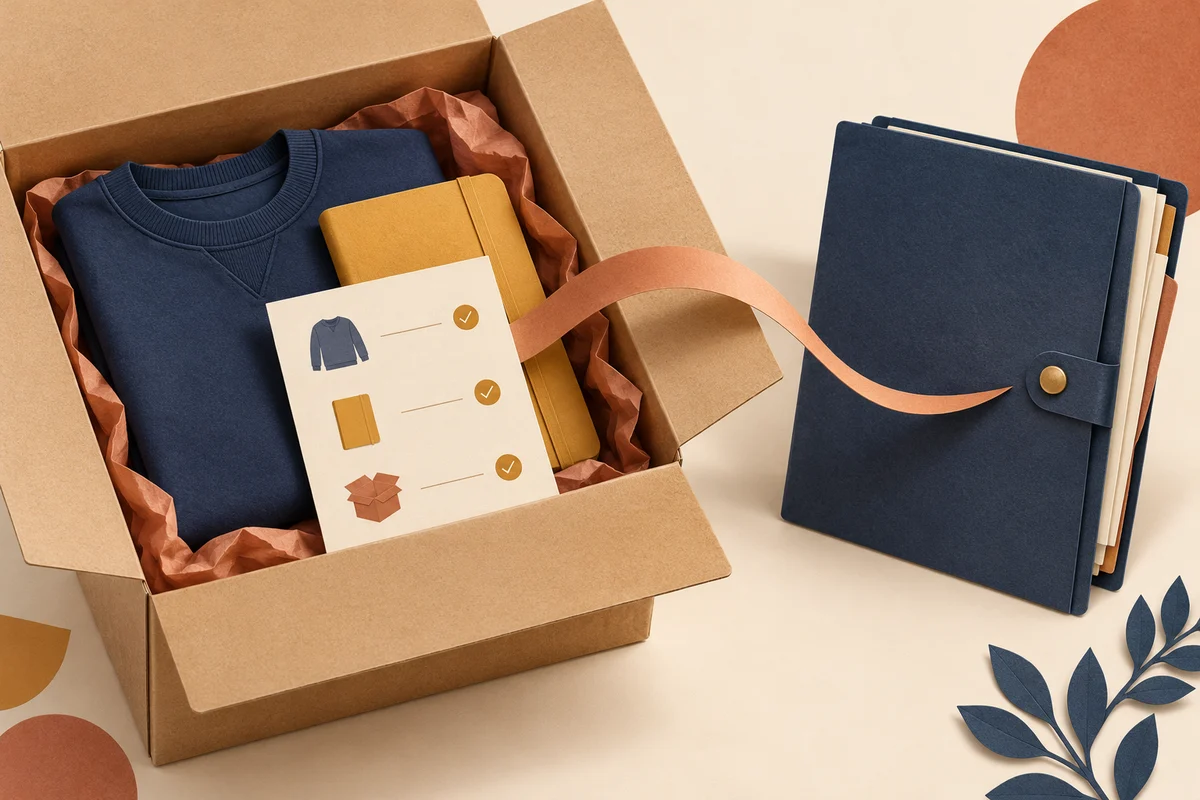
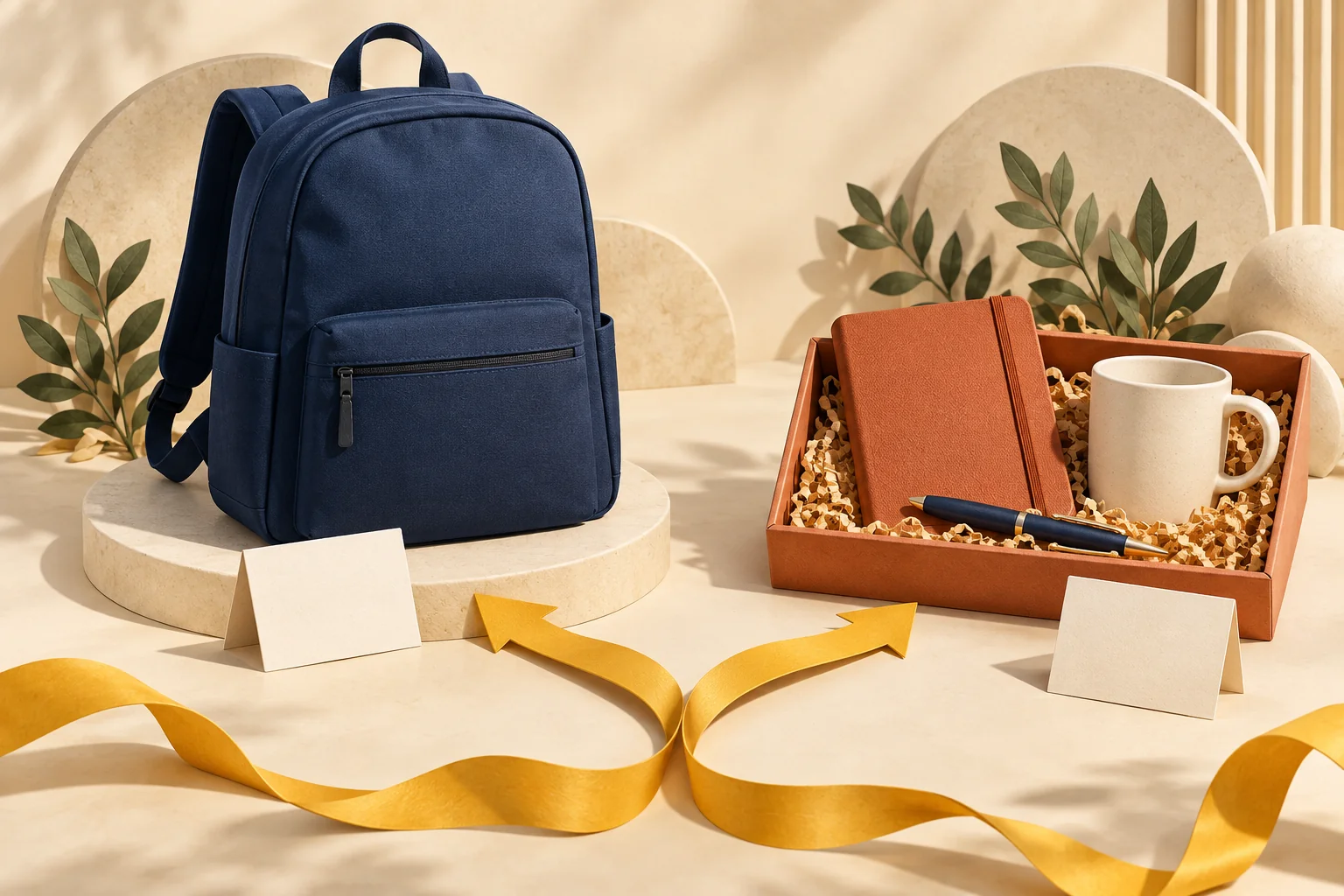
Choose one premium employee gift when its extra quality solves a real recipient need. Choose a bundle when the items work together and employees want the complete set. If both are credible, offer each as one equal-status gift choice—not as a contest between price tags or item counts.
The decision is not simply “one expensive thing or several inexpensive things.” It is how to allocate a recognition budget across usefulness, choice, presentation and delivery. A backpack someone will use can be a better gift than a full box of unwanted accessories. A coordinated notebook-and-drinkware set can also be more useful than an expensive item the recipient already owns.
Brand Sauce publishes this guide and provides employee gifting and managed company-store services. The framework below is our editorial recommendation, not a report of measured client results. Product examples and budget figures are illustrative; exact products, decoration, destination coverage and prices require confirmation.
Define what premium buys before comparing formats
“Premium” should describe a useful improvement, not just the highest quote. Identify the feature that earns the additional spending: a bag with the right laptop compartment, a jacket that fits the recipient’s climate, or a notebook with the binding and paper they prefer. Ask what the lower-cost alternative cannot do as well for this particular audience.
Keep brand familiarity separate from suitability. A recognizable label might matter to some employees, but it does not establish fit, everyday usefulness or acceptable decoration. Similarly, a bundle is not automatically generous because it contains more pieces. Each component needs a job beyond filling the box.
A useful caution comes from Flynn and Adams’s 2009 gift-price research, summarized by Stanford GSB. Across three studies, givers expected higher spending to produce greater appreciation, while recipients did not report the same price-appreciation association. These were gift-giving studies, not a test of your employee program. They support questioning price as a proxy for appreciation—not declaring that inexpensive gifts always perform better.
Write a one-sentence value case for every proposed option. “This bag accommodates the laptop and commute setup employees described” is actionable. “This looks expensive” leaves the important question unanswered.
Use a format decision matrix
| What you know about recipients | Format to investigate | Condition before approval |
|---|---|---|
| One product would solve a specific, recurring need | One stronger item | The proposed upgrade is useful and the exact product fits |
| Several items support the same activity | A coordinated bundle | Each component earns its place, with no unwanted mandatory filler |
| Needs differ meaningfully across the group | A choice between complete options | Every option is viable within the employer’s budget and delivery rules |
| A shared ceremony needs a consistent physical presentation | A common presentation with recipient-selected contents, if feasible | Selection, assembly and delivery can meet the event date |
| The budget covers good merchandise but not elaborate packing | A simple single-item or minimal-set presentation | Protective packaging remains adequate; decorative extras do not consume the useful gift |
Use this matrix to narrow the brief, not to bypass employee input. A small group of sample reviewers can explain what would make an option useful or unsuitable. Show the actual proposed contents, dimensions, colors and decoration—not only a category name such as “executive bundle.” Our employee gift preference survey guide explains how to collect useful input without promising unapproved products.
Make every bundle component pass a usefulness test
Start with the activity the set supports. A meeting kit might pair a suitable notebook with a pen. A travel-oriented set needs products that suit how recipients actually travel. An assortment assembled only because the pieces share a color is visually coordinated, but not necessarily useful.
For each component, ask four questions:
- Purpose: What does this item help the recipient do?
- Complement: Does it add a distinct function, or duplicate something already in the set?
- Fit: Can it work for the intended recipient without an uncollected size, device or lifestyle assumption?
- Removal: Would removing it materially weaken the gift?
If removing an item barely changes the experience, quote the bundle without it. Redirecting that money to a better core product may be sensible; so may retaining a lower overall cost. There is no requirement to spend the entire allowance just because it exists.
Consider an illustrative notebook, mug and pen set. The pen complements the notebook. The mug may be useful, but it serves a separate need and should survive review on its own. Adding a second writing accessory solely to reach “four gifts” makes the count larger without explaining the benefit.
Also review the decorated samples together. A consistent artwork treatment can unify a set without putting a large logo on every surface. The supplier should confirm feasible placements and methods for each exact item; a proof on one component does not approve the others.
Offer equal-status choices, not a hidden gift hierarchy
If employees can choose one substantial item or a bundle, describe both with the same care. Use equally clear photography, specifications and delivery information. Avoid labeling one “premium” and the other “basic” on the selection page unless those labels communicate a real, relevant difference employees need to understand.
Your internal costs do not have to match to the cent. Instead, establish an approved cost band and make every option a complete employer-funded gift. Explain the program consistently: “Choose one of these gift options” is clearer than showing a monetary allowance that cannot actually be spent flexibly.
Decide whether the entitlement is one option or a spendable balance. These are different operating models. Under a one-option program, a three-piece bundle counts as one selection. Under a balance model, employees may be assembling their own basket, raising questions about remaining credit, extra payments and delivery charges. Do not imply the latter when the approved experience is the former.
Ask the provider to demonstrate the agreed rule. Can an employee accidentally claim both the bag and the bundle? Can a bundle component be removed? What happens if a variant is unavailable? These are acceptance questions, not claims about features every store supports. The principle behind letting employees choose their gifts only works when the offered choices are genuinely deliverable.
Compare the complete delivered cost
A merchandise-only comparison can favor a bundle that later requires extra packing or handling. A single item can also carry substantial freight or decoration costs. Request a comparable delivered scope for each option rather than assuming either format is cheaper.
Illustrative planning arithmetic only—not Brand Sauce pricing, a supplier quote or measured savings: suppose an employer sets an $85 per-recipient planning cap. The following hypothetical quotes show why the lower merchandise subtotal does not necessarily create more room in the budget.
| Illustrative cost per recipient | One item | Three-item bundle |
|---|---|---|
| Products and decoration | $60 | $48 |
| Additional packing and assembly | $2 | $8 |
| Delivery | $10 | $15 |
| Subtotal | $72 | $71 |
| Unallocated room within $85 cap | $13 | $14 |
The remaining room is not a final surplus. This simplified example excludes tax, program fees, storage, inbound freight where applicable, replacements and unusual destinations. Each excluded line needs a quote or an explicit determination that it does not apply. Do not count packing twice if it is already included elsewhere.
Run the comparison for the actual delivery groups, not just one convenient address. If one option cannot be supplied to a particular country, it is not a real choice there. Decide whether the program needs a local equivalent or a different assortment before employees see an invitation. Use quote needed wherever price or scope remains unresolved.
Choose production separately from gift format
A single-item gift is not automatically on-demand, and a bundle is not automatically a bulk purchase. Format describes what employees receive. Production and fulfillment describe how you obtain and deliver it.
Bulk can be appropriate for a known group choosing before a fixed event, especially when confirmed quantities support the required decoration and coordinated presentation. It still needs a plan for unclaimed sets and incorrect forecasts. Obtain the actual price break rather than assuming volume will justify the commitment.
On-demand can suit rolling recognition when quantities and variants are not known in advance. Confirm the exact item, decoration and delivery route; do not assume that one-item production includes multi-item assembly. A bundle with components produced in different places may require another service.
A hybrid might use pre-purchased common components alongside a recipient-selected item. That can be practical, but creates separate stock and release responsibilities. The complete gift must remain available—not just the headline product. If you have already chosen a bundle and now need the packing decision, see our separate guide to one-box versus separate-shipment welcome kits.
Treat presentation as part of the brief, not a reason for filler
A thank-you note, a clean layout and an accurate explanation of the gift can create a deliberate presentation without a large decorative box. For an event, consistent wrapping may matter. For dispersed employees, protecting the item and making the delivery easy to recognize may be the more important requirements.
The EPA’s waste guidance recommends refusing unnecessary items and extra packaging, and buying only what is needed. Applied here, that is a reason to challenge filler and unnecessary packaging—not evidence that every single-item gift has a smaller environmental footprint than every bundle. Material, durability, actual use and transport would need their own evidence for that comparison.
Keep essential protection. Removing packaging that prevents damage can create a replacement problem. Ask for a packing proposal that distinguishes protection from presentation, then approve the intended finished experience.
Pilot the decision, not just the order button
Before committing the full program, review both complete options with people representing relevant recipient needs. This is a practical usability check, not a statistically representative employee study. Record the reasons behind preferences rather than treating a small sample’s vote as a universal verdict.
- Can reviewers explain what each option contains without assistance?
- Does the proposed premium feature matter to them?
- Which bundle component would they leave out, and why?
- Can they identify a suitable option without paying extra?
- Are size, compatibility, availability and delivery limitations clear?
- Does a test selection enforce the approved entitlement?
- Is there a named owner if an entire option or one component becomes unavailable?
After delivery, separate selection rate from usefulness. A popular listing tells you what employees chose from the offered menu; it does not tell you whether the gift was used. A short optional follow-up can ask which components were useful and what recipients would change. Report the response count and limitations; do not turn a handful of replies into an engagement claim.
Frequently asked questions
Is one expensive gift always better than several smaller gifts?
No. A useful upgrade can justify concentrating the budget, while complementary products can justify a bundle. Price and item count are inputs, not measures of appreciation. Validate the proposed options with recipients and decorated samples.
Should all choices have the same retail value?
Not necessarily. Use a consistent employer-funded promise and an approved delivered-cost range. Avoid unsupported retail-value comparisons, particularly when decoration, packing and service are included in one quote but not another.
Can employees build their own bundle?
Potentially, if the provider can support the selection, budget and fulfillment rules you need. Define allowed combinations, additional payments, remaining balances and shipping treatment first. A fixed choice between complete options may be simpler when those controls are unavailable.
What should we ask Brand Sauce to quote?
Bring the audience, destinations, deadline, all-in budget and two or three complete gift concepts. Ask which exact products and delivery arrangements are feasible, which costs remain unresolved and how the choice rule would work. Our employee recognition gifting overview is a starting point for that discussion—not confirmation of any particular bundle, price or country coverage.