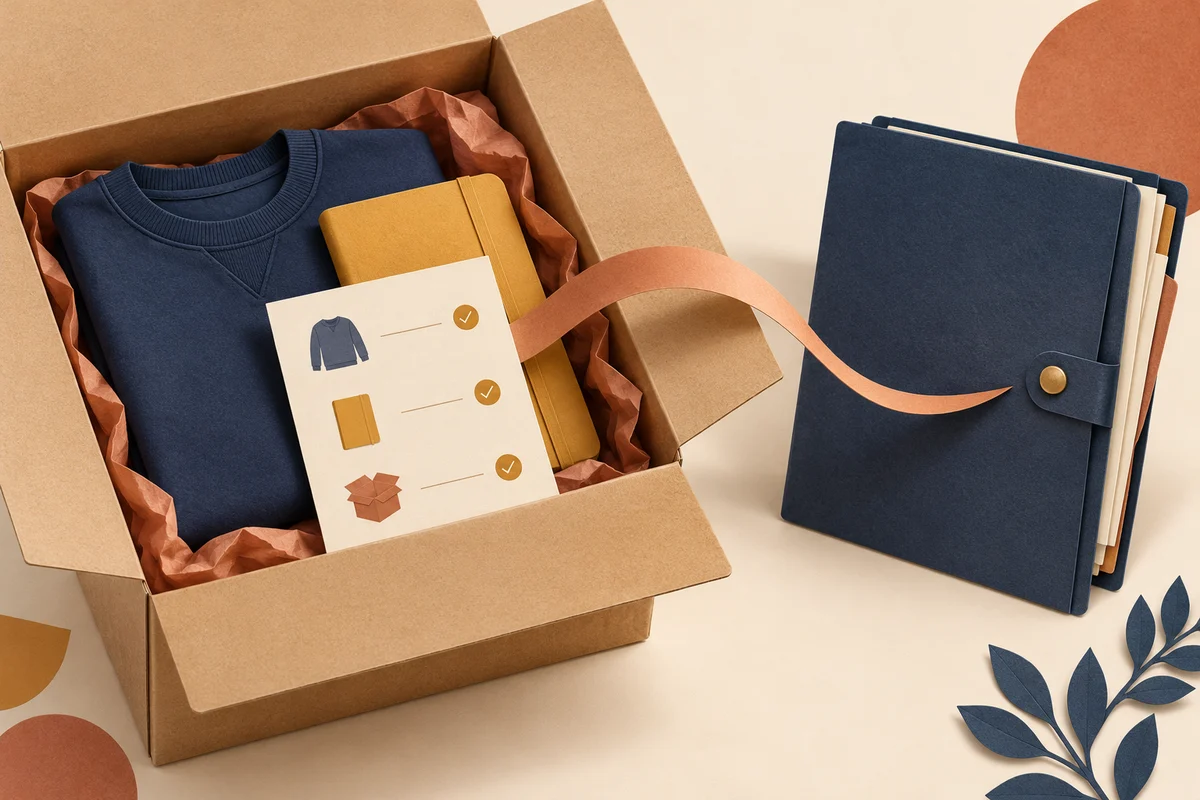
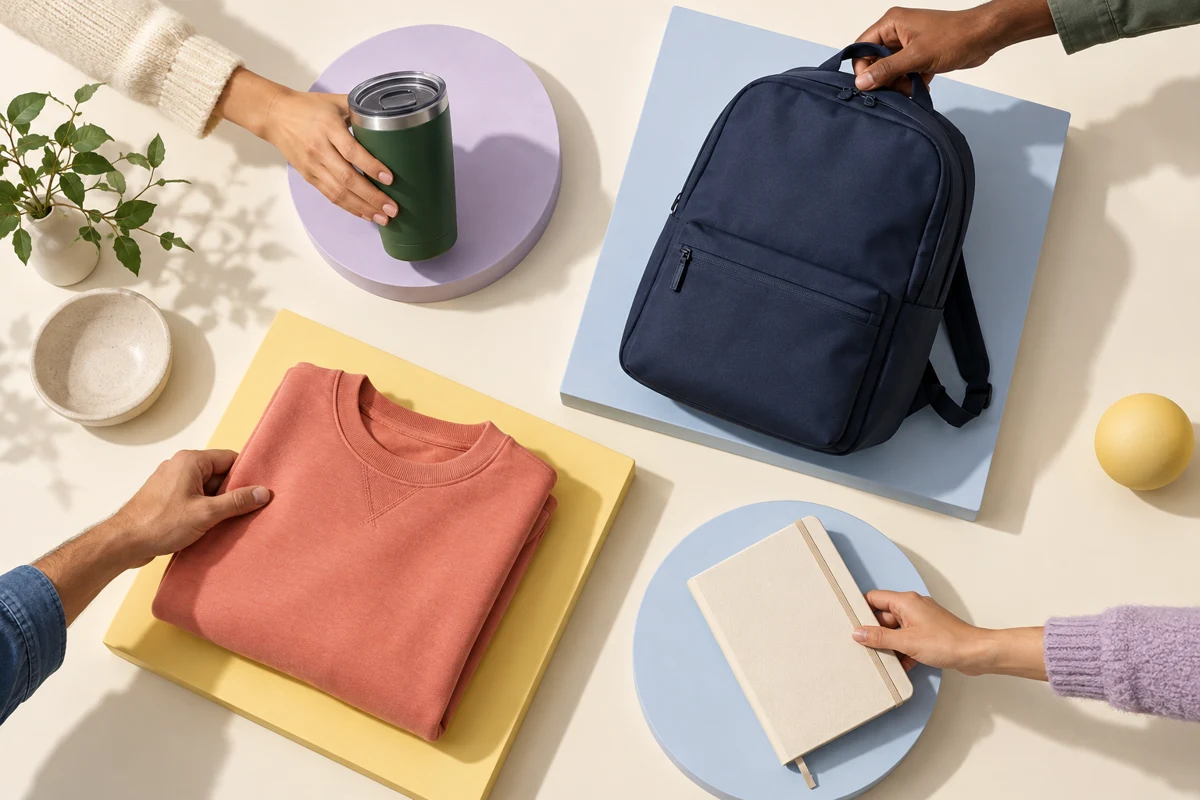
Let employees choose from a curated collection within a clear budget. Include apparel and non-apparel options, show size and delivery information, and make the gift easy to decline. Choice lets recipients select something that fits their needs; it does not, by itself, prove higher retention or a measurable reduction in waste.
Your employees share a company. They do not share a wardrobe, a morning routine, a favorite color, or an opinion about the perfect backpack.
So why do we keep giving them all the same gift?
Letting employees choose their gifts is a simple way to make appreciation more personal. Instead of guessing what someone wants, give them a thoughtful collection and permission to pick something that fits their life. A gift they actually want has a better chance of becoming something they use. And when that useful item carries your brand, your brand gets to come along.
That is the opportunity: not more merchandise pushed out the door, but more merchandise welcomed into everyday life.
Your team is made of people, not matching rows in a spreadsheet
Imagine three colleagues receiving the same insulated coffee mug. One loves it. One already has a cupboard full. One does not drink coffee and would have been delighted by a notebook. The purchase order was consistent. The experience was not.
The same problem shows up with apparel. A beautifully made hoodie can still be the wrong fit, the wrong weight for someone's climate, or simply not their style. A backpack can be excellent and unnecessary. An expensive gift can miss just as completely as an inexpensive one.
This is not a criticism of the person organizing the program. Choosing one item for hundreds of people is an impossible personalization brief. The problem is the assumption that one person's preference can stand in for everyone else's.
Choice changes the brief. You decide what meets your quality standards and represents your company well. Employees decide what belongs in their lives. Both sides get to contribute the expertise they actually have.
Giving someone a choice says, “We see you”
A thoughtful gift does not have to be a surprise. Sometimes the thoughtful part is listening.
There is a meaningful difference between “Here is what we decided you should want” and “We wanted to do something for you. Choose something you will love.” The second message leaves room for individuality. It recognizes that the recipient is a person with preferences, not just a delivery address.
That is how choice can show care—even love, in the everyday sense of paying attention to what makes someone happy. It does not need a complicated personalization engine. It can start with a short, useful collection and a sincere note.
Keep that note specific: thank the team for the launch they worked on, welcome someone to their new role, or acknowledge a milestone. The choice personalizes the object; your words explain the appreciation. A store link without a human message can still feel transactional.
And a gift should remain a gift. Employees should not feel obliged to select something, wear it publicly, or post about it. The brand benefit is something you earn by offering a genuinely desirable product—not another job you assign the recipient.
Design for the hundredth use, not just the unboxing
A beautifully packed box makes a good first impression. But the more important question is what happens a month later.
Does the sweatshirt come out on Saturday morning? Does the backpack make the commute? Does the bottle go to the gym? Or is the gift still sitting in its packaging?
Research summarized by Carnegie Mellon University describes a mismatch in gift giving: givers often focus on the exchange itself, while recipients pay more attention to a gift's usefulness over time. That is a useful lens for employee gifting, although it is not a workplace-swag ROI study.
Our practical takeaway is to work backward from ordinary life. Look for the products people reach for, the features that make them convenient, and the styles they would choose without a company initiative attached. Let the employee make the final call.
Choice alone is not magic. A selection of uncomfortable shirts and flimsy bags is still a disappointing selection. Product quality, fit, design, delivery, and support all matter. Choice works best when every available option is worth choosing.
Wanted. Used. Seen. The visibility loop.
The marketing case for employee choice follows a straightforward path:
- Better personal fit: the employee chooses something relevant to their needs and taste.
- More opportunity for use: a relevant, well-made product has a better chance of entering their routine.
- More opportunity for visibility: when the branded item is used around other people, the company name may be seen.
- A more natural association: your brand appears on something someone willingly keeps using, rather than on an obligation.
This is a mechanism to aim for and measure, not a guarantee that every chosen item will become a favorite. A home-office notebook and a commuter backpack also create different kinds of visibility. Both can be good gifts even if only one regularly leaves the house.
Think of the logo as a passenger. The product has to earn its place in someone's day before the brand can go anywhere.
Could better choice mean 10× more use?
It could in a particular program. But “10× the marketing impact” is not a result you can claim simply because you offer choice. Here is an intentionally simple illustration of how the difference might arise.
Illustrative scenario only—not Brand Sauce customer data or an industry benchmark. Suppose two programs each deliver 100 gifts at the same total cost. We assume equal delivery counts here to isolate use; a real choice program may have people who decline or never redeem.
| Over a 12-week period | One-size-fits-all gift | Employee-selected gift |
|---|---|---|
| Delivered gifts | 100 | 100 |
| Recipients who use their gift | 20 | 80 |
| Uses per active recipient | 6 | 15 |
| Total use occasions | 120 | 1,200 |
Under those assumptions, the second program creates 10× as many use occasions: 1,200 divided by 120. The difference comes from two things working together: more people use the gift, and those people use it more frequently.
Use occasions are not verified advertising impressions. Some happen in private; others happen in public. The same people may see an item repeatedly, and seeing a logo does not automatically produce awareness, leads, or sales. This example demonstrates the potential leverage of use—not a measured tenfold increase in revenue or brand exposure.
The ambitious question is still worth asking: could you get dramatically more useful life from the same gifting budget by buying what people want? Test that with your own team instead of treating the multiplier as a promise.
The cheapest gift is not always the least expensive
Price per item is easy to compare. Price per item that people actually use is more revealing.
If a program costs $5,000 all-in and 50 recipients use their gifts, that is $100 per active recipient. If the same spend produces 125 active recipients, it is $40. These are illustrative calculations, but the distinction is real: a lower unit price does not rescue a program whose products go unused.
The budget leak is larger than the unwanted item itself. Someone spent time picking it, approving artwork, collecting addresses, guessing sizes, handling changes, and distributing it. Leftover inventory then needs space and someone to manage it. None of those activities becomes valuable just because the initial order was discounted.
Choice can reduce some guessing, but compare the complete costs. Individual fulfillment, shipping, packaging, platform fees, and support may change the economics. For a single event with a known audience and a firm deadline, a well-planned bulk order can still be the right tool. Use our swag program cost guide to build an honest comparison.
The waste conversation starts before anything is made
Before asking whether a giveaway is recyclable, ask whether anyone wants it.
The EPA's materials and waste management hierarchy prioritizes source reduction and reuse. Applied to a merchandise program, that makes avoiding unnecessary products a sensible starting point—not merely finding somewhere for unwanted products to go afterward.
A choice-based, on-demand approach can help you avoid decorating quantities and sizes nobody requested. It separates an invitation to receive a gift from an assumption that every employee needs another object. Include a graceful way to decline, and do not automatically replace an unredeemed invitation with a random shipped item.
This is not a claim that on-demand production has no environmental footprint or always beats bulk. Production methods, materials, shipping routes, individual packaging, returns, and durability all matter. Producing after selection also does not mean the blank product was manufactured only after selection. The narrower, defensible benefit is reducing the guesswork that can create unwanted decorated inventory.
Give them a good choice, not a second job
You do not need to present thousands of products. Start with a manageable collection that offers genuinely different ways to enjoy the gift.
- Something to wear: appealing apparel with clear measurements and appropriate fit options.
- Something to carry: a useful bag for work, errands, or travel.
- Something for a daily routine: drinkware or a practical desk item.
- Something outside apparel: a strong alternative for anyone who does not want clothing or cannot find a suitable fit.
Keep the value equitable without forcing the objects to be identical. Make sure every eligible employee can choose at least one worthwhile option without paying extra. Explain shipping and any allowance rules before checkout, and check destination availability before sending invitations.
Branding should help make the item desirable. A considered mark, attractive color combination, and useful product can do more for everyday wearability than simply maximizing logo size. Ask whether someone would like the object even before they notice who supplied it.
For a more detailed assortment framework, see our company store product curation guide.
Turn employee choice into a simple program
A branded company store gives this idea a repeatable home. Your team approves the assortment and artwork. Employees choose within the program's rules. The order communicates their preference instead of asking an HR coordinator to guess.
Start with one occasion: a welcome gift, an anniversary, a project thank-you, or a holiday invitation. Set the budget, confirm available destinations and fulfillment expectations, and test the complete recipient experience before rolling it out.
Try a message like this:
Thank you for everything you brought to this team. We picked a few things we think you'll love—but the final choice is yours. Choose the gift that feels most like you.
Brand Sauce builds and manages branded company stores. If you want to put this approach into practice, talk with us about a choice-led gifting program. We can start with your people, budget, and product needs rather than a warehouse full of assumptions.
Measure what happens after delivery
Redemption tells you someone selected a gift. It does not tell you they loved it. Follow up after the product has had time to enter their routine.
- Which item did you choose, and did it meet your expectations?
- Have you used it in the past 30 days? Roughly how often?
- Was there something you wanted but could not find?
- What would make the next gift more useful?
Use an optional survey and report its response rate. People who answer may differ from those who do not; do not count silence as satisfaction. Track the program's full spend, delivery problems, unredeemed invitations, and leftover products alongside the feedback. Compare similar occasions and budgets before attributing an improvement to choice.
Then let the answers change the next collection. That is the real advantage: your gifting program learns from the people it exists to appreciate.
Questions about employee-choice gifting
Does letting employees choose make the gift less personal?
It does not have to. A curated collection and a thoughtful message let you express appreciation while leaving the final preference to the person receiving the gift. Personal does not have to mean guessed.
Should every company gift offer a choice?
Not necessarily. A meaningful keepsake, a specifically requested gift, or an event item with a clear purpose may work well without a store. Choice is especially helpful when preferences vary and the gift is intended for ongoing personal use.
Does choice guarantee more brand visibility?
No. It can improve the chance of choosing a relevant product, but quality, design, actual use, and where that use happens determine the opportunity for visibility. Measure behavior instead of promising a fixed multiplier.
What if someone does not want any merchandise?
Respect that answer. Offer an alternative where your program allows it, or let them decline without friction. Appreciation should not require accumulating something unwanted.
Make the person happy. Give the brand somewhere to go.
The goal is not to put your logo on the most things. It is to put it on things people are happy to have.
Start with choice. Back it with quality. Make the experience easy. When the gift fits the person, it has a better chance of being loved, used, and seen. That is a stronger foundation for your brand than another unopened box.
Your people are unique. Your gifts should leave room for that.