Before buying crochet kits for a library craft evening or employee workshop, confirm whether the pattern uses US or UK stitch names—and make the instructor’s demonstration match. An English-language booklet is not enough. The same abbreviation can ask participants to make different stitches.
This is a kit-approval question, not a reason to reject imported gifts. Either convention can work. The avoidable problem is giving beginners a pattern in one convention and teaching them from a video or handout in the other.
The small abbreviation that changes the project
The Craft Yarn Council’s abbreviation reference distinguishes US and UK terminology: US single crochet corresponds to UK double crochet; US double crochet corresponds to UK treble. It also notes that designers may define special abbreviations within their own patterns. Read that pattern’s key rather than treating a general glossary as a complete instruction manual.
DMC’s crochet abbreviation guidance says its Gift of Stitch patterns use UK terms and advises checking the convention before starting. That is a useful reminder to inspect the supplied instructions—not assume the convention from the delivery country, the workshop language or a familiar-looking kit box.
A quick check for the instructor
- If the pattern says US “sc”: the corresponding UK name is double crochet.
- If the pattern says US “dc”: the corresponding UK name is treble.
- If it says only “dc,” with no stated convention: pause approval and request clarification. Do not guess from the abbreviation alone.
This is a narrow cross-check, not a complete conversion chart. It does not replace instructions for starting chains, turning, increases, decreases or special stitches. Keep the original pattern available and use its definitions.
Approve the instruction bundle, not just the yarn
Ask for one complete sample of the edition that will actually ship. Review the booklet, any QR-linked tutorial and the facilitator’s lesson notes together. Use this release checklist:
- Identify the edition. Record the kit name, pattern title, language and revision or file version. A photograph of the cover alone does not show the terminology.
- Find the declaration. Mark the line that states US or UK terms. If none appears, obtain a written answer from the publisher or supplier and have the instructor confirm it against the stitch instructions.
- Follow the included learning route. Open the actual QR link or video supplied with the kit. Check that its stitch names align with the booklet. A convenient replacement tutorial needs the same review.
- Rehearse the first taught section. Have the instructor work from the supplied pattern using the included materials. Record unclear instructions and where a beginner would need help. This is a proposed acceptance exercise, not a Brand Sauce product test.
- Label the class materials. Put the chosen convention on the session handout. If alternate names are necessary, pair them explicitly instead of switching vocabulary halfway through the demonstration.
- Keep the handoff intact. Give take-home recipients the same approved instructions and tutorial link used in class. Record who handles questions after the event.
For other needlecraft activities, our counted-versus-stamped cross-stitch kit guide addresses a different preparation decision: what participants must read from a chart versus what is already marked on fabric.
Worked example: a mismatched demonstration
Illustrative scenario: a library buys kits whose pattern is explicitly written in UK terms. Its facilitator prepares a US tutorial for a section labeled “dc.” The two resources are not asking for the same stitch. Merely printing “double crochet” in larger type does not resolve the conflict.
The organizer can keep the kit and use a demonstration that follows its UK terminology. Alternatively, select an authorized US version of the instructions and align the entire lesson with that version. Do not make a quick global text replacement in the pattern: the instructor still needs to review the complete instructions and any special definitions.
Copyable kit-release note
Kit and pattern edition: ____. Instruction language: ____. Declared stitch convention: US / UK / unresolved. Included tutorial URL: ____. Facilitator’s materials use: ____. First-section rehearsal completed by: ____. Questions resolved: ____. Approved instruction bundle retained at: ____. Destination-country supply, decoration options and price: supplier confirmation / quote-needed. Any replacement kit or revised booklet requires another terminology check.
That last condition belongs in the gift-substitution approval, not just the instructor’s notes. Two kits described as “beginner crochet” can still arrive with different teaching materials. This guide does not confirm any kit’s Brand Sauce catalog availability or offer a product shortlist.
Release rule: approve when the kit, tutorial and instructor agree on the stitch language. Hold when the convention is unresolved—even if the yarn, packaging and event branding are ready.
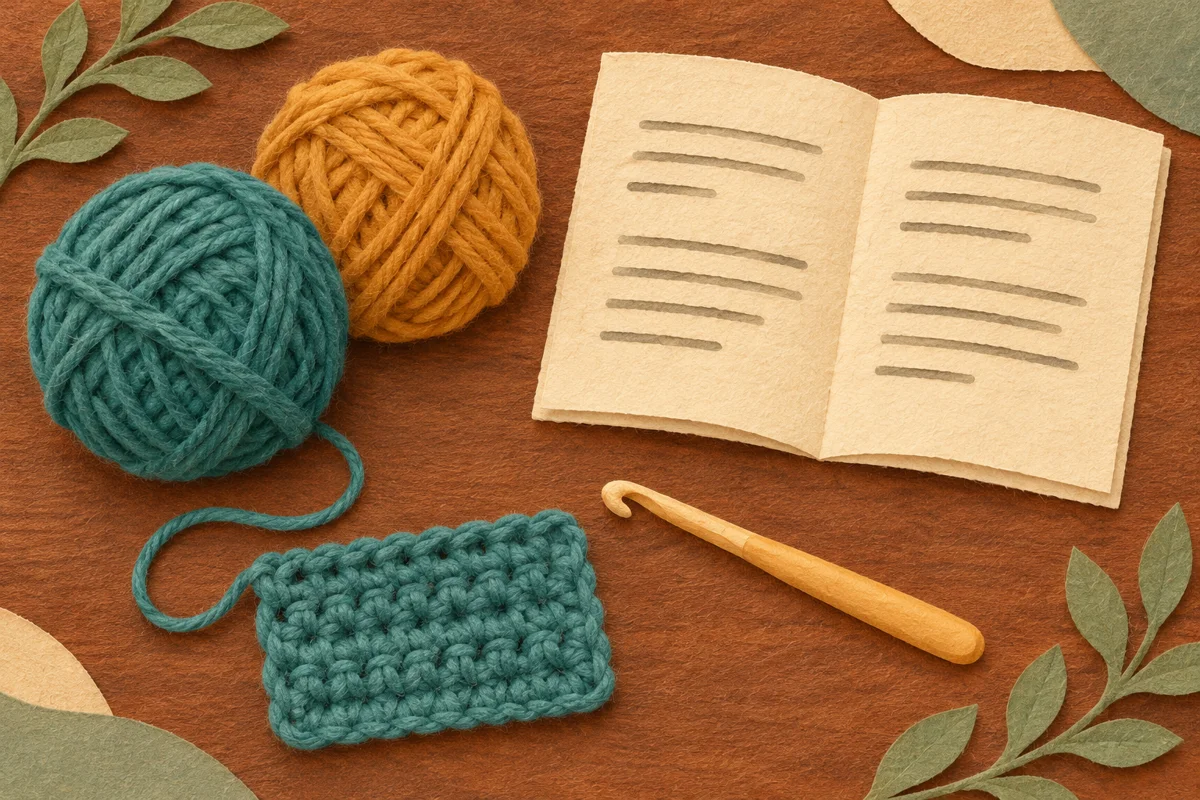
Illustration: AI-generated editorial concept, not a photographed kit or stitch demonstration. Primary references checked November 10, 2026.