No: a weather-resistant notebook does not automatically work with every pen. For a conservation volunteer kit, outdoor training day or field-team gift, approve the notebook and writing instrument together. The key question is not just whether finished notes survive rain. It is whether the recipient can add new notes while the page is wet.
A premium gel pen may be a lovely desk gift and the wrong companion for the chosen outdoor paper. Make that pairing decision before approving the logo or assembling the kits.
Two questions that “waterproof” does not answer
- Writing first, rain later: will the existing marks stay legible after exposure?
- Rain first, writing later: can someone make a usable new mark on the damp page?
Ask the supplier to answer both for the exact notebook stock and pen or pencil. A durable cover does not establish anything about the inner pages; a water-resistant sheet does not establish compatibility with the ink you already buy.
Read the instructions for that paper, not the whole category
Rite in the Rain’s official FAQ recommends a standard pencil or all-weather pen on its paper in wet or dry conditions. It distinguishes ordinary ballpoints and permanent markers, which work on dry paper but can struggle when the paper is wet. It advises against gel pens, highlighters and fountain pens because water-based inks can bead or wash off.
That is guidance for this manufacturer’s paper, not a universal rule for every notebook labeled waterproof. Field Notes’ Expedition notebook uses nonporous Yupo synthetic stock. Field Notes says it does not absorb ink like conventional paper and recommends ballpoints, pencils or fine-tip Sharpies. Its general writing recommendation should not be treated as proof that your selected ordinary ballpoint writes through rain.
These are manufacturer examples of why pairing matters, not a Brand Sauce stock list or results from our own testing. Confirm sourcing, decoration options, destination-country availability and a current quote separately.
Choose the kit by the actual task
- Outdoor observations where pencil is acceptable: start with a pencil approved for the selected paper. Include a practical way to keep writing: sharpening for a wood pencil, or the correct spare leads for a mechanical one.
- Notes that must be made in ink while exposed to rain: request a paper-and-pen pairing with explicit wet-writing guidance. Specify the exact pen and refill, not merely “black pen.”
- Mostly indoor training with occasional outdoor stops: decide whether people can keep the notebook dry. If gel pens, highlighting and color coding are central to the activity, a conventional notebook kept in suitable protection may be a better brief than a specialist sheet that rejects those tools.
For the broader page layout, binding and carrying-size decision, use our company notebook selection guide. Here, the approval unit is the paper-and-writing-tool combination.
A two-stage sample check before ordering
This is a proposed buyer acceptance check, not a laboratory standard or a test we have performed. Follow the manufacturer’s use instructions; do not assume a rain-use product is intended for prolonged immersion.
- Identify the pair. Record notebook model, inner-page material, pen model and refill or pencil lead. Use the supplied production sample, not a visually similar notebook.
- Write on a dry page. Have a representative user enter a date, a short location name, several numbers and a small sketch. Try the actual note-taking pace. Record how long they wait before closing the book.
- Check existing notes after dampening. Use a small amount of clean water within the product’s intended conditions. Inspect legibility and transfer to the facing page after the normal closing interval.
- Try new notes on a damp area. Repeat the same entries. Keep this result separate from step three: readable old writing does not mean wet writing succeeded.
- Decide against the job. Ask another person to read the numbers without help. Record skipping, beading, smearing or page transfer. Retain the marked sample and approve only the combination that meets the team’s real workflow.
If a supplier changes the pen refill or paper stock, reopen this check. An unchanged cover design is not enough to approve the substitution. Our mechanical-pencil refill checklist helps if the approved route uses replaceable leads.
A copyable brief for an outdoor volunteer kit
Illustrative scenario: a park group wants pocket notebooks for volunteers recording plant locations during damp morning walks. Pencil is acceptable; color highlighting is not part of the task. The sensible starting brief is a notebook whose maker supports wet pencil writing, paired with a pencil and a replenishment plan—not an unspecified premium pen added for presentation.
Task and weather exposure: ____
Must users write while the page is wet? ____
Is pencil acceptable for these records? ____
Notebook model and inner-page material: ____
Writing instrument and exact refill/lead: ____
Manufacturer compatibility instructions: ____
Dry-writing/rain-later result: ____
Wet-page/new-writing result: ____
Closing interval and facing-page transfer result: ____
Approved sample, reviewer and date: ____
Destination, decoration and quoted kit contents: ____
Buying rule: do not approve “waterproof notebook plus pen.” Approve a named paper-and-tool pair for a defined task, and include a short use note so recipients know which instrument belongs with it.
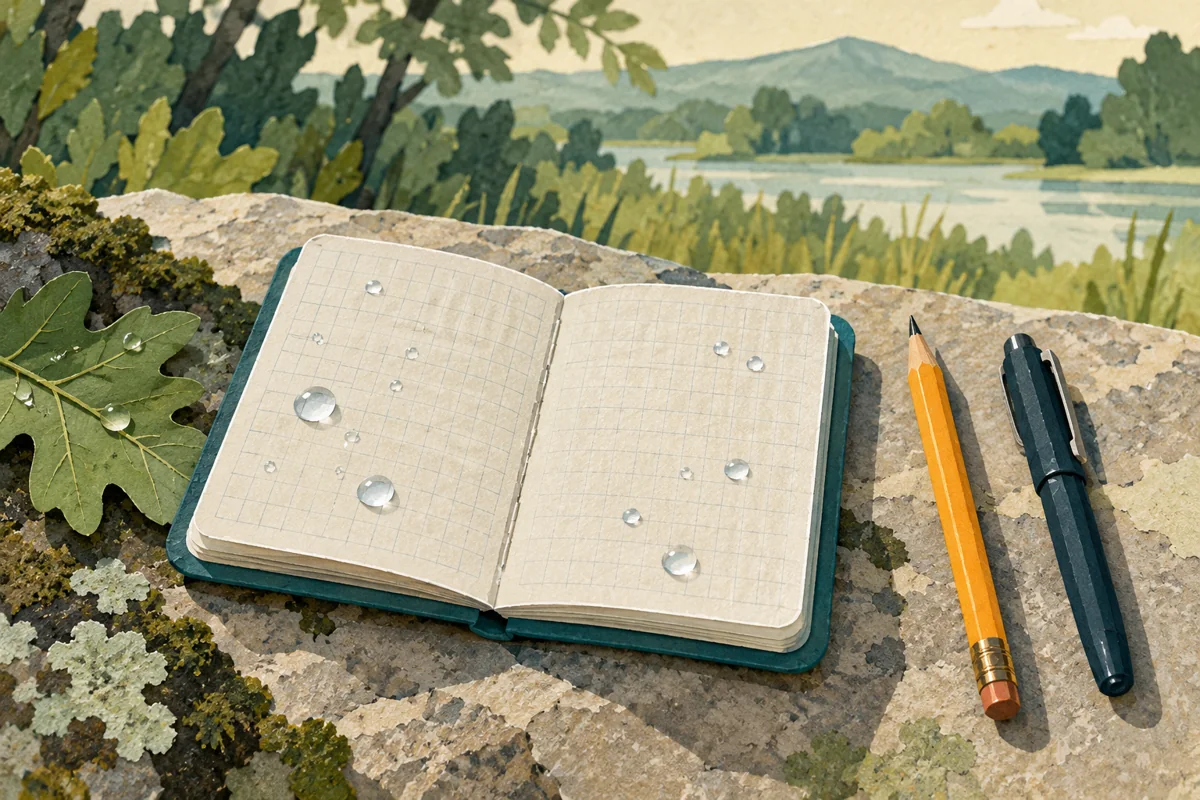
Hero image: AI-generated editorial illustration, not a product photograph or performance test.