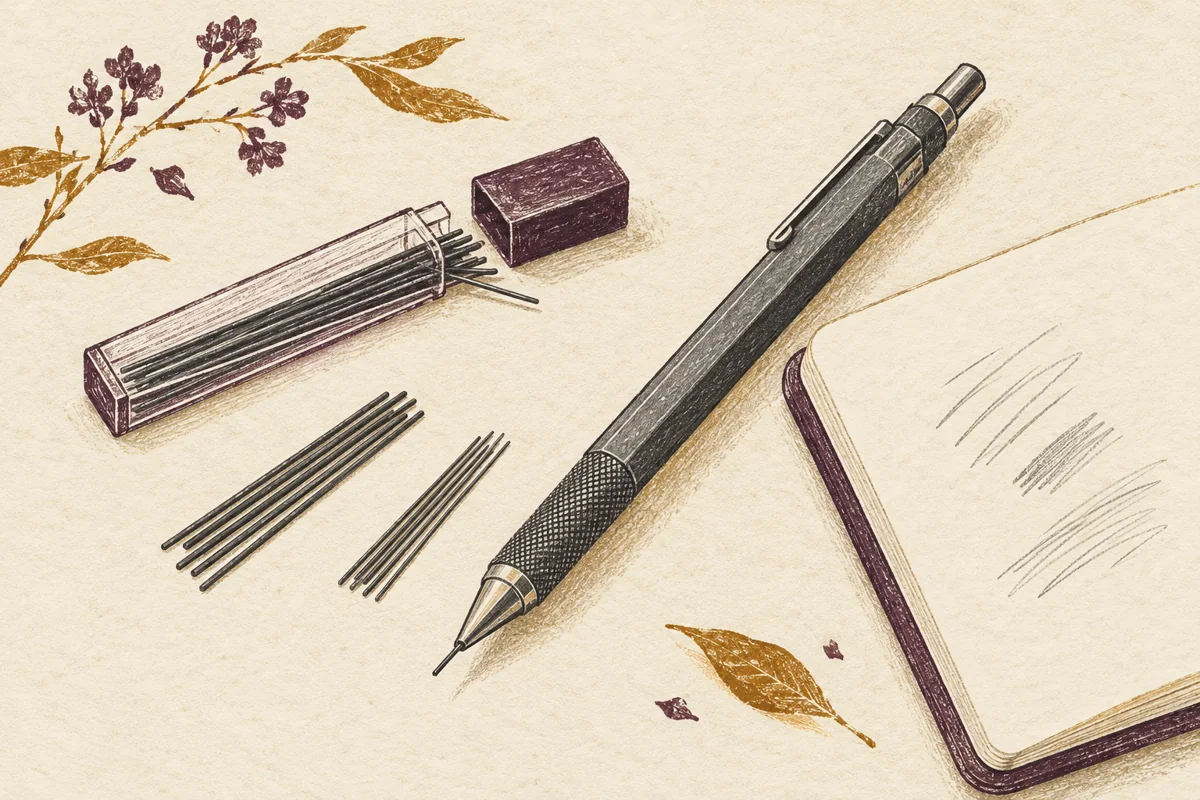
Match the pencil’s marked lead diameter first, then confirm how that model is refilled. A tube marked HB is not enough information: HB describes the grade, while 0.5 mm or 0.7 mm identifies a different part of the specification. Buying the right grade in the wrong diameter does not create a usable refill kit.
For an architecture studio’s welcome pack or a training-room stationery supply, approve the pencil and its replacement consumables together. The useful question is not simply “is it refillable?” It is “can the recipient identify, obtain and load the correct refill after the supplied lead runs out?”
Keep three specifications separate
- Diameter: record the nominal millimeter size printed on the pencil or specified for its exact variant. Do not treat different sizes as interchangeable options for the same mechanism.
- Grade: record the supplied grade and the grade you want for replacements. If the decision is about darker sketching versus everyday notes, see our separate HB versus 2B workshop guide.
- Refill format: identify loose leads, a replacement cartridge or a leadholder system. A matching diameter alone does not establish that a cartridge will fit.
For example, Pentel’s UK P200 page lists 0.3, 0.5, 0.7 and 0.9 mm variants, supplied with HB lead, and separately identifies the Z2-1N replacement eraser. “P200, HB” therefore leaves the buyer without a complete lead-size specification. The eraser is another reorder item, not something established by the lead diameter.
Do not promise one universal loading method
Pentel’s US Quick Dock refill is a cartridge containing twelve preloaded 0.7 mm HB leads, with Quick Dock COLORS compatibility specifically stated. That is a reason to retain the cartridge model on the purchase record—not a reason to assume any 0.7 mm pencil accepts it.
STAEDTLER’s mechanical-pencil instructions distinguish supported tube-to-barrel loading on Mars micro and graphite 779 from loading a 2 mm leadholder through its tip with the clutch open. Its twelve-at-once refill instructions apply to identified models. Do not copy them onto an unidentified promotional pencil or pour a whole tube into every barrel.
These are manufacturer examples of specification differences, not a Brand Sauce catalog shortlist. US or UK manufacturer pages do not establish customization, stock or delivery availability in your recipient’s country. Obtain confirmation for the exact decorated item and refill; branded-order prices remain quote-needed.
Use a refill-first acceptance check
Before approving a batch, request one pencil sample and the exact refill proposed for the kit. This is a suggested buyer check, not a report of testing by Brand Sauce.
- Read the identification. Find the diameter on the item or its retained instructions. Confirm decoration will not obscure it. Do not rely solely on barrel color, which may change between manufacturers or variants.
- Match the packaging. Compare the refill’s diameter, grade and any cartridge compatibility statement with the pencil specification. Resolve a mismatch before loading.
- Follow the model’s instructions. Load only the specified amount using the documented entry point. Advance the lead and write several lines. If it will not feed normally, stop and check the instructions rather than forcing it.
- Check the second consumable. If the gift includes an attached eraser, record whether it is replaceable and its refill code. If replacements are not available, decide whether a separate eraser is a better kit component.
- Rehearse the reorder. Have someone who did not choose the pencil identify the replacement from the proposed handoff card. If they need the original buyer’s memory, the card is incomplete.
For a pencil-and-journal kit, also check the actual paper pairing using the notebook paper and binding guide. A successful refill check establishes neither writing preference nor paper performance.
A small card that belongs with the gift
Pencil: [manufacturer / exact model and variant]
Lead: [diameter in mm] / [grade]
Format: [loose leads / specified cartridge / leadholder]
Refill code or confirmed compatible item: [reference]
Loading instructions: [manufacturer link or included instruction sheet]
Eraser: [refill code / not replaceable / separate eraser]
Replacement source: [approved supplier for recipient country]
Illustrative purchasing decision: a studio wants one shared refill supply for its welcome-kit pencils. Two proposed pencils use HB, but one is 0.5 mm and the other 0.7 mm. The buyer can standardize on one verified diameter or keep two clearly labeled refill supplies. Calling both “HB refills” and putting them in one unlabeled drawer does not solve the mismatch. If a future substitution changes the mechanism or size, update the card and refill supply together.
Bottom line: approve a repeatable refill path, not just a refillable label. Keep the diameter visible, retain the format and loading instructions, and give recipients a usable replacement reference.
AI-generated editorial illustration, not a product photograph or test result. Manufacturer sources checked October 18, 2026.