Choose company notebooks by the writing job first, then verify paper, page layout, binding and decoration on a physical sample. A recognizable brand or heavier paper can be a useful specification, but neither replaces checking whether the notebook works with the pens, bags and meeting habits of the people receiving it.
For a general employee store, start with one portable everyday notebook rather than a wall of near-identical journals. Add a second format only when it solves a different need, such as sketching or structured workshop notes. Confirm the exact item’s decoration minimum, replenishment route and delivery timing before putting it into an ongoing program.
Brand Sauce publishes this guide from a merchandise-buying perspective. The recommendations are an original selection framework, not results from a comparative product test. Named manufacturer examples illustrate specifications to request; they do not establish Brand Sauce availability, a supplier relationship or current decorated pricing.
1. Start with the writing job, not the cover color
“A nice notebook” is not a complete brief. Write down who will use it, where it will travel and what they will put on the page. A notebook for a two-hour workshop has a different job from a journal that travels between client meetings for months.
| Primary use | Useful starting specification | What to test |
|---|---|---|
| Daily meeting notes | Portable size, ruled pages, reliable opening | Writing near the spine and finding earlier notes |
| Planning and diagrams | Dotted or grid layout, enough working area | Visibility of the guide marks and room for sketches |
| Facilitated workshop | Format matched to the exercises and desk space | Writing alongside the printed workbook or laptop |
| Frequent travel | Compact dimensions and protected page edges | Bag fit, closure and comfortable carry |
| Optional recognition gift | Considered cover, useful interior, recipient choice | Whether the recipient wants paper at all |
Do not turn a notebook gift into a requirement to change working methods. Someone who takes digital notes may prefer another item. Keep it within a thoughtful assortment, as described in our company-store product curation guide, rather than treating a familiar promotional category as universally useful.
2. Compare dimensions and usable pages
Request the closed dimensions, thickness and usable page count for the exact variant. Terms such as “large,” “executive” and “pocket” are not sufficient for comparing different product lines. If the notebook belongs in a welcome kit, test it inside the actual packaging with the other items, not just against a box’s nominal dimensions.
Also distinguish pages from sheets. One sheet has two sides; a listing of 80 sheets is not the same quantity as 80 pages. Ask whether the advertised count includes an index, introductory material or other printed sections. For a workshop, determine how much writing space the exercises actually need instead of buying the thickest book that fits the budget.
As a specification example, LEUCHTTURM1917’s hardcover notebook page lists its Medium A5 format at 5.71 × 8.27 inches with 251 pages and 80 g/m² paper. It also describes numbered pages, a contents section and a thread-bound construction that opens flat. Those details help a buyer compare working features; they are not proof that every notebook from that brand has the same interior.
Check the chosen ruling and color on the final quote. A substitute with the same outer dimensions may have fewer pages or a different opening behavior. Specify which differences would require fresh approval.
3. Treat paper weight as one input, not a quality score
Paper weight expressed in g/m², often called gsm, is mass per unit area. It does not by itself tell you whether your pen will smear, show through the reverse side or feel pleasant to write with. Avoid making a purchasing rule that simply ranks the largest gsm number first.
For another real specification example, Moleskine’s light-blue Classic hardcover notebook page describes ivory-colored 70 g/m² paper, an elastic closure, a ribbon and an inner pocket, and states that the notebook opens flat at 180 degrees. This is information about that listed product, not evidence that one brand’s paper performs better than another’s.
Use the following sample procedure before approving a large order. These are proposed acceptance checks, not tests we claim to have performed:
- Use the real writing tools. Try the office ballpoint and gel pen, plus any specialty pen that matters to this audience. If a pen will be included in the gift, test that exact pairing.
- Write ordinary notes. Add a heading, a paragraph and a quick diagram. Use normal pressure rather than trying to force failure.
- Turn the page. Check whether marks on the reverse side interfere with reading or writing. Distinguish visible show-through from ink that has actually penetrated the paper.
- Check handling. Try highlighting after the ink has dried, then close and reopen the book. Record any transfer or smearing with the pen and timing used.
- Compare the same task. Use identical tools and notes on each candidate. Keep the samples with the approval record.
A left-handed colleague may expose handling issues that a right-handed reviewer misses. Invite feedback on actual use without asking anyone to disclose a disability or explain a personal preference. The aim is a usable item, not a claim that one notebook suits every person.
4. Choose ruling and binding together
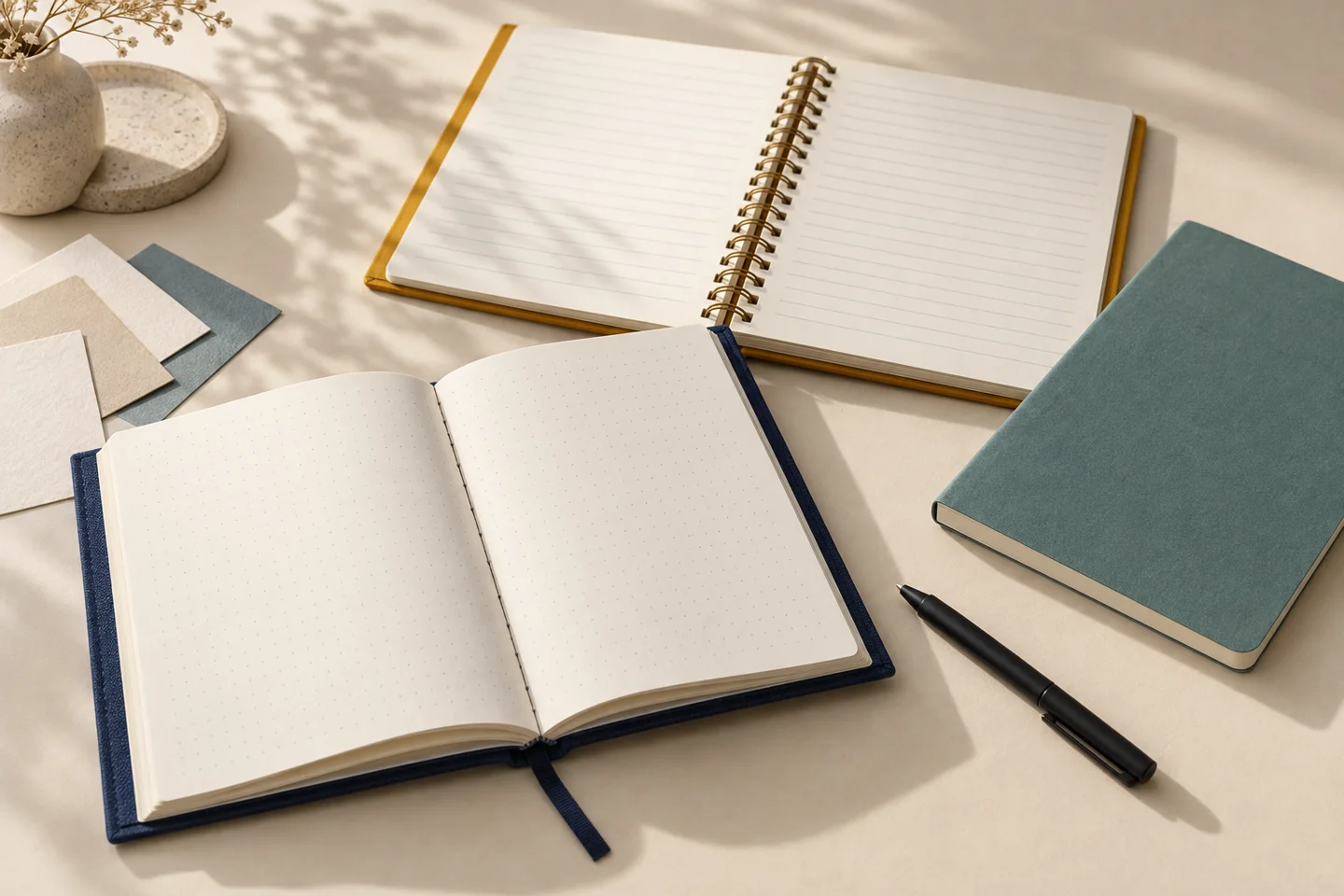
Ruled pages are a straightforward starting point for prose notes. Dots and grids offer structure for diagrams and planning. Blank pages leave the most freedom but may frustrate someone who wants a writing baseline. Check the actual line spacing and contrast: a product thumbnail is a poor way to judge the interior.
Binding affects the working space. With a sewn notebook, inspect how the book rests open at the beginning, middle and end. With a wire-bound notebook, test whether the wire obstructs the writing hand and whether the cover folds back comfortably. Neither construction is automatically the premium or practical answer.
Test the notebook where it will be used: beside a laptop, on a small meeting table or on a lap if that is a realistic situation. A hardcover may provide useful support, while a slimmer flexible cover may be easier to carry. Record the tradeoff instead of treating rigidity as a universal benefit.
Small features should earn their place. An elastic closure is useful only if it stays secure without being awkward. A pen loop needs to fit the intended pen. A pocket needs enough room for the materials people actually keep. Ask whether these features are included in the specified variant rather than inferred from a lifestyle photograph.
5. Approve the decoration on the actual cover
Ask the decorator which methods are supported on the selected cover material. Printed artwork, foil and an impression pressed into the cover create different visual effects. Do not assume that a method shown on another notebook can be transferred without a new proof or sample.
Provide a logo file suitable for the proposed process, the intended size and the placement. Ask about minimum line thickness, small lettering and whether a separate setup is needed for each design. If individual names are involved, confirm how spelling is approved and how errors are handled before collecting the personalization list.
Review a decorated sample for readability in ordinary light, position relative to the spine and closure, and surface appearance after normal handling. Keep an approved reference. A digital proof establishes the intended artwork and position; it does not demonstrate the feel of the finished impression or the appearance of foil on a textured cover.
Keep the main mark restrained enough for daily use. If changing campaign details must be included, consider a removable insert instead of permanently dating the notebook. Confirm the insert’s production and packing costs; it is an option to quote, not a free addition.
6. Make material claims specific
A brown cover does not establish recycled content, and a forest-certification claim is not a promise that the entire finished notebook can go into a local recycling bin. Ask for documentation tied to the actual product and distinguish the paper, cover and packaging.
FSC’s explanation of its labels distinguishes FSC 100%, FSC Mix and FSC Recycled. FSC Recycled concerns forest-based materials verified as recycled; FSC Mix can involve certified, recycled and controlled sources. Do not translate “FSC Mix” into “100% recycled paper,” or apply a paper claim to every component of a notebook.
For the store description, use the supplier-supported wording and identify what it covers. Request the appropriate approved label artwork if a certification mark will appear; do not recreate a mark yourself. If the evidence is unclear, omit the claim until it is clarified. Describe useful, verified construction features instead of filling the gap with “eco-friendly.”
7. Compare bulk, on-demand and hybrid quotes
A fixed workshop with a confirmed headcount can be a good bulk-order case. Everyone needs the same item at one place and time, and a shared decoration setup may make sense. Include receiving, storage, distribution and any leftovers in the comparison.
An ongoing store with unpredictable individual demand may benefit from on-demand decoration and fulfillment when the exact notebook supports it. Confirm the minimum for that item and process. A supplier offering individual apparel orders does not establish that its notebooks, foil decoration or personalized covers follow the same rules.
A hybrid can reserve a small batch for immediate handouts while serving optional employee selections through a separate ordering route. Check whether both routes produce the same approved item. Our no-minimum-order guide explains why the product and decoration combination matters; the broader on-demand versus bulk comparison covers the operating tradeoffs.
Illustrative quantity calculation, not a recommendation or measured result: a workshop has 86 confirmed attendees, four facilitators who also need notebooks and a deliberately chosen reserve of six. The requirement is 96 notebooks. If the quoted order increment forces a purchase of 100, assign the remaining four a specific purpose or record them as unallocated stock. Do not quietly turn a supplier increment into a forecast of demand.
Ask every bidder to quote the same specification: item and color, interior layout, page count, decoration method and size, quantity, setup, proof or sample, packaging, shipping destination and required arrival date. Separate one-time charges from repeat-order charges. Add fulfillment and individual postage where relevant; a unit price alone is not a program cost.
8. Keep a one-page approval record
- Exact manufacturer item, variant and interior layout.
- Closed dimensions, page count and paper specification.
- Sample notes using the intended pens and writing task.
- Binding, closure, pocket and pen-loop observations.
- Approved artwork version, placement and decorated reference.
- Documented material claims and the components they cover.
- Order minimum, increment, replenishment conditions and substitution rules.
- Complete quote, delivery requirement and named receiving owner.
Once launched, record useful feedback: whether employees selected the item, what support issues occurred and whether the next batch still matches the approved specification. A notebook that photographs well but remains unchosen needs reconsideration, not a larger reorder.
Company notebook FAQs
Is higher-gsm paper always better?
No. Compare it with the intended pen and task. Paper weight is a specification, while the acceptance decision should include writing, reverse-side readability and handling on a sample.
Should every employee receive the same notebook?
For a workshop, a shared format may support the exercises. For a discretionary gift, offer an alternative for people who do not want paper notebooks. Standardizing branding does not require identical recipient preferences.
Can a company notebook be ordered one at a time?
Sometimes, but confirm the exact product, decoration and fulfillment combination. A minimum may apply to the notebook, a particular imprint or custom interior even if other products in the store support single-unit orders.
Does a familiar brand remove the need for a sample?
No. Verify the selected edition, paper, ruling and decorated result. Brand recognition can be part of the gift experience, but it is not a substitute for matching the notebook to its job.
Ready to include notebooks in your company store? Bring the intended use, quantity pattern and delivery requirements to Brand Sauce. Start with a clear specification and an approved sample, then choose the ordering model that supports the program.
Manufacturer and certification sources checked September 27, 2026. Specifications can vary by edition and region; confirm the exact quoted item. Hero image is an AI-generated editorial still life, not a photograph of the named products.