Moisture-wicking and quick-drying are related, but they are not the same buying claim. Wicking concerns how liquid moves through or across a fabric; drying concerns how that moisture leaves it. When approving company shirts, request evidence for the property you actually need, then check the finished decorated garment in its intended use. A wicking description does not establish a drying time, and a fast-drying fabric report does not establish comfort for every employee.
The practical decision is whether a supplier's evidence supports your purchasing requirement and your store's product description. This guide explains how to separate those decisions without turning an ordinary apparel order into an unnecessary laboratory project.
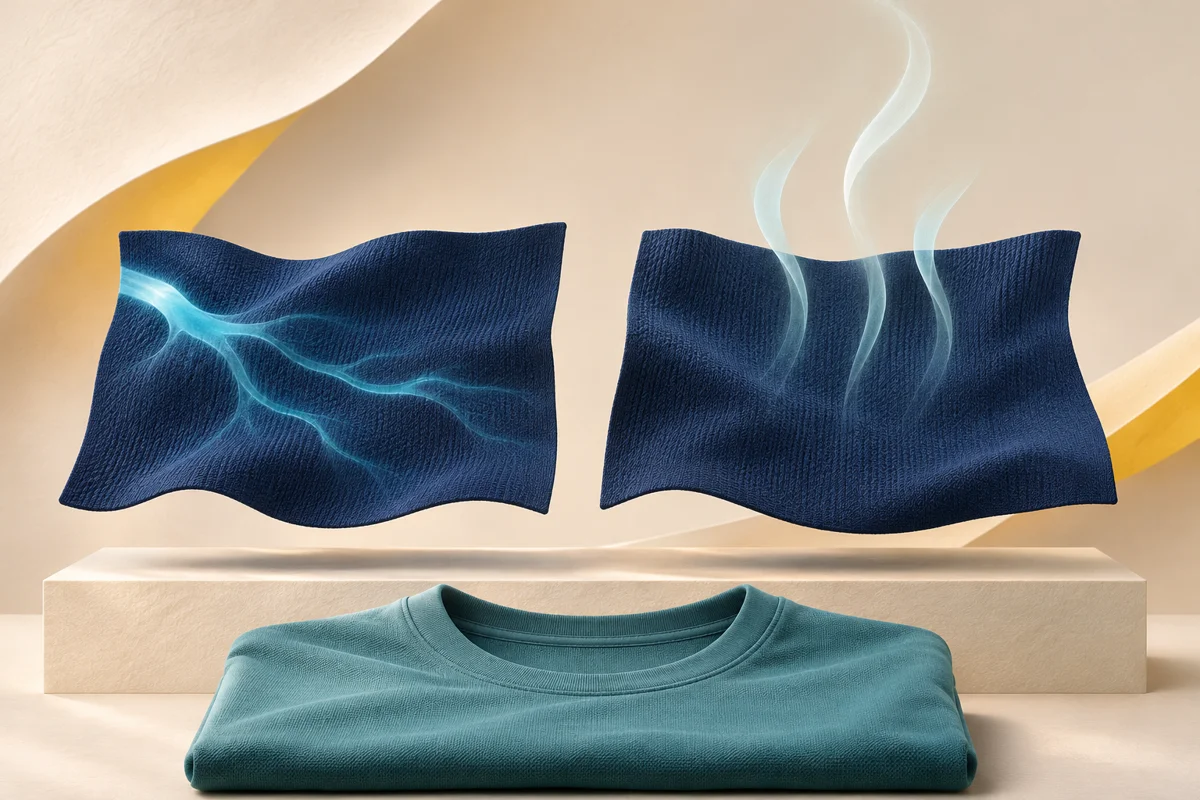
Publisher perspective: this is Brand Sauce's editorial purchasing guidance, not a laboratory comparison or a report of tests we conducted. The proposed checks and examples below are planning tools. The hero image is conceptual artwork, not a microscopic image or test result.
1. Put the two claims in separate columns
AATCC publishes distinct methods for these properties. Its TM195 summary describes evaluating liquid moisture management in fabrics, including the influence of fabric structure and fiber or yarn wicking characteristics. Its TM201 summary describes measuring drying rate with a prescribed water volume and a heated plate. Those summaries establish the methods' different purposes; they do not provide results for a shirt you are considering.
| Purchasing question | Evidence to request | What not to infer |
|---|---|---|
| Does the fabric manage liquid moisture? | Style-specific claim and, where required, a relevant liquid-management report | That the garment dries within a particular number of minutes |
| How was drying performance assessed? | Method, conditions, result and identity of the tested material | That two differently conducted tests produce comparable rankings |
| Will employees like wearing it? | Ordinary wear feedback on the finished garment in relevant fits | That a favorable laboratory number guarantees personal comfort |
| Can the store promise faster drying? | Evidence identifying the comparison, conditions and product scope | That a generic performance label supports a comparative claim |
Keep absorbency separate too. Taking up liquid is not, by itself, proof that the liquid moves in the desired direction or leaves quickly. A single demonstration in which a water drop disappears is therefore not a complete purchasing answer. It may prompt a useful supplier question, but it should not become a store badge saying “tested quick-dry.”
2. Specify the problem before requesting performance data
Write a requirement describing the actual situation. “Comfortable during a walk between buildings, then presentable at a desk” differs from “can be washed in a hotel room and worn again the next morning.” The first emphasizes the wearing experience; the second adds a garment-drying requirement under a particular care routine. Neither is adequately specified by “premium performance shirt.”
For an optional employee gift, consider making moisture-management apparel one choice alongside a different feel or construction. You do not need to prove one shirt is universally best to offer a well-described option. For mandatory team apparel, gather feedback from the roles and fit needs the selection must serve before narrowing the range.
Write down the wearing layer as well: directly against the skin, over an undershirt, or beneath another garment. Ask testers to use the intended arrangement. A positive experience wearing a loose shirt alone does not resolve whether the same person likes it under a jacket or with a backpack.
Our cotton-versus-performance polo guide addresses the wider fabric and assortment choice. Here, the narrower approval question is whether the evidence matches the moisture-related promise.
3. Do not use fiber content as a substitute for evidence
A polyester percentage is not a test report. Nor does a cotton label automatically exclude engineered moisture management. Cotton Incorporated's TransDRY explanation describes combining treated water-repellent cotton yarns with absorbent yarns to create moisture pathways. It also notes that dry time varies with formulation, construction and finishing. This is a useful counterexample to fiber-only purchasing, not proof that an unspecified cotton shirt uses the technology.
Ask the supplier to identify the exact style, color, composition and fabric construction behind each claim. If the explanation concerns a fabric family rather than the finished style, retain that distinction. Do not silently expand a report for one material into approval for every companion cut, color or substituted blank.
When comparing two candidates, make a small evidence register. Give each property one of three statuses: documented for the selected configuration, supplier statement with limited detail, or not established. “Not established” is not the same as “performs badly.” It means you cannot currently make that property a verified reason to prefer the item.
4. Read a test report for scope, not just a score
If a technical claim is important enough to determine the purchase, ask for the underlying report or an appropriately scoped supplier confirmation. A method number alone does not tell you the measured result, and the words “tested to” do not explain your acceptance threshold.
Use this report-review checklist with the supplier or laboratory:
- Identity: does the sample identifier map to the fabric and variant you are buying?
- Method: which procedure and edition were used, and were deviations recorded?
- Condition: was the material tested as received or after a specified laundering process?
- Result: what quantity or rating was reported, in which units, and what does its direction mean?
- Comparison: if “faster” is claimed, what was the comparator and was it assessed under equivalent conditions?
- Scope: was the sample undecorated fabric, part of a finished item, or the exact decorated construction?
Do not convert unlike evidence into a homemade league table. A supplier's laboratory drying result and another supplier's household hang-dry demonstration are different observations. You can keep both in the file, but mark them as not directly comparable.
Illustrative evidence decision: Candidate A has a documented liquid-management result but no drying report. Candidate B has a drying report but no evidence about the required moisture-transfer behavior. Neither wins both columns by default. If your brief requires both, request the missing evidence or revise the brief honestly. Do not average the two unrelated entries into a “performance score.”
5. Approve the decorated shirt separately from the fabric claim
Request a sample with the intended logo size, location and decoration process. Treat the question “is the blank suitable?” separately from “is this finished shirt comfortable and presentable?” That is particularly useful when choosing between a small chest mark and a much larger printed area.
Ask wear testers about specific locations: the decorated area, collar, underarms and places beneath straps or outer layers. Record what they experienced without diagnosing a production cause. “The printed panel felt uncomfortable during the walk” gives the supplier a concrete observation. “This ink reduced breathability by half” is not justified without suitable measurement.
For the full physical approval record, use our branded-apparel sample checklist. Add two fields for this decision: the exact moisture claim being evaluated, and whether the evidence refers to the blank or the decorated product. A comfortable sample can support your selection without proving a new scientific claim.
If a proposed alternate uses different decoration or a different blank, request a fresh assessment of the affected questions. Similar appearance is not enough to transfer the evidence automatically.
6. Make laundering part of the decision
Obtain care instructions for the finished garment before the sample trial. As one concrete manufacturer example, Under Armour's Australian FAQ directs users to the garment tag and gives general instructions that exclude fabric softener and dryer sheets. That is a brand-specific reference, not a universal recipe for every performance shirt.
Record the actual care process used in your trial. If a report describes new fabric but your requirement concerns repeatedly washed clothing, ask what evidence is available after laundering. Do not invent a universal number of wash cycles that every product must survive, or assume that one home wash proves performance throughout its life.
For the hotel-room example, separate three observations: whether the allowed care method is practical, whether the garment is acceptably dry at the needed time, and whether it looks appropriate afterward. A favorable answer to one does not answer the others. Record the room conditions and drying arrangement if you run a practical check, and describe the finding as a limited trial rather than a guaranteed drying time.
7. Choose the buying model after defining the approved configuration
On-demand ordering can suit an ongoing store with uncertain size demand, but it does not make a moisture claim more reliable. Confirm the blank and decoration route that individual orders will use. If substitutions are possible, decide which differences require reapproval before customers can receive them.
Bulk production can be sensible for a known team, a fixed event or an agreed uniform allocation. It can also make sense when the selected decoration has setup costs or minimum quantities. Compare actual quotes for the same approved specification, including samples, decoration, freight and any relevant testing; prices are quote-needed, not inferred from the production label.
A hybrid may use an approved bulk run for launch and replenishment afterward. Verify whether the replenishment route preserves the original configuration. A company store should not keep the first run's performance description if the replacement garment is materially different. Our substitution decision guide explains the broader recipient-choice implications.
8. Keep a claim card beside the product listing
Use a short internal record so a later editor does not turn cautious supplier language into an unsupported promise:
| Field | What to retain |
|---|---|
| Approved item | Style, variant, decoration and approval date |
| Permitted wording | The specific supported moisture claim, with attribution where appropriate |
| Evidence | Manufacturer page, report reference and material scope |
| Unresolved questions | Missing drying data, post-wash evidence or variant confirmation |
| Recheck triggers | Changed blank, finish, decoration, supplier evidence or intended use |
For example, “manufacturer describes this style as moisture-wicking” is narrower than “keeps everyone dry all day.” Do not add a drying-time promise because a description sounds incomplete. If evidence is limited, use a precise description and let the approved sample, fit information and care requirements help employees choose.
Frequently asked questions
Does moisture-wicking mean quick-drying?
No. Treat liquid movement and drying as separate properties requiring relevant evidence. A product may be described as both, but one claim alone does not establish the other.
Can we compare two shirts by putting water on them?
You can observe how samples behave, but an improvised demonstration is not a standardized test. Unequal amounts, different areas or different conditions can make the comparison misleading. Use it to generate questions, not publish performance rankings.
Should every company-shirt order require laboratory testing?
Not necessarily. Scale the evidence request to the importance of the claim. A voluntary gift chosen for feel may need accurate manufacturer information and a practical sample review; a purchase dependent on a specified technical result needs evidence that actually addresses that result.
What if the supplier cannot provide a drying report?
Record drying performance as unestablished. You may still choose the shirt for other supported reasons, but do not describe it as demonstrably faster-drying than an alternative. If that comparison is essential, obtain suitable evidence before approving the claim.
Primary-source descriptions checked November 10, 2026. AATCC links provide public method summaries, not the full procedures or product certifications. No wear tests or laboratory results are claimed by Brand Sauce in this article.