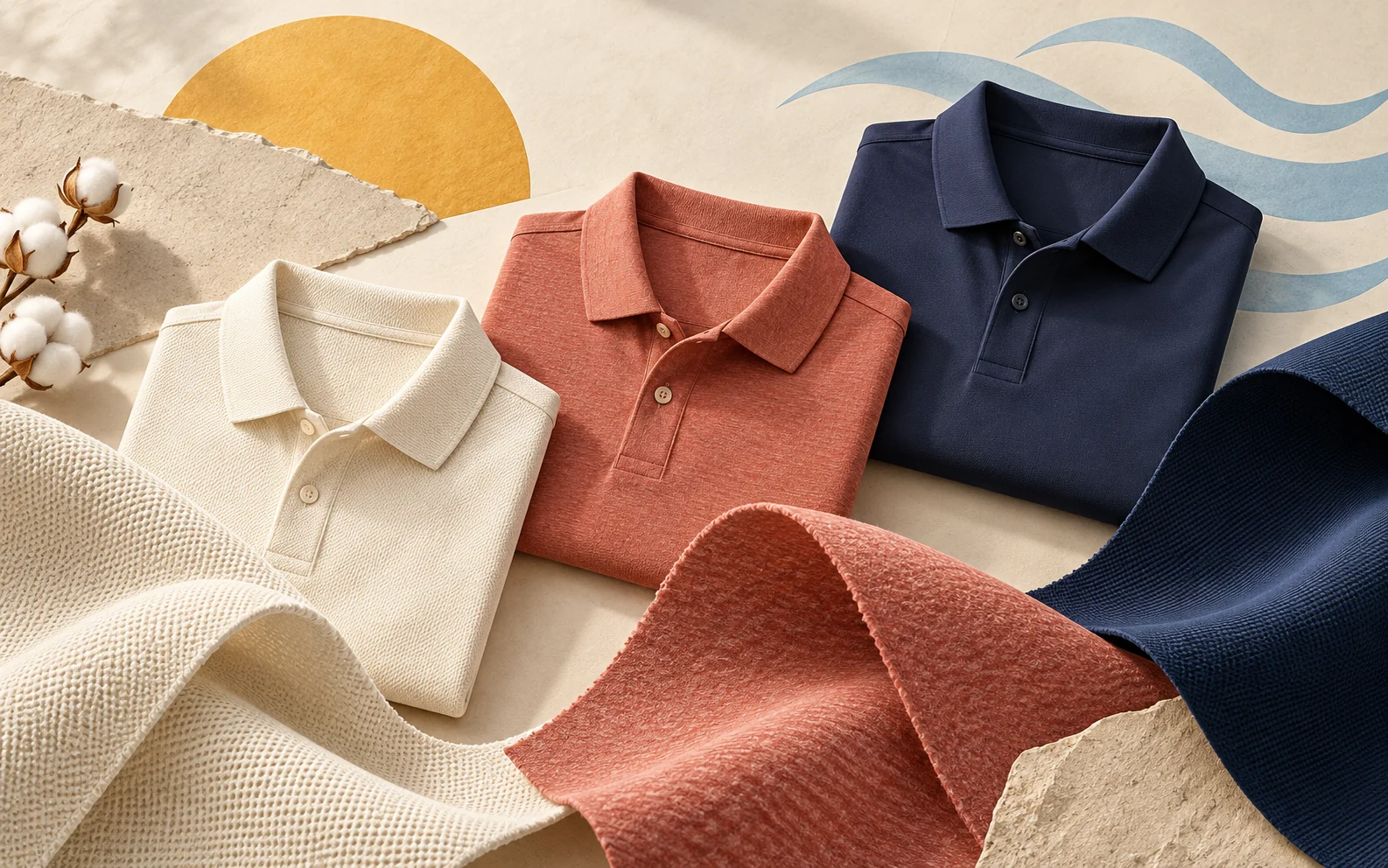
Choose a cotton or cotton-blend polo when a traditional feel is the priority; shortlist a documented moisture-wicking performance polo when the workday involves more movement. For a mixed workforce, offer two approved options instead of forcing one fabric on everyone. Then test the actual garments. Fiber percentages alone do not tell you how a polo fits, looks under office lighting, feels after a commute, or holds your logo.
The useful question is not “Which fabric is best?” It is “Which polo suits this role, this wearer, and this care routine?” A receptionist, a traveling sales representative, and an employee who mainly wants a comfortable Friday shirt may need different answers.
This is Brand Sauce’s editorial buying guide, not an independent laboratory comparison. The product examples below illustrate specification differences; they are not a promise of current decorated availability, pricing, or delivery. We have not wear-tested these examples.
Start with three lanes, not a cotton-versus-polyester argument
Separate your shortlist into cotton, blends, and performance styles. “Performance” describes intended functionality, not a single fiber recipe. Check the exact product claim rather than treating the word as a universal quality grade.
| Shortlist lane | Reason to investigate | Question the sample must answer |
|---|---|---|
| Cotton polo | A wearer prefers a traditional cotton hand and textured appearance | Does this specific weight and fit stay comfortable through the intended day? |
| Cotton/polyester blend | You want a middle option with a familiar polo look | Does it deliver the feel, shape and care experience employees want? |
| Performance polo | Movement and moisture management are explicit selection criteria | Does the documented functionality come with acceptable coverage, feel and decoration? |
These are starting hypotheses, not guarantees. Cotton Incorporated describes its TransDRY technology as a treatment that gives cotton moisture-management properties. That is a useful counterexample to “cotton cannot be performance.” It does not establish that an ordinary cotton polo has that treatment, or that every treated cotton fabric performs identically.
Likewise, do not award a polyester shirt a moisture-wicking checkmark just because its label says polyester. Ask for the exact style’s specification. Keep comfort preferences separate from documented technical properties: someone liking a sample is valuable feedback, but it is not a laboratory performance result.
Read three real specifications side by side
These manufacturer-published examples show why product names and photographs are not enough. Specifications were checked September 20, 2026; confirm the selected color and variant before ordering.
| Example | Published construction | Buyer takeaway |
|---|---|---|
| Port Authority K420 Heavyweight Cotton Pique Polo | 7-ounce, 100% ring-spun combed cotton pique for the cited Burgundy variant | A heavyweight cotton example; assess whether its substance suits the working environment |
| Port Authority K500 Silk Touch Polo | 5-ounce, 65% polyester / 35% cotton pique | It contains cotton but is not majority cotton; record the percentage order correctly |
| Port Authority K540 Silk Touch Performance Polo | 4-ounce polyester double knit; White is specified at 4.3 ounces for additional coverage | The performance version is a different construction, and color can change the specification |
Sources: SanMar’s K420 specification, K500 specification, and K540 specification. SanMar describes the K540 as moisture-wicking and snag-resistant. Those are supplier claims for that style, not findings from our own testing.
Notice what the table does not prove: which shirt feels best, which lasts longest, or which gives your team the best value. Fabric weight is not the finished garment’s shipping weight, and a heavier specification is not automatically a higher quality score. Use the numbers to identify differences worth testing, not to manufacture a winner.
Match the polo to a real workday
Write a one-sentence use case before asking for samples. “A collared shirt for people who alternate between client meetings and walking a large facility” is more actionable than “a premium corporate polo.” It gives the buyer and supplier something specific to solve.
- Mostly seated, indoor work: begin with feel, fit, collar appearance and whether the wearer likes the texture. Compare cotton and blends without excluding a performance option.
- Frequent walking or travel: add documented moisture management, comfort under a bag strap, and appearance after sitting to the shortlist criteria.
- Customer-facing group event: prioritize approved color, coverage, fit availability and the delivery deadline. A matching fabric may matter more here than in an optional employee store.
- Voluntary everyday merchandise: give people a meaningful fabric choice. A relaxed cotton-feel option and an active option can serve different preferences without creating a sprawling assortment.
Ask what employees already wear and what they avoid. “The sleeves feel restrictive when I reach” is useful. “I don’t like polos” deserves a follow-up: is the problem the collar, fabric, fit, or being required to wear one? Replacing cotton with polyester will not solve every objection.
Keep workplace-specific clothing requirements outside the assumptions of an ordinary merchandise purchase. If a role has prescribed garments or laundering rules, have the responsible team confirm suitability before the style enters the store.
Use a repeatable sample check before approving the range
A sample process does not need to become a research project. It needs to make the decision more reliable than choosing a photograph. Use the same questions for each shortlisted style and include employees with different fit needs and working conditions.
- Identify each sample precisely. Record brand, style code, color, size, composition and the specification link. Do not let feedback on one variant approve every related style automatically.
- Check fit in motion. Sit, reach, bend and wear the shirt tucked or untucked as intended. Record pulling at the placket, sleeve restriction, collar comfort and hem coverage.
- Check appearance in relevant lighting. Look at light colors over the undershirt employees would actually wear. Assess the shirt while worn, not just held against a window.
- Run an ordinary wear trial. Ask about comfort at the start and end of a representative day. Capture what happened rather than asking for a vague five-star rating.
- Wash according to the label. Photograph and measure consistently before and after. Check length, width, collar shape and overall appearance. Record the washing and drying settings.
- Approve a decorated sample. Repeat the appearance and comfort checks with the real logo, placement and decoration method. A blank sample does not approve the finished shirt.
Decide your acceptance rules before reviewing results. For example: every required fit has a workable option; the light color passes the team’s coverage check; the approved logo remains legible; and testers can follow the care instructions at home. These are proposed program rules, not standardized textile tests.
Do not extrapolate a short trial into a multiyear durability promise. Keep the sample for comparison with the first production order, and record who signed off. If the supplier later proposes a substitute, evaluate the differences instead of accepting “equivalent” as a specification.
Treat decoration and care as part of the product
The right blank can still be the wrong finished polo. Ask the decorator to confirm compatibility with the exact garment and artwork, including logo size, backing or transfer choice, and placement. Inspect how the decorated area moves and feels when worn.
SanMar’s K420 decoration sheet explicitly notes that available decoration area depends on garment size, method and equipment. That is why a nominal placement diagram should not replace approval of your actual application. For the method decision itself, see our embroidery-versus-printing guide.
Care instructions also belong in the decision, not just on the label after delivery. The cited K500 guidance calls for cold washing with like colors and low tumble drying, with a cool iron if needed. K420 permits a warm iron if necessary. Similar-looking polos can have different instructions; confirm the finished decorated garment’s care requirements with your supplier.
Give employees concise, accurate care information on the product page. Do not invent a universal “wash hot” or “never tumble dry” rule for all company polos. If the recommended routine will not work for the intended users, select a different garment before committing.
Build a small, understandable polo range
A useful company store can offer two approved polo families: one chosen for traditional feel and one chosen for active-day use. Explain the difference in plain language, while retaining each manufacturer’s composition and care details. Avoid calling one “basic” and the other “professional” when both are approved for the same workplace.
Each listing should show:
- The exact style and fiber blend, in the correct order.
- The fabric weight and any color-specific exception that matters.
- A style-specific measurement guide and clear measurement instructions.
- Available fits and sizes, with a route for someone who cannot find a workable option.
- The approved logo treatment, care guidance and current fulfillment expectations.
Do not assume the same size label produces the same fit across brands or companion cuts. Nor should a shared color name be treated as proof of an exact visual match. If employees must appear together in a coordinated uniform, compare physical samples across the proposed styles.
The goal is meaningful choice, not every possible combination. Our company-store curation framework explains how to keep the wider assortment focused. For polos, two clearly differentiated options usually make a better starting hypothesis than six nearly identical listings; expand only when an unmet need is clear.
Choose the production model after the garment
On-demand, bulk and hybrid are purchasing decisions, not fabric properties. Do not choose an unsuitable polo simply because one fulfillment model is convenient.
| Situation | Model worth evaluating | What to confirm |
|---|---|---|
| Optional employee purchases throughout the year | On-demand | Exact style, decoration, size and destination eligibility; replenishment and delivery expectations |
| A known team needs matching polos for a fixed event | Bulk | Final quantities and sizes, sample approval, all-in quote and required arrival date |
| Regular uniform issue plus unpredictable new starters | Hybrid | Who owns reserve stock and whether individual replenishment matches the original garment |
Compare quotes on the same basis: garment, decoration, setup, freight, taxes where applicable, distribution and likely unused stock. Bulk can be sensible when demand is known and a consolidated order suits the deadline. On-demand can reduce the need to predict every future size, but it does not make blank stock or production lead times disappear.
For the economics, use our on-demand-versus-bulk decision guide. Keep the fabric decision grounded in wearer fit and the purchasing decision grounded in actual program demand.
Frequently asked questions
Are cotton polos better for office employees?
Not automatically. Cotton is worth sampling when employees prefer its feel and appearance. Office temperature, garment weight, fit and personal preference still matter. Compare real samples rather than assigning one fiber to everyone with a desk.
Is every performance polo 100% polyester?
No. Performance is not a fiber composition. Read the exact blend and the specific documented functionality. Cotton treatments such as TransDRY also illustrate why cotton and performance are not mutually exclusive categories.
Should everyone receive the same fabric?
Only when the program genuinely needs it. A coordinated event or uniform may require a tightly matched range. An optional company store can support different preferences with a small set of approved options and consistent branding.
Can we choose from specifications without samples?
Specifications can narrow the field, but they cannot answer every fit, feel, coverage or finished-logo question. If you must decide without a trial, acknowledge those unknowns and avoid treating the first order as proof that every employee will like the style.
The best polo program starts with the workday, verifies the actual garment, and makes the choice understandable. A fiber label is a useful input. It is not the whole buying decision.