Choose polyester embroidery thread when the documented care process calls for a thread designed to tolerate demanding laundering. Choose rayon when its particular finish wins your physical sample review and its care restrictions fit the garment’s actual use. Neither fiber name approves the finished shirt. Specify the thread product, color, thickness and decorated garment together before releasing an order.
For a company store, the practical question is not which spool an embroiderer prefers. It is whether a replacement polo ordered next quarter will look like the approved one and survive the care employees or your laundry provider actually use. That makes thread selection a purchasing specification, not simply a production detail.
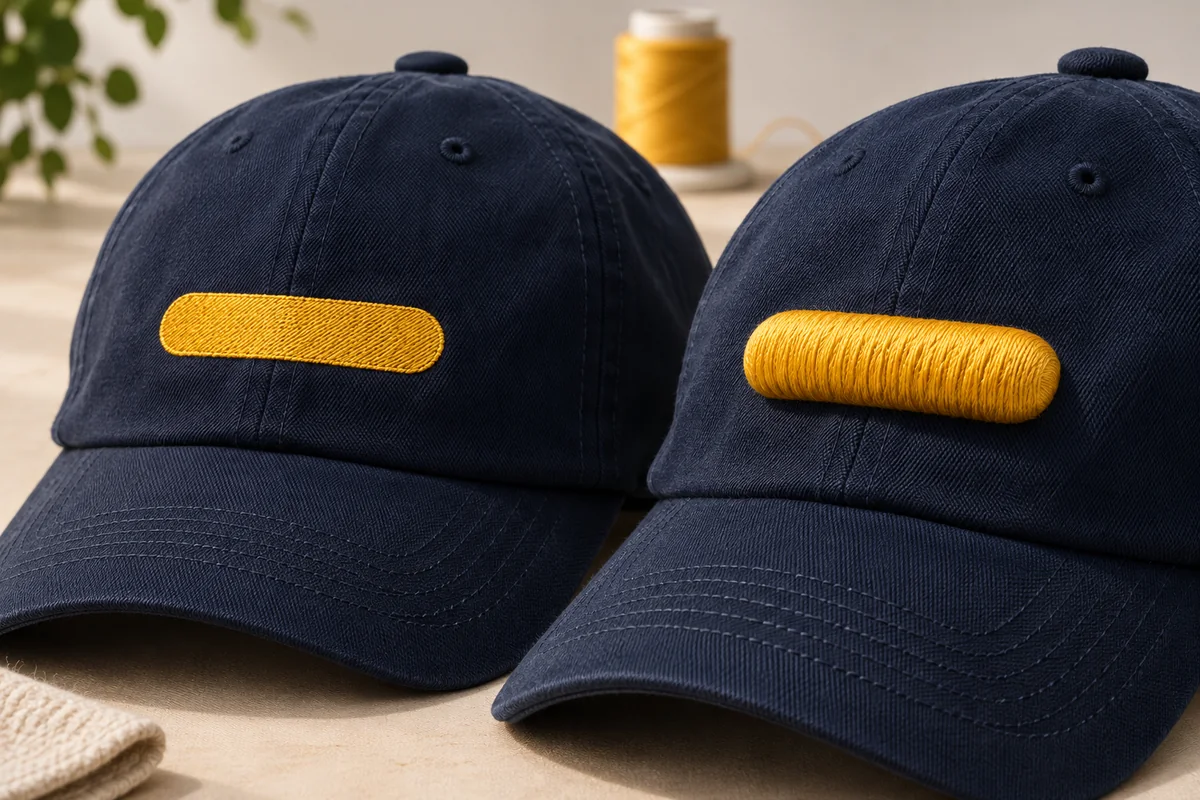
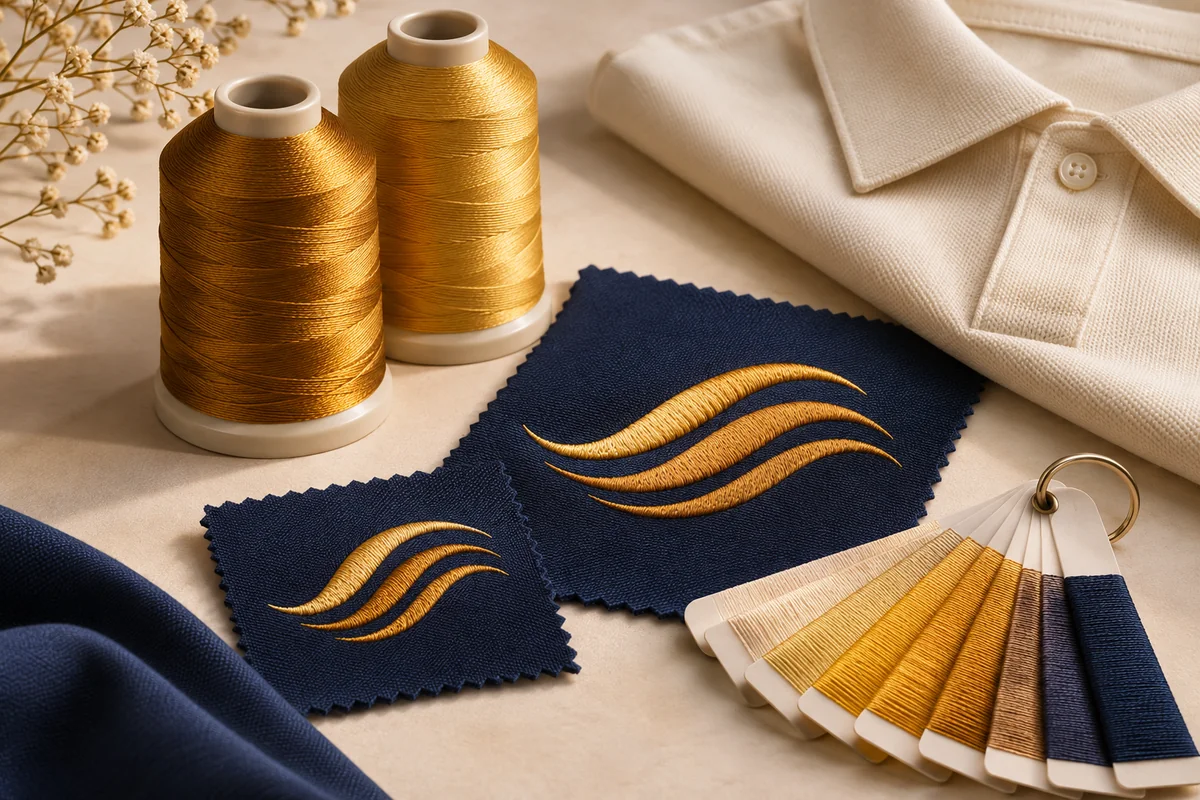
Publisher perspective: Brand Sauce publishes this apparel buying guide. The approval workflow is editorial guidance, not a report of laboratory tests or a promise that particular threads are available through every Brand Sauce production route. Manufacturer references were checked November 10, 2026. Prices, destination availability and special thread requests require a quote. The hero image is conceptual, not a comparison of tested products.
Start with the care requirement, then judge the finish
Ask the program owner to complete one sentence: “These garments will be cleaned by ___ using ___.” “Employees wash them at home” and “a contracted laundry processes every uniform” are materially different briefs. If nobody can describe the process, pause the material decision instead of treating a generic durability claim as approval.
| Program requirement | Starting shortlist | Evidence needed before release |
|---|---|---|
| Known bleach-containing laundry process | A specified bleach-resistant polyester thread | Written compatibility for the actual chemistry and process, plus approval of the whole decorated garment |
| Appearance-led office apparel with compatible care | Rayon and polyester sew-outs | Physical finish preference, readable artwork and agreed care instructions |
| Recurring replacements across producers | A thread range each approved route can source | Matching product identifiers and a controlled alternative, not just “gold thread” |
| Very small lettering | A suitable fine thread and revised embroidery setup | Actual-size sample on the chosen fabric; fiber alone does not settle readability |
| Different cleaning requirements within one workforce | Separate approved garment specifications if necessary | A clear ordering distinction so the wrong version is not issued |
This is a shortlist, not an automatic ranking. An attractive sample that cannot follow the required care route is not a workable uniform. Equally, a technically suitable thread is not enough if the finished logo fails the visual brief.
What the manufacturer evidence actually establishes
Madeira’s product overview identifies Classic as viscose/rayon, describes its lustrous finish and lists washing up to 203°F alongside a prohibition on bleach and brighteners. That is a useful correction to the idea that rayon embroidery cannot be washed. It is not permission to wash every garment carrying that thread at that temperature.
Madeira’s Polyneon product page identifies that range as polyester and positions it for chlorine/bleach resistance and frequent industrial laundering. It also offers finer versions for small lettering. These are product-range claims, not proof that every polyester thread, color or finished uniform meets your specific laundry conditions.
Keep the distinction between a component and an assembly. Your garment also has fabric, seams, trims, backing and possibly other decoration. A favorable thread specification does not override a more restrictive garment instruction. Give the supplier the proposed process and require a compatible finished-product answer; do not build a care label by selecting the highest temperature from a thread page.
Where the garment has a specialist performance specification, obtain the garment maker’s permitted decoration instructions before proceeding. This guide does not establish approval for protective clothing.
Compare real sew-outs, not fiber stereotypes
A buyer can reasonably prefer one sample’s sheen, but “rayon looks premium” is too vague for a purchase order. Put both options on the same garment color, with the same intended artwork size, and review them in the lighting where people will wear the apparel. Ask the embroiderer to optimize each setup rather than force an unsuitable setting merely to keep the machine files identical.
Record what wins: a calmer highlight, clearer edge, better separation between adjacent colors or a more suitable visual texture. Do not score softness by touching an untouched spool. Judge the decorated area as worn, including its reverse side. Our inside-finish approval guide treats backing and skin contact as separate decisions that thread selection does not replace.
Also separate color identity from material choice. Madeira’s thread-color resources warn that screens and printouts may differ from actual thread and direct buyers to physical cards for precise matching. The same resources distinguish reference color names from orderable color numbers.
Request a physical reference for each proposed range. If a supplier changes the thread family, ask for a new comparison even when its conversion chart suggests an equivalent color. Record acceptance of the finished appearance, not an unsupported promise that all materials reproduce one digital color identically. For multi-product programs, use the broader brand-color consistency workflow.
Write a thread specification a second producer can follow
A useful order brief connects purchasing language to production identifiers. Keep the following fields with the approved garment record:
- Garment: manufacturer, style, color, approved placement and artwork dimensions.
- Top thread: manufacturer, exact product range, material, thickness designation and color number for each design area.
- Production reference: approved artwork revision and embroidery-file revision, with the supplier’s sample identifier.
- Construction: the approved backing, finishing and any relevant bobbin specification, recorded by the producer.
- Care basis: the finished-garment instructions and any documented laundry process used for approval.
- Change control: who can approve a substitute and whether a new sew-out or care check is required.
Do not guess machine tension or stitch settings to make this record seem technical. The embroiderer should own those production decisions and connect them to the approved result. Your responsibility is to make the accepted appearance, intended use and allowed substitutions unambiguous.
A simple substitution clause is useful: “No change of thread range, thickness or color number without written approval against the retained sample.” If the supplier cannot offer that level of control, discuss a more flexible specification honestly. A standard production service may suit the program, but it should not be sold internally as exact component control.
Use a five-part approval gate
1. Give the supplier the real care brief
For contracted laundering, obtain the process description from the laundry operator: relevant products, temperatures, drying and finishing steps. Ask the supplier to identify conflicts before sampling. For home care, agree on instructions employees can reasonably follow. Avoid replacing a required uniform-cleaning process with a gentler one simply to preserve a preferred decoration.
2. Review matched finished samples
Order the actual garment with the intended logo placement and size. Retain an unwashed reference and identify every sample. A loose fabric swatch may help narrow choices, but it does not show how the finished polo hangs or how its decorated area feels in use. Confirm any sampling charge and whether it is credited later; neither arrangement should be assumed.
3. Rehearse the intended care route
Agree with the supplier and laundry owner on an appropriate evaluation before production. Document the process and number of cycles used. Inspect the garment and embroidery together after drying, comparing them with the retained reference. This is a program acceptance check, not certification or a universal lifespan test.
4. Decide what would fail
Before seeing results, define unacceptable changes: visible color change relative to the reference, loss of readable detail, loose stitches, puckering or an uncomfortable finish. Use consistent photographs for the record, but make the physical sample the approval reference. If a sample fails, ask the producer to investigate the whole setup; the failure alone does not prove the top-thread fiber caused it.
5. Preserve the release record
Keep the accepted sample, specification and care evidence together. Date the release and name the approver. Reopen approval when the garment, thread range, embroidery file, producer or required care process changes. For a broader purchase checklist, see how to approve a branded apparel sample.
An illustrative two-role decision
Imagine a hospitality business choosing the same embroidered mark for guest-relations polos and separately laundered service uniforms. This is a hypothetical planning example, not a Brand Sauce customer story.
The guest-relations owner prefers the rayon sew-out, and the supplier confirms a compatible finished-garment care route. The laundry operator for the service team requires a process for which that rayon option is not approved. The buyer shortlists a documented polyester alternative for the service uniform and asks for a finished sample through that laundry route.
There are two legitimate outcomes. The business can approve separate specifications with clear ordering labels, or it can select one polyester appearance both teams accept and simplify replenishment. The decision turns on the value of a distinct finish versus the administrative burden of two controlled variants—not on declaring one fiber universally superior.
If the laundry requirements remain unknown, neither route is ready for release. That is a missing operating input, not a reason to infer compatibility from a product’s “workwear” description.
Bulk, on-demand and hybrid production change the control problem
Bulk can make sense for a known uniform rollout where one approved production run and coordinated delivery matter more than ongoing item-by-item selection. Ask how samples relate to the final run and how future top-ups will be matched. A large first batch does not automatically solve the replacement order six months later.
On-demand can reduce the need to prebuy finished apparel, but ask whether the approved thread specification is available on every route serving the store. If routing changes with destination or capacity, establish what gets reapproved and who authorizes substitutions. Do not assume that a recurring listing means unchanged production components.
Hybrid can separate a controlled initial uniform batch from later employee-choice items. Keep those offers clearly distinguished if their appearance or care differs. A recipient should not discover after delivery that a store replacement is a visually similar but differently approved garment.
Compare quotes on the same scope: garment, decoration, samples, setup, quantity, freight, taxes where applicable and replacement-order conditions. There is no supported universal price winner between rayon and polyester, nor between bulk and on-demand. Ask what the supplier actually charges and which requirements its quote covers.
Frequently asked questions
Does rayon embroidery mean dry-clean only?
No. The cited Classic product guidance permits washing with restrictions. Follow the approved finished-garment instructions, not a generalization from the fiber name or the thread’s maximum temperature.
Does polyester thread make a shirt bleach-safe?
No. A thread-range claim cannot approve the shirt fabric, trims or other decoration. Confirm the complete garment against the proposed care process.
Must embroidery thread match the garment’s fiber?
Do not use fiber matching as your purchasing rule. Ask the producer to select a compatible setup for the actual fabric, artwork, appearance and care requirements, then approve the sample.
Can a supplier change thread brands for a reorder?
Only under the substitution rules you agreed. If appearance or care is controlled, require the proposed replacement’s identifiers and supporting sample or evidence before authorizing it.
Bottom line: buy an approved decorated garment and a repeatable specification—not a promise attached to the words rayon or polyester. The right choice is the one whose finish, care and replenishment requirements all fit your program.