For company gifts, do not choose glass drinkware by treating “borosilicate” and “tempered” as competing quality grades. Borosilicate describes a glass composition; tempering describes a strengthening process. Double-wall describes construction. Shortlist the finished vessel for the drink, handling routine and delivery route, then approve its decoration and care instructions together.
A desk coffee gift and a shared meeting-room tumbler can both look excellent in a photograph while needing different purchasing decisions. The coffee gift may prioritize a comfortable grip and a particular presentation. The meeting-room program may prioritize rack fit, storage and repeat ordering. Neither requirement is answered by one material adjective.
Publisher perspective: Brand Sauce publishes this buyer’s guide. Manufacturer products mentioned below illustrate documented specifications; they are not claims of Brand Sauce catalog availability, decoration authorization or partnership. Request a quote and destination-specific confirmation for the exact finished item.
Separate three labels before comparing two quotes
SCHOTT’s explanation of heat-resistant glass connects heat resistance with properties including low thermal expansion, and describes borosilicate glass and thermal toughening. The useful purchasing distinction is between what glass is made from and how it is processed. Neither term alone provides instructions for a completed drinking vessel.
Duralex describes its tempered-glass manufacturing expertise and attributes resistance to mechanical and thermal shocks to its products. That is a manufacturer’s description of its own range, not evidence that any item advertised as tempered performs identically. Keep brand, model and supporting document attached to each claim.
| Label on a quote | What it identifies | What still needs an answer |
|---|---|---|
| Borosilicate | Glass composition | Approved beverage use, handling and care for this model |
| Tempered | Strengthening treatment | Product-specific performance evidence and limitations |
| Double-wall | Two-wall vessel construction | Insulation claims, grip, cleaning and any vent instructions |
| Dishwasher-safe | A stated care permission | Whether it covers the decorated item and the intended wash routine |
The practical consequence: a comparison worksheet needs separate columns for composition, treatment and construction. Do not fill an unknown field by inference. A listing that says borosilicate but nothing about tempering has not answered the treatment question. A single-wall tumbler is not double-wall simply because its glass is heat-resistant.
Choose the use case before the material
Write a one-sentence use brief before requesting samples: “A personal hot-drink gift used at home,” “Cold-water tumblers for meeting rooms,” or “An optional glassware set shipped to employees.” Add what recipients will actually do after opening the box. Who washes it? Where is it stored? Will someone carry it between buildings?
- Personal desk or home gift: compare drinking comfort, handle clearance, usable volume, exterior dimensions and instructions. Offer a different category for people who do not want glass.
- Shared office drinkware: compare the documented wash method, fit in the actual rack, cupboard storage and replacement ordering. Confirm stacking permission rather than deciding from the shape.
- Event takeaway: assess the whole journey, including how attendees carry the gift after handout. A nice presentation carton is not automatically an adequate travel package.
- Work area with a no-glass policy: remove glass from the shortlist. A material comparison cannot override the site’s rule.
This is a selection framework, not a finding that one material is always tougher, safer or more premium. If your program is primarily about closed lids and carrying drinks, start with the separate employee drinkware and lid guide. An open glass may be answering the wrong question.
Double-wall is a construction decision, not a synonym for borosilicate
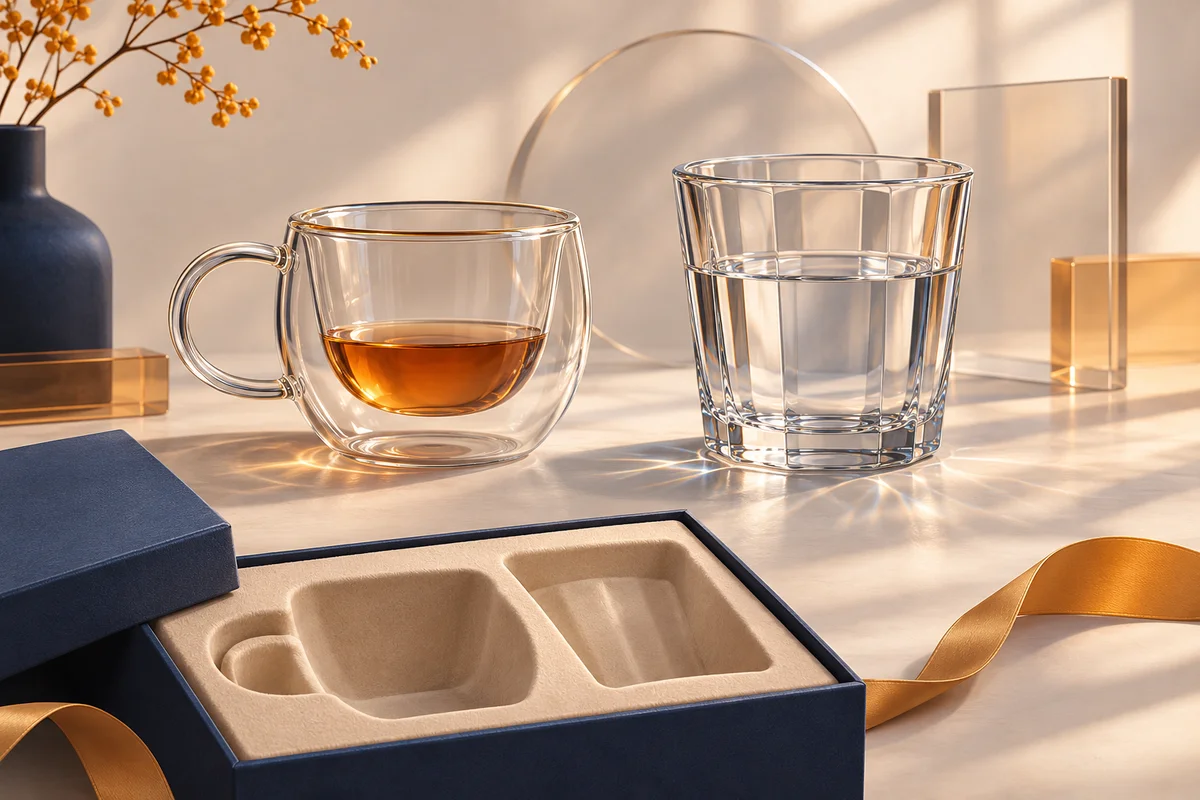
A useful documented example is Breville’s Iced Coffee Duo. The official page identifies borosilicate glass, double-wall construction and a silicone air-pressure valve. These are three distinct attributes of that product. Its listed appliance-care permissions belong to that model; they are not blanket permissions for other glassware or for a subsequently decorated version.
On a sample review form, separate the visual impression from the functional question. “We like the floating-drink appearance” is a legitimate design preference. “It will hold our intended serving with room to drink comfortably” requires a volume check. “It fits the coffee machine” requires a dimensional check. “It suits this wash routine” requires the applicable instructions.
For a double-wall candidate, ask whether there is a vent or other feature that recipients need to understand. Obtain the manufacturer’s instructions rather than inventing cleaning advice. For a handled candidate, assess the grip with the intended serving under permitted use conditions. Do not promise an exterior will never become hot merely because it has two walls.
Keep the same discipline when comparing a faceted tempered tumbler. Facets are visible; the manufacturing process and performance limits are not. A photograph can show the silhouette, but it cannot establish the claim attached to it.
Approve four things separately: vessel, decoration, care and package
A strong blank-product specification is only the first approval. The company gift is the decorated vessel delivered in its chosen packaging with the instructions the recipient sees. Use four sign-offs so a change in one part does not disappear into a generic “sample approved” email.
| Approval | Ask the supplier for | Hold the order when |
|---|---|---|
| Vessel | Exact model, dimensions, composition, construction and current use instructions | The quote substitutes a similar-looking vessel without an identified model |
| Decoration | Written approval of the method and placement on that model, plus a decorated sample | The proposed method is supported only by a generic glass-decoration claim |
| Care | Instructions applicable to the completed decorated item | The listing and enclosed care card contradict each other |
| Package | The actual inner protection and outer shipping configuration | Only a gift-box photograph is available for a parcel-shipped program |
Do not direct a decorator to engrave, etch, print or apply a transfer solely because another glass item accepted that treatment. Ask the supplier to confirm suitability for this vessel and process. If a different method changes the care requirements, resolve that before employees choose the gift.
The same principle applies to dishwasher language. A blank’s appliance permission and a logo’s durability are separate questions. Our decorated-drinkware dishwasher approval guide covers that evidence gap in more detail. Here, the decision is whether the finished glass option remains appropriate once its real care requirements are known.
Run a normal-use sample review, not an improvised strength test
The buyer’s job is to assess program fit and identify missing evidence. It is not to establish a thermal-shock rating by pouring boiling water into a chilled sample or to compare breakage by dropping glasses in the office. Request relevant supplier evidence for performance claims; stay within the model’s instructions during your own review.
- Match the sample to the quote. Record model, capacity, finish, decoration method and packaging version. Photograph identifying details and the enclosed instructions.
- Check the intended serving. Use the beverage volume the program expects, allowing practical drinking space. Record that working volume separately from the supplier’s nominal capacity.
- Check the environment. Measure machine clearance, shelf height and wash-rack fit where relevant. Verify permitted storage arrangements rather than forcing vessels together.
- Review the complete presentation. Examine logo placement and readability on the actual glass, both empty and with the intended drink. Confirm the care card remains legible and accompanies each recipient’s item.
- Trial the delivery configuration. Send sample parcels through the intended fulfillment route, inspect arrival condition and ask the fulfillment provider what packaging validation supports the rollout.
- Close exceptions in writing. A successful sample delivery is useful evidence about that parcel, not a measured damage rate for the program. Record unresolved questions instead of converting them into promises.
Decide who owns each failure before launch. A mismatched carton, missing care card and incorrect logo are different problems even when all three produce a replacement shipment. Use the gift packaging versus shipping packaging guide to keep the recipient experience and transit protection connected without treating them as interchangeable.
Compare cost per complete gift, not just per glass
Normalize quotes to the same recipient outcome. A two-glass set with a protective insert is not directly comparable with one loose glass. Ask whether decoration, setup, proofing, gift packaging, outer shipping materials, packing labor, freight and taxes are included or separately quoted. Leave unknowns marked “quote needed.”
Illustrative planning example—not a supplier quote or measured result: 120 employees choosing a two-glass set require 240 glasses and 120 complete recipient packages. Holding six additional complete sets would bring the plan to 252 glasses and 126 sets of packaging. Six extra loose glasses would support only three two-glass replacements, and would still need packaging. The reserve is an assumption to approve, not a predicted breakage rate.
On-demand ordering can fit an optional gift with uncertain uptake, if the exact item, decoration and destination are supported at the required quantity. It does not eliminate the need for suitable packing or confirmed stock. Bulk can be sensible for a known office requirement or a fixed event quantity when its setup, case quantities and consolidated handling fit the plan. A hybrid can reserve a confirmed batch and release individually packed sets after recipients choose.
Compare those routes using actual quotes and the same package definition. Do not presume one is cheaper. Ask how individual replacement sets will be supplied after the main batch, including whether the same model and decoration remain available.
Use a one-page glassware approval card
Keep this record with the purchase approval, not just in a presentation deck. The person arranging a replacement should be able to identify the finished gift without reconstructing the original buying conversation.
- Recipient use: drink, setting, personal or shared use, and any site restriction.
- Product identity: manufacturer, model, composition, treatment if documented, wall construction, nominal capacity and approved working volume.
- Finished specification: decoration method, placement, artwork version and approved sample reference.
- Care: current instructions for the decorated item and the exact recipient-facing card.
- Fulfillment: glasses per set, packaging components, destination scope, delivery route and replacement owner.
- Decision: approved uses, excluded uses, unresolved questions, approver and date.
If two candidates both pass, choose on the experience and operational fit you actually value. A familiar tumbler can be the better shared-office choice; a double-wall design can be the preferred personal gift. Those are program decisions supported by the specific samples, not universal material rankings.
Frequently asked questions
Is borosilicate always better than tempered glass?
No. The terms describe different aspects of glass. Compare the finished models and their documented uses, then assess the handling, care and packaging your program requires.
Does tempered mean unbreakable?
No. Do not describe a glass gift as unbreakable. Use the manufacturer’s supported language for the exact model, and include its handling and care instructions rather than a stronger marketing promise.
Can we put any borosilicate glass in a microwave?
Do not grant that permission from composition alone. Check the completed product’s instructions, including its decoration and any added components. General material-temperature information is not an appliance-use instruction for your gift.
Should everyone receive the same glass set?
Only if it fits the program and recipients. An optional selection can accommodate people who prefer another kind of drinkware or a different gift entirely. Confirm replacement and packaging arrangements for each offered option before opening selection.
Bottom line: choose glassware through a finished-product approval, not a material slogan. Composition, treatment and construction help you ask better questions; the exact vessel, decoration, instructions and delivery package determine what you can responsibly offer.