Choose employee drinkware by how the recipient will carry it, what they will drink, and how they will clean it—not by capacity or brand alone. A desk tumbler, a cold-water bottle that closes for transport, and a hot-drink travel vessel solve different problems. The lid is often the deciding feature.
For a company store, start with those distinct use cases and offer a small, clearly described choice. For a one-time gift, find out which use case actually fits before ordering hundreds of matching cups. The biggest vessel is not automatically the most useful, and an insulated body does not make every compatible lid suitable for every drink.
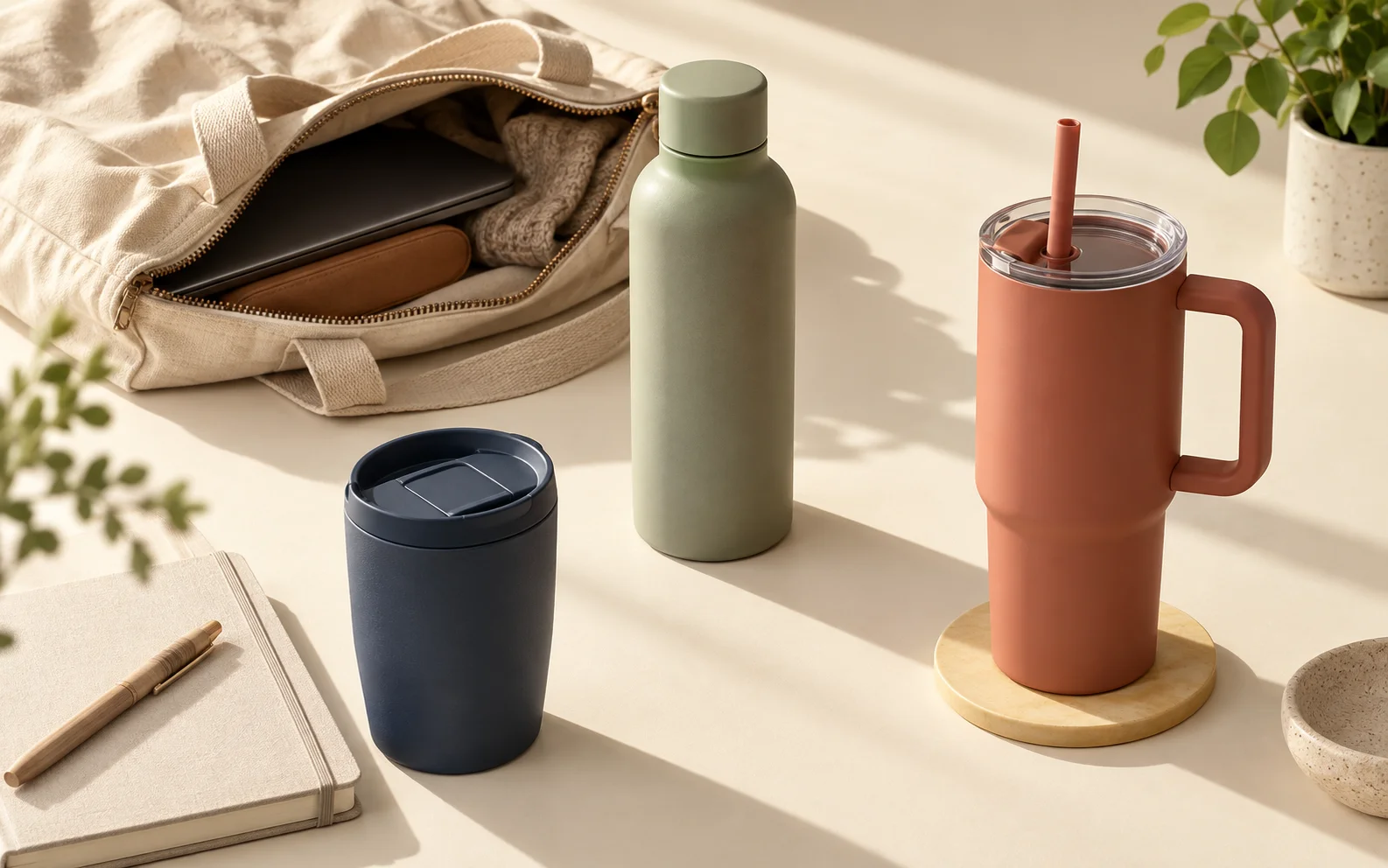
Publisher perspective: Brand Sauce publishes this guide to help teams plan branded merchandise programs. Manufacturer examples explain product differences; they are not a ranking, a claim of current Brand Sauce availability, or evidence of hands-on testing. Product guidance was checked September 21, 2026. The hero is a conceptual illustration, not a photograph of the named products.
Start with the journey, not the ounces
Ask one practical question: Where does the filled drink spend its time between refills? On a desk, upright in a vehicle, carried in a hand, or enclosed in a bag? Those answers produce a much better brief than “a premium bottle everyone will love.”
| Recipient’s routine | First feature to verify | Tradeoff to explain |
|---|---|---|
| Desk-based coffee or tea | Hot-drink suitability of the exact body-and-lid combination | An easy-access sip opening may not seal for bag transport |
| Water carried inside a work bag | Manufacturer’s leakproof claim and required closed position | A secure closure adds an opening and closing step |
| Cold drinks kept nearby throughout the day | Straw access, comfortable grip and cleaning instructions | A fixed straw opening is not a transport seal |
| Regular vehicle commute | Actual base dimensions, height and handle clearance | More capacity can mean a taller or heavier vessel |
| Shared or flexible workspace | Easy identification and a manageable footprint | A large handle or broad base may crowd a small work surface |
These are selection criteria, not guarantees about whole product categories. A bottle can have a straw closure designed for transport; a travel mug can still be only leak-resistant. Read the specification for the item and lid together.
Leakproof and leak-resistant are different promises
Do not rewrite a supplier’s “splash-resistant” description as “leakproof” in the employee store. A closable opening is not sufficient evidence that a filled vessel belongs beside a laptop in a backpack.
For example, YETI’s MagSlider lid guidance explicitly says the lid is not leakproof and does not prevent spills. That does not make it a bad desk-drink option. It makes it the wrong product to describe as sealed bag storage.
By contrast, Hydro Flask’s 32 oz Travel Bottle with Flex Straw Cap is described as leakproof when closed. The qualification belongs in your product description, alongside the exact cap name. “When closed” is part of the feature, not disposable fine print.
Build a simple approval rule: if bag transport is a core requirement, the buyer must produce manufacturer documentation covering that use for the exact configuration. If the source is ambiguous, ask the supplier to resolve it before approval. Do not infer a claim from a screw thread, a gasket, a photograph, or another product from the same brand.
Match the lid to the drink, not just the insulated body
A cold-water straw bottle and a coffee vessel should not share interchangeable marketing copy. Hydro Flask states that the Flex Straw Cap supplied with the Travel Bottle above is not intended for hot liquids. The same product page describing insulation and leakproof closure does not remove that restriction.
Similarly, YETI’s Rambler care and use FAQ explains that warnings depend on the lid or cap and identifies its Straw Cap and Straw Lid as unsuitable for hot beverages. Its instructions also include restrictions for particular beverage types and configurations. Link to the applicable instructions instead of creating a universal “handles any drink” promise.
In the store, keep three fields separate: intended drinks, closure behavior, and care. A concise description could say “For cold water; leakproof when the specified cap is fully closed; follow the linked cleaning instructions.” That is an example of a copy structure, not an approved description for an unnamed item.
If a supplier proposes a replacement lid because stock has changed, treat it as a product change. Recheck suitability, compatibility and the employee-facing description. Similar appearance is not enough to preserve the original promise.
Choose capacity around comfort and fit
Capacity matters, but it is only one dimension. A large vessel may suit someone who keeps water nearby; another employee may prefer a compact option that fits under a coffee machine or in a bag pocket. Consider the filled vessel, not just its empty shipping weight.
Request the base diameter, overall height, empty weight and handle dimensions where relevant. “Fits most cupholders,” which appears on the Hydro Flask Travel Bottle page, is not “fits every cupholder.” Verify representative spaces with a sample instead of promising universal fit.
A useful sample session involves ordinary tasks: lifting a filled vessel from the table, opening and closing it, reaching the drink opening, setting it down, and taking apart the lid according to its instructions. Ask participants which actions are awkward. Do not assume that a handle, straw, twist cap or narrow body is easiest for everyone.
You do not need employees to disclose health information to offer a choice. Describe physical features clearly and let people select what works for them. Include a non-drinkware alternative when the gift program permits it; someone who already owns a favorite bottle may prefer something else. That is the practical case for letting employees choose their gifts.
Evaluate cleaning and replacement parts before decoration
A lid that looks simple from the outside may have several removable parts. Before approving a product, find its cleaning instructions and identify which parts need removal, where they go during washing, and how they fit back together.
YETI’s cap and lid cleaning guide provides component-specific instructions rather than one generic rinse instruction. Use this as the standard for the information you request: employees should have instructions for the lid they actually receive.
For the decorated item, ask the supplier to confirm care requirements in writing. Do not assume that a claim for an undecorated blank establishes the care requirements of a separately applied print, coating or other decoration. Resolve conflicting instructions before launch.
- Can recipients access the care instructions without logging into an administrator account?
- Are the instructions matched to the delivered cap and product version?
- Can replacement lids, seals or straws be sourced, and through whom?
- Does the support team know the exact model identifier?
- Who handles an incorrect lid, missing part or damaged delivery?
Replacement availability should be checked, not presumed. Record the confirmed replacement part number if one exists. If no replacement is available, factor that limitation into the decision rather than hiding it behind a premium brand name.
Use a sample acceptance checklist
Approve the combination of vessel, lid, decoration and packaging. A digital logo proof alone cannot tell you how the lid operates or how the mark looks against a curved, textured surface.
| Check | What to record | Reason to pause |
|---|---|---|
| Identity | Manufacturer, model, size, color and lid | Sample or quote omits the lid version |
| Use claim | Source for closure and beverage suitability | Store copy promises more than the manufacturer |
| Everyday handling | Feedback on opening, grip and placement | Intended users find routine actions difficult |
| Decoration | Actual dimensions, location, contrast and method | Small details disappear or placement interferes with use |
| Care | Instructions for the finished item and all components | Supplier and manufacturer guidance conflict |
| Delivery | Included parts, packaging and support contact | Recipients cannot identify or obtain a missing component |
For an item specifically documented as leakproof, a routine sample check with room-temperature water over a sink can help catch a missing seal or assembly problem. Follow the manufacturer’s instructions; do not improvise pressure, heat or impact tests. This is an acceptance check, not laboratory certification, and it does not justify claims beyond the documentation.
Keep photos of the approved finished sample and a dated specification with the purchase record. State whether substitutions require approval. When a reorder changes the color, lid or decoration method, identify which checks must be repeated.
Build a small assortment with genuinely different jobs
A useful starting assortment is one hot-drink option, one closed-transport water option, and one cold-sipping option—provided each fills a real employee need. This is an editorial framework, not a requirement to buy three products. A small team may need only two choices.
Do not fill every position with nearly identical tumblers differentiated only by color. Your company-store assortment should make the decision easier. Name the primary use case first, then show capacity, closure, cleaning and decoration details consistently.
Compare total delivered quotes for each approved configuration. Include the vessel and correct lid, decoration setup and unit charges, packaging, freight, destination-specific taxes or charges, and any personalization. A retail price for an undecorated item is not a quote for an employee program.
If employees choose among options under a company contribution, decide whether each option is fully covered and explain any employee payment before selection. Do not unexpectedly turn appreciation into a checkout surcharge. Where one product costs more to deliver, consider a different equivalent option rather than silently reducing the included components.
Choose bulk, on-demand or hybrid after the product is right
On-demand can fit ongoing employee choice when the exact drinkware and decoration are available in individual-order quantities with acceptable fulfillment terms. It avoids committing to a large mix before knowing preferences, but individual shipping and product restrictions still matter.
Bulk can be the better fit for a known headcount, one approved item, a consolidated delivery location or a fixed event date. Confirm production timing and the distribution plan. A lower unit price is not useful if the order arrives after the event, but neither is an on-demand offer whose delivery window misses it.
A hybrid program might use a small confirmed batch for an in-person welcome day and a recipient-choice selection for remote employees or later hires. Keep the gift value and practical usefulness comparable even when the logistics differ.
Use the same approved specification when comparing production models, and examine the on-demand versus bulk tradeoffs rather than assuming one always wins. Get minimums and reorder terms for the particular item, lid and decoration—not for “drinkware” as an entire category.
Frequently asked questions
Is a tumbler or a bottle the better employee gift?
Neither wins universally. Start with desk use versus transport, hot versus cold drinks, and the preferred opening style. A well-described choice is more useful than treating product names as a performance standard.
Does a lid that closes mean the product is leakproof?
No. Check the exact manufacturer claim. YETI’s MagSlider example shows why a closable sip opening and a leakproof seal should not be treated as the same feature.
Can a straw bottle be used for coffee?
Do not assume it can, particularly for hot coffee. Follow the instructions for the specific lid and vessel. Select a documented hot-drink configuration when hot beverages are the intended use.
Should every employee receive the same size?
Only when that size genuinely serves the program. Capacity, weight, workspace and carrying habits differ. A compact and a larger option can be more meaningful than several colors of the same oversized product.
What should we send a merchandise partner?
Send intended uses, recipient locations, headcount or order cadence, delivery date, total delivered budget, artwork and required closure behavior. Ask for exact model-and-lid recommendations, current availability, a decorated sample and a written substitution policy. That brief gives the partner something concrete to solve.
The best branded drinkware is the piece that fits an ordinary day. Choose the use case, verify the lid, make care easy to understand, and let the branding support a product people have a reason to keep using.