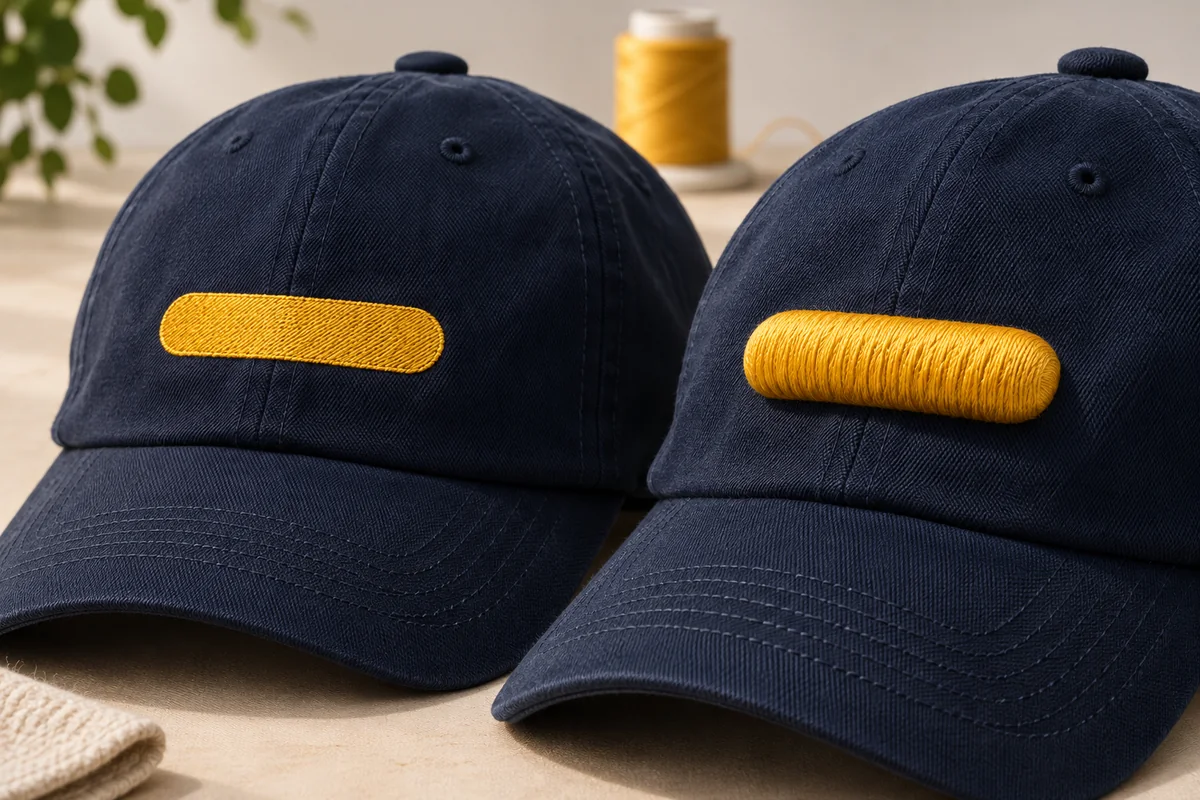
Choose flat embroidery when your company cap needs a detailed, understated or information-rich mark. Consider 3D puff when a simple, bold shape should visibly stand above the fabric—and the exact cap, artwork and production method pass a physical sample review. Puff is a different construction, not a universal quality upgrade. A mixed design can keep the main symbol raised while leaving supporting details flat.
The purchasing decision is therefore not simply which look people prefer in a mockup. It is which version preserves the approved identity, can be reproduced on the selected cap and remains practical to reorder. This guide separates those decisions so a striking first sample does not become an awkward ongoing company-store product.
Publisher perspective: Brand Sauce publishes this buying framework. The acceptance criteria below are our recommendations, not claims that every decorator or Brand Sauce program supports every combination. Exact cap availability, decoration options, countries served, minimums, timing and prices are quote-needed.
Editorial image: AI-generated conceptual flat and raised stitching, not a production sample or an exact relief-height reference.
What changes when embroidery becomes 3D puff?
Puff embroidery uses foam beneath the stitched design to create relief. It is not just ordinary embroidery with extra thread. Madeira's dimensional-embroidery tutorial calls for a file adapted for 3D work, shows the foam being added during production, and describes satin stitching followed by excess-foam removal. Those steps explain why a screen rendering alone cannot confirm the finished result.
Madeira USA's foam guidance identifies caps and other stable fabrics as applications and distinguishes regular from firmer foam. Its named foam products are 3 mm thick, but that is a material specification—not a guarantee that every finished raised design will measure exactly 3 mm above the cap.
For a buyer, the useful distinction is the complete recipe: cap construction, artwork size, embroidery file, thread, foam and finishing. Approve that combination. Do not approve an isolated word such as “premium,” “raised” or “3D” and assume everyone means the same result.
Flat, puff or mixed: a practical decision table
| Design or program need | Starting recommendation | Approval question |
|---|---|---|
| Small tagline, several words or fine internal detail | Start with flat embroidery; simplify if needed | Can a person read the essential information on the actual cap? |
| Large, simple symbol or short bold lettering | Sample puff alongside flat | Does the relief improve the mark without closing its internal spaces? |
| Bold symbol with a smaller supporting line | Consider a mixed flat-and-puff design | Are the raised and flat regions explicitly identified in the proof? |
| One identity across several cap constructions | Qualify each cap separately | Does each version preserve the same recognizable proportions? |
| Frequent small reorders with changing blanks | Favor the method with a repeatable approved supply route | What changes trigger a new sample rather than an automatic substitution? |
| Fixed-quantity event with a hard handout date | Compare qualified bulk production with individually fulfilled options | Which route leaves enough time for sample correction and delivery? |
These are screening recommendations, not universal digitizing limits. Ask the decorator to mark any features that cannot be reproduced at the proposed size. A logo can be too detailed for flat embroidery too; choosing flat does not make a tiny tagline magically readable.
Approve the identity before approving the texture
Start with the smallest indispensable version of the brand. Identify the symbol, wordmark, tagline, registration mark and other secondary elements. Then classify each as essential at this placement, optional with brand approval, or unsuitable for this application. This is a brand decision before it becomes a production decision.
For a puff candidate, request a marked proof showing which regions will be raised and which will remain flat. Ask how open ends, narrow spaces and transitions between those regions will be handled. Do not silently remove small text or enlarge one letter just to make the effect work. If a simplified cap-specific lockup is needed, have the brand owner approve it as a separate asset.
Gunold's Puffy Foam guidance says designs need digitizing specifically for foam and that the digitizer should know the foam thickness. It also recommends matching foam and thread colors where possible and explains that foam density changes the look. The buying implication is straightforward: “use our existing embroidery file” is not enough information to authorize a puff version.
For file custody and repeat orders, use our embroidery digitizing handoff guide. Record the approved cap application separately from a file used on polos or jackets. A shared brand asset does not imply a shared production setup.
Choose the cap before locking the decoration
A foam specification is not a cap approval. The sample must use the intended blank, including its crown, front-panel construction and placement. Ask the decorator to assess any center seam and the available decoration area on that exact model. Avoid buying a different cap after approving a sample merely because both products are described as navy baseball caps.
Compare the decorated cap while worn, not only while resting flat on a table. Check whether the design sits where expected, whether the panel looks distorted and whether the inside finish is acceptable to the wearer. Inspect from the front and side. For a raised mark, the side view is part of the appearance being purchased.
Keep the fit decision separate from the decoration decision. A beautifully stitched cap still fails as an employee option if the intended wearer cannot adjust it comfortably. Our company-cap fit and construction guide covers that earlier selection step. Where your program offers more than one fit, qualify the decoration on each approved alternative rather than forcing every recipient into one blank.
Use a six-part physical sample gate
Request a physical sample before committing the full program. Use the following review record for both flat and puff candidates, with extra attention to the raised edges on puff. These are proposed acceptance checks, not a claim that we laboratory-tested a particular product.
- Identity: Compare the stitched result with the approved lockup. Confirm spelling, orientation, essential elements and the intentionally omitted details.
- Coverage: Inspect edges, corners and open spaces for visible foam or unfinished areas. Photograph any defect under ordinary light, not only a magnified close-up.
- Shape: Check the mark from the front and side on the worn cap. Look for distortion or inconsistent relief that changes the intended appearance.
- Placement: Record dimensions and reference points agreed with the decorator. “Centered” should not be the only instruction when two reviewers could interpret it differently.
- Wearer experience: Inspect the inside and wear the cap with its normal adjustment. Flag rough areas, uncomfortable backing or unexpected stiffness for supplier review.
- Care and repeatability: Obtain care instructions for the decorated cap, retain a control sample and agree how reorders will be compared with it.
Document pass, revise or reject for each item. If the logo needs revision, approve the new physical sample before changing the status to pass. An email promising that production will look better than the sample is not a substitute for an agreed reference.
Do not extrapolate a thread or foam care statement to the whole cap. Ask for the finished product's instructions, including any decoration-specific restrictions. If washing is part of the intended use, agree on a sample-care trial following those instructions and inspect it afterward. That is a purchasing check, not a lifetime-durability guarantee.
Compare equivalent quotes, not a generic puff surcharge
Ask each supplier to price the same blank, quantities, artwork dimensions, locations and delivery pattern. Request separate treatment of initial digitizing, sample production, artwork revisions, decoration, packing and freight. Confirm whether a repeat order carries setup or minimum charges and whether the same approved blank can be reordered.
There is no universal percentage premium in this guide. A supplier's marketing advice about what decorators might charge is not your delivered quote. Nor does a thicker foam automatically represent better value. Pay for the approved appearance and service requirements, not an unexplained thickness upgrade.
Illustrative comparison, not actual pricing: Suppose two otherwise equivalent quotes for 120 caps are $2,400 for flat and $2,760 for puff, including all costs within the same agreed scope. The incremental spend is $360, or $3 per cap. If the puff quote excludes its sample or sends all caps to one office while the flat quote includes individual delivery, that calculation is not yet comparable. Normalize those differences before presenting the choice to the budget owner.
The brand owner should decide whether the approved raised effect is worth the verified difference. Do not label the higher-cost option better merely because it looks more dimensional, and do not discard it if that appearance is central to the brief.
Bulk, on-demand or a qualified hybrid?
Decoration choice does not dictate inventory strategy. Bulk can be a sensible fit when the approved design is stable, the quantity is known and caps will be handed out together. It also creates a clear opportunity to inspect a batch before distribution. The tradeoff is holding any remaining stock and owning the forecast.
On-demand may fit an ongoing employee-choice store with uncertain timing, but first confirm that the exact cap and puff combination is available through that route. Do not infer single-unit availability from a provider's general embroidery offer. Ask about reapproval if the blank, production location or decoration recipe changes.
A hybrid might use a qualified bulk run for a launch and a separately approved reorder route for later hires. Make the distinction visible internally: a later flat version is not automatically an acceptable replacement for a promised puff version. The broader on-demand versus bulk decision guide helps compare inventory exposure and fulfillment costs without assuming one model always wins.
A copyable approval brief
Send this brief before asking for final pricing:
- Blank: exact cap model, color and fit options; proposed alternatives require approval.
- Artwork: approved lockup and finished dimensions; identify raised, flat and omitted elements.
- Production: decorator to propose the compatible file, thread, foam and finishing recipe.
- Sample: physical decorated cap required; reviewer, revision deadline and retained reference named.
- Supply: initial quantity, reorder pattern, destinations and required arrival date.
- Commercial scope: setup, sample, revisions, decoration, packing, shipping and applicable charges itemized.
- Change control: list substitutions that require reapproval; retain reference photos and the approved file version.
For a hypothetical bold icon plus a fine tagline, a useful brief might request three samples: entirely flat, icon-only puff with the tagline flat, and an approved simplified puff lockup. The decision is then between real readable outcomes—not between a realistic flat sample and an idealized raised mockup.
Frequently asked questions
Can the same logo use flat and puff embroidery?
Potentially. Specify the regions separately and have the decorator confirm the proposed combination on the chosen cap. Approve the combined physical result, not just two independent artwork files.
Can we convert an approved flat design by adding foam?
Do not authorize that shortcut. Have the digitizer evaluate a foam-specific version and sample it. Keep the original flat approval separate so nobody mistakes the new file for an interchangeable production asset.
Is puff always more durable or more expensive?
Neither is a useful blanket promise. Evaluate the actual decorated cap, care requirements and comparable written quote. A raised look is an aesthetic characteristic, not evidence of longer service life.
What if the puff sample compromises the logo?
Choose the approved flat version, revise the lockup with brand-owner permission, or reconsider the placement. A recognizable, comfortable cap is a stronger outcome than preserving a decoration effect at the expense of the identity.
Bottom line: Buy puff for a verified visual purpose. Approve the cap and decoration as one product, preserve the production recipe, and choose the fulfillment model separately.