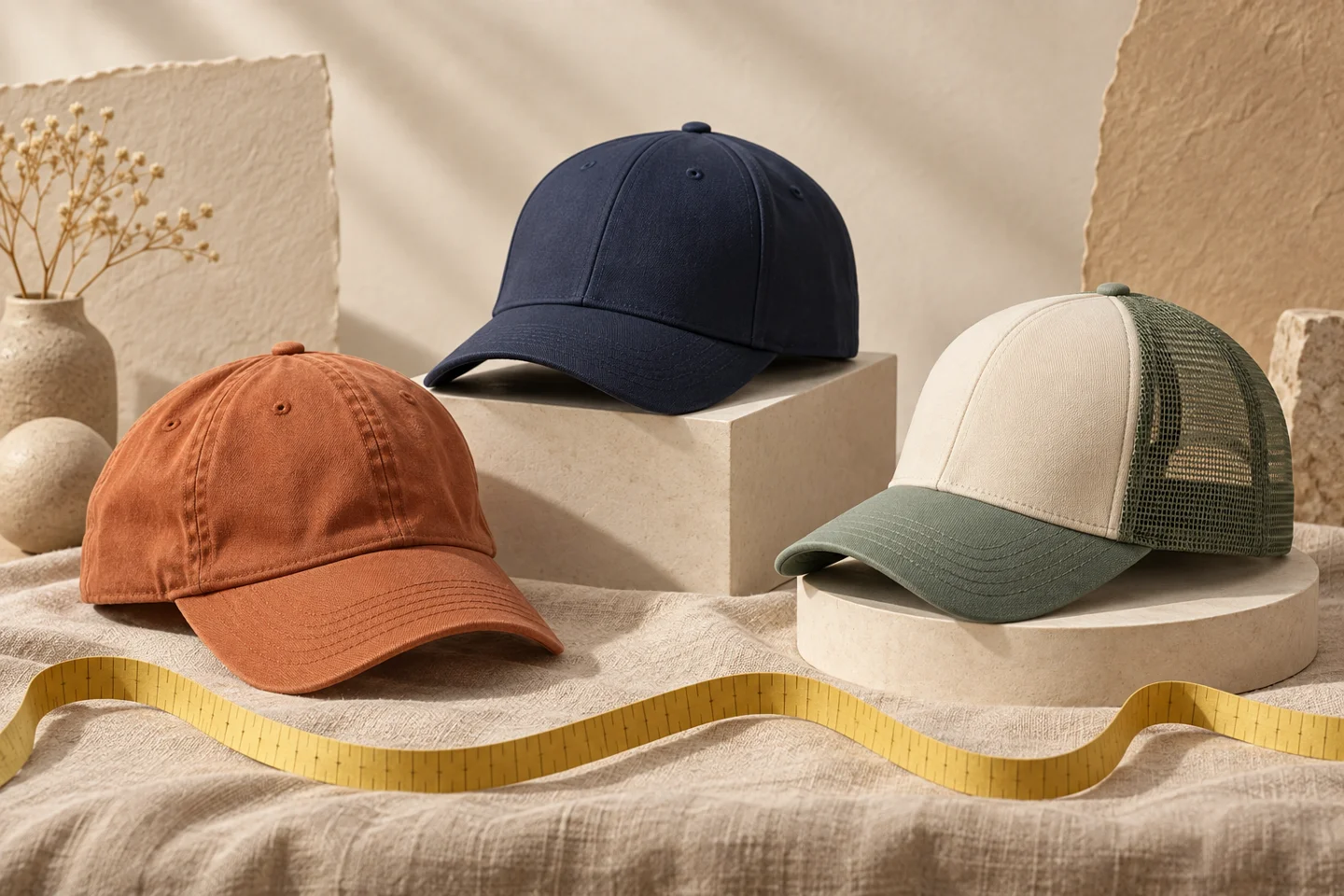
Choose company caps in this order: how employees will wear them, fit and closure, crown construction, then decoration. An adjustable cap is a useful starting point for a mixed team, but it is not a promise that one size will fit everyone. Offer a different fit or a non-headwear option, and approve your actual logo on the actual cap before opening orders.
The most expensive mistake is not necessarily choosing a premium hat. It is ordering a perfectly embroidered shape that people do not want to wear. This guide focuses on baseball-style caps for employee gifting and company stores, not protective headwear. It is Brand Sauce’s editorial buying framework; the examples are planning scenarios, not client results or claims of current catalog availability.
1. Write a wearing brief before choosing a brand
Start with one sentence: “We want employees to choose a cap for everyday commuting and weekends,” or “We need matching caps for a staffed event.” Those are different briefs. The first makes personal preference central. The second adds a fixed date, a coordinated appearance and a known delivery location.
Ask the program owner to settle four questions before requesting samples:
- Optional gift or required appearance? Optional gifts should include an alternative for someone who does not wear caps.
- Everyday use or a specific occasion? A cap for a one-day gathering does not automatically belong in the permanent store.
- One destination or individual addresses? Compare the complete delivery plan, not just decorated unit prices.
- Subtle identity or prominent event branding? Decide whether the logo should be the main visual feature or a quieter detail.
For a workplace uniform, have the responsible operations team confirm where caps are permitted. Do not imply that ordinary merchandise replaces required head protection or that a “performance” label establishes suitability for a particular job.
2. Separate closure, size and crown depth
A closure tells you how the circumference adjusts. It does not tell you how deep the crown sits, how the bill feels, or whether the wearer likes the shape. Treat those as separate sample questions.
| Fit approach | Useful starting point | What to verify |
|---|---|---|
| Adjustable snapback | A shared style with wearer-adjustable circumference | Published size range, comfortable adjustment positions and the rear opening |
| Adjustable strap or buckle | A casual option when a strap closure is preferred | Adjustment travel, how the loose end is managed and ease of operation |
| Stretch-fit | A closed-back appearance with some fit flexibility | The exact style’s size choices and measurement chart |
| Fixed fitted size | A deliberate choice for recipients who know their preferred fit | Individual size selection and the replacement policy |
Flexfit’s official sizing guide directs shoppers to measure their head and match the result to a size range. That is the important purchasing lesson: stretch does not eliminate size selection. Use the chart for the particular style being offered, rather than transferring a size label from another cap.
For an adjustable option, ask the supplier for its actual fit information. If the only answer is “one size,” mark the fit range as unconfirmed. Do not turn that into “fits all” in your store copy.
At sample review, have volunteers check circumference and crown depth separately. Can they get a comfortable fit without using an extreme adjustment? Does the crown sit where they want it? Does it interfere with their usual glasses or hairstyle? Gather private, practical feedback rather than asking people to explain personal reasons publicly.
For a gift program, the fallback can be simple: a second cap shape, or a similarly positioned non-headwear gift. A recipient should not have to accept an unusable cap just because it is the only item with the company logo.
3. Read construction terms as separate attributes
Structure, profile, panel layout and fabric are not synonyms. Structure describes support in the crown; profile describes its silhouette or height. Panel layout tells you where seams sit. Fabric and mesh choices describe other aspects of the product. A mesh-back cap can still have a supported front, and “six-panel” does not tell you everything about how it will feel.
SanMar’s cap-decoration guidance explains that buckram, seams and materials affect decoration. For buyers, that means the silhouette you select and the logo treatment cannot be approved independently.
- Structured front: sample it when you want the front to keep a more defined shape. Check whether that shape suits the recipients, not just the logo.
- Unstructured front: sample it when you want a softer look. Evaluate the finished decorated cap, because the undecorated blank is not the complete experience.
- Mesh back: choose it because recipients want that construction and appearance, not because every product called a trucker cap is interchangeable.
- Profile: compare actual side views and samples. Do not assume a low-profile label from one manufacturer describes the same fit as another.
A useful shortlist is two genuinely different shapes in restrained color choices. Five almost identical caps create more ordering decisions without necessarily solving a fit problem. Add a third option only when it addresses a specific gap discovered in the sample review.
4. Fit the logo to the cap—not the mockup
A logo that works across a jacket back may not work across a cap front. Ask the decorator to review the artwork, exact cap style, intended placement and dimensions together. Your approval should refer to that combination, not to a generic “hat logo.”
SanMar’s embroidery guidance distinguishes structured and unstructured fronts and identifies stabilizer needs for softer caps and other placements. A successful sample on one construction is not automatic approval to move the same design to a different one.
For a concrete example, the Port Authority C914 decoration sheet lists a maximum front-panel area of 1.5 inches high by 5 inches wide. It also states that decoration area depends on product size, method and equipment. That is a style-specific planning reference, not a universal cap limit or a recommendation to fill the entire area.
Send the decorator a short decision list:
- Can the full logo remain legible at the proposed dimensions?
- Does a center seam affect the chosen placement?
- Should an approved simplified mark replace a detailed lockup?
- Will the design be direct embroidery, an applied patch or another method?
- What sample and setup charges apply, including revisions?
If you prefer a patch, ask how it will be attached to that exact cap and inspect a finished sample. Do not assume that an attractive patch rendering confirms attachment quality, comfort or compatibility. If you prefer dimensional embroidery, request evidence on the selected design rather than assuming any logo can become a raised version.
Our broader embroidery-versus-printing guide explains the method decision. For caps, the additional constraint is the small, shaped surface and its construction. Keep the method choice subordinate to the finished result.
5. Use a cap-specific sample scorecard
Photograph the sample from the front, side and back, and retain the supplier style code, color and decoration revision. Then record a pass, revision or unresolved question for each check below. This is a buying acceptance exercise, not laboratory testing.
| Check | What the reviewer does | Record before approval |
|---|---|---|
| Fit | Try the intended size or adjustment and evaluate crown depth | Fit limitations and the alternative offered |
| Closure | Open, adjust and close it using normal handling | Any difficulty or uncomfortable contact |
| Artwork | Read the finished logo at a normal conversational distance | Approved dimensions, colors and revision |
| Placement | Inspect alignment against the cap’s seams and bill | Approved reference photos and any agreed tolerance |
| Interior | Inspect and wear the decorated sample | Any scratchy, stiff or protruding area requiring review |
| Care | Read the supplied instructions for the finished item | Recipient-facing care guidance and unresolved restrictions |
Do not impose a universal placement tolerance without agreement. Record what your decorator can consistently deliver and what your brand team accepts. Equally, do not prescribe machine washing simply because a cap looks durable; confirm care guidance for the blank and the applied decoration.
The finished-apparel sample approval checklist provides a fuller sign-off process. Keep cap-specific fit findings attached to that record, so a future substitute is not accepted solely because its color is similar.
6. Choose the ordering model after the assortment
On-demand is useful when employees select caps throughout the year and demand by style or size is uncertain. It can reduce the need to guess how many decorated units to hold. It does not guarantee that the preferred blank will always be in stock or that every decoration treatment is available one unit at a time.
Bulk can be the better fit when you have a confirmed headcount, approved design, common destination and fixed event date. Request a complete quote, with sample approval, production timing, packaging and freight spelled out. The relevant comparison is the cost and practicality of delivering the required caps—not a headline unit price.
A hybrid program can use a bulk run for a scheduled gathering while keeping an approved style available for later hires, if the provider supports that arrangement. Verify that the later-order decoration matches acceptably; different production routes should not be assumed identical.
Illustrative planning scenario: a company wants 80 matching caps for an offsite and optional cap ordering for future employees. Quote the 80-piece event delivery separately from ongoing individual orders. Ask who holds any remaining event stock, whether later orders use that stock or new production, and which cap sizes or alternatives must stay selectable. These are hypothetical quantities, not Brand Sauce order data.
Before committing, agree on what happens when a cap is unavailable. A substitute with the same color but a deeper crown or different closure changes the recipient’s choice. Get fresh approval where that difference matters.
7. Publish a useful product page and a simple fallback
Give employees enough information to make the choice without becoming headwear specialists. Show front, side and rear images of the actual style, including the closure. Identify the decoration shown; a conceptual illustration is not a product photograph.
A practical product-page record includes:
- Manufacturer and style identifier, with the offered color clearly named.
- Structured or unstructured construction, profile information and closure type.
- Actual size options and the relevant measurement instructions.
- Decoration method, placement and an approved representation.
- Care instructions, current production expectations and delivery information.
- What to do if no size works, and the terms for decorated-item replacements.
For a recipient-choice program, keep the cap within a small assortment of useful alternatives. Our company-store curation framework helps organize that wider selection. You do not need more cap colors when the unmet need is a different fit—or no cap at all.
Frequently asked questions
Is an adjustable cap the safest gift for everyone?
It is a practical starting point, not a universal solution. Confirm the specific fit range and sample the crown depth. For optional gifts, provide an alternative for employees who cannot or do not want to wear the selected cap.
Are structured caps better for a company logo?
Not automatically. Construction affects decoration, but the right choice also depends on the artwork, placement and preferred silhouette. Let the decorator assess the exact combination, then approve a finished sample.
Can we reuse the embroidery file from our polos?
Send the existing artwork and production file for assessment, but do not assume it is ready for caps. Require confirmation or revision for the selected cap and placement, followed by a sample approval.
Should we offer fitted caps in an employee store?
Yes, if there is a clear recipient preference and you can support accurate size selection. Publish the style-specific chart and a clear replacement policy. Do not make employees guess a fitted size to redeem a gift.
What should we ask Brand Sauce to confirm?
Share the intended use, destinations, timing, artwork and preferred shapes. Ask for current style availability, supported decoration, fit information, sample costs and the complete ordering model. This guide is a framework for that conversation, not a promise that every cap or method is supported.
The buying rule: approve the fit, construction and finished decoration as one product. A recognizable logo matters; a cap someone chooses to wear matters just as much.
Manufacturer and decoration references checked September 25, 2026. Specifications and availability should be reconfirmed for the exact style, color and order. Hero image is an original AI-generated conceptual illustration of unbranded caps, not a photograph of specific available products.