A gift box and a shipping box do different jobs. Approve the protective packaging first, then add presentation only where it improves the recipient experience without compromising protection, fulfillment or the budget. A retail carton, decorative rigid box or tissue-lined mailer is not automatically ready for parcel shipping. Some packages can perform both jobs, but that needs evidence for the actual product-and-package combination.
For a company store, the useful question is not “Should everything arrive in a beautiful box?” It is “Which approved packaging configuration should accompany each employee selection, through each fulfillment route?” That turns an aesthetic preference into a repeatable operating decision.
Publisher perspective: Brand Sauce provides company merch stores. This is our buyer framework, not a promise that custom packaging, storage, assembly or testing is included in a particular program. Confirm those services, minimum quantities, destinations and prices in a written proposal. Carrier and packaging-industry sources checked October 3, 2026.
1. Separate the three jobs packaging can do
| Layer | Primary job | Approval question | What not to assume |
|---|---|---|---|
| Product or retail packaging | Keep the product, components and information together | Does the decorated item still fit with its accessories and instructions? | A manufacturer's attractive carton is necessarily a parcel-ready shipper |
| Gift presentation | Create a deliberate reveal and carry the message | Does it add something the recipient will notice and value? | Tissue, ribbon or a fitted-looking tray provides adequate transit protection |
| Transport packaging | Protect the complete shipment through the delivery route | Is the box, cushioning, closure and packing method suitable for these contents? | A “fragile” label can replace the protective design |
These are functions, not a requirement to buy three boxes. An appropriately designed printed corrugated shipper might combine presentation and transport. A simple apparel shipment might need no decorative inner box. A fragile gift may need an inner package plus a protective outer carton. Select the configuration deliberately rather than stacking layers by default.
Preserve useful product information when changing the presentation. If a fulfillment team removes the original carton, specify where care instructions, included parts and support details will go. A cleaner reveal is not an improvement if the employee cannot identify a missing accessory.
2. Approve the delivery route before the reveal
A box handed to an employee at a recognition event has a different final journey from one delivered individually to a home. However, event gifts still need protection on the way to the event. Document both the inbound transport and the final handoff, including who removes any master cartons.
For parcel shipments, start with the selected carrier's applicable guidance and the packer's assessment of the exact contents. FedEx's breakables guidance recommends double-boxing fragile items with three inches of cushioning in and around the inner box. A slim presentation carton should not be treated as a substitute for that protection.
UPS's packaging guidance also distinguishes protective materials by use. It describes crumpled kraft paper as void fill for lightweight, non-fragile items and air bags as void fill for lightweight items without sharp corners or edges. “Paper-filled” or “air-cushioned” is therefore not a complete specification. Have the packer document the material and arrangement appropriate to the product.
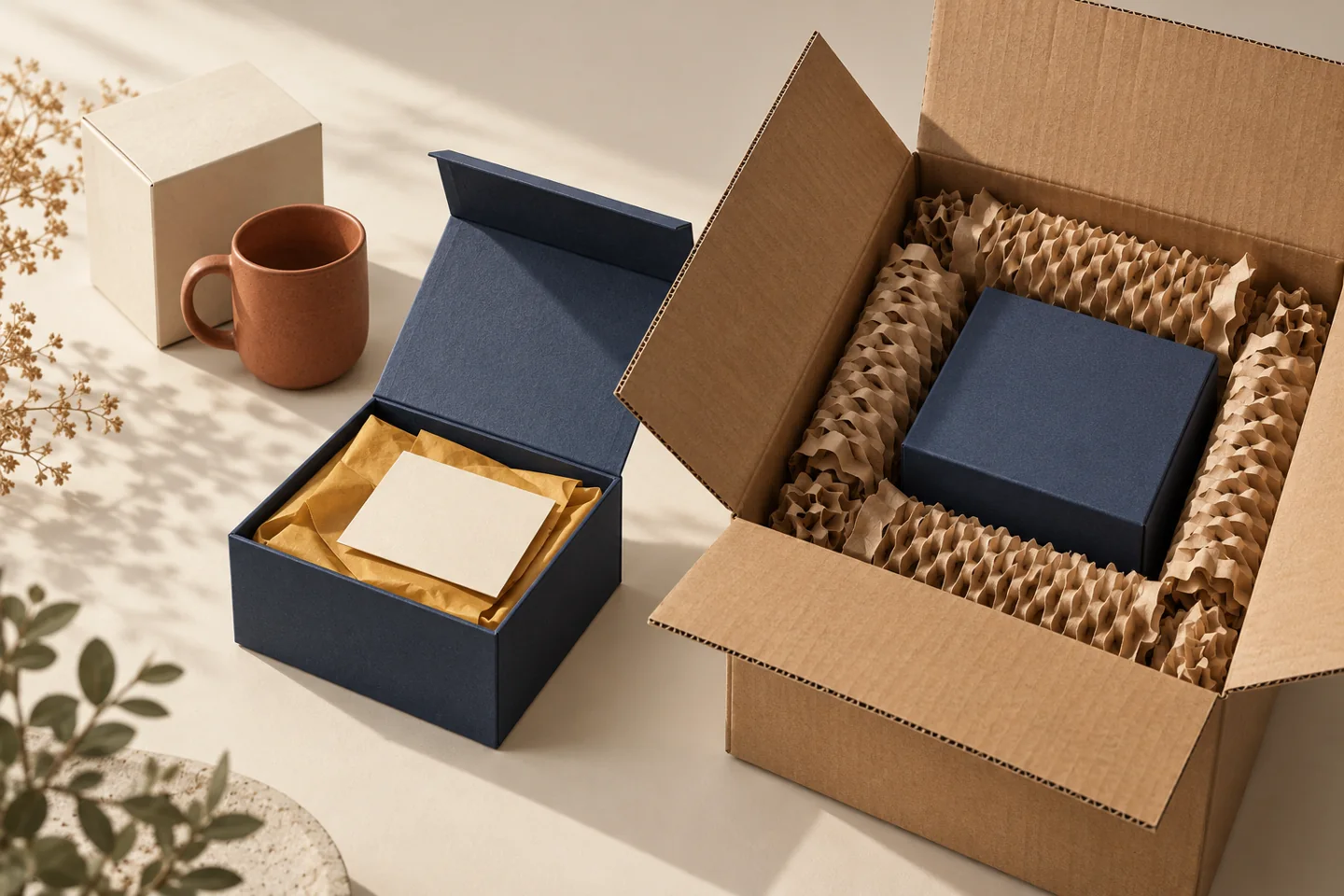
The editorial image above illustrates the layers; it is not a tested packing specification. For an actual order, require a packing photo or diagram showing the approved contents, inserts, cushioning, outer package and closure. The next person assembling the shipment should not have to interpret a mood board.
3. Give employee choice a packaging compatibility map
A single gift box can become an unnecessary restriction on the assortment. The bottle fits, but the backpack does not. The small sweatshirt fits, but a larger size needs a different fold or package. A replacement notebook is slightly wider than the fitted insert. These are reasons to design a few approved configurations, not reasons to limit employee choice silently.
Build a small map before invitations go out:
| Selection pattern | Packaging decision to confirm | Exception to resolve |
|---|---|---|
| One apparel item, multiple sizes | Approved package options across the full size range | The largest size does not fit without excessive compression |
| One fragile drinkware item | Product-specific protective configuration and any presentation layer | A different shape or handle invalidates the insert |
| Bag or backpack | Suitable transport package and optional note | Rigid gift box adds substantial volume without a useful presentation benefit |
| Mixed bundle | Separation and restraint for the actual combination | Hard items can move against softer or fragile items |
| Substitute product | Fresh fit and protection review | “Same category” gets mistaken for “same packaging” |
This map should name exact styles or approved groups of equivalent configurations. “All drinkware” is usually too broad to be a useful instruction. Include who approves a new combination and whether it can ship while a packaging decision is pending.
Choice and presentation can remain consistent without making every physical box identical. A shared note, color treatment or message can connect different configurations. Use the company-store assortment framework to decide what belongs in the collection before making packaging the constraint that decides for you.
4. Compare the packed shipment, not just the box price
Request two complete quotes: the simplest approved protective configuration and the proposed presentation upgrade. Hold the merchandise, destination assumptions and service level constant. Include packaging setup, unit materials, inbound freight, receiving, storage, assembly, outbound delivery and the treatment of unused custom stock.
The external dimensions matter. FedEx explains dimensional weight as a space-based measure and states that shipments are charged using the greater of dimensional or actual weight. Its published U.S. explanation uses length × width × height in inches divided by 139. Obtain a current shipment quote under the actual account and service terms rather than treating that formula as the entire rate calculation.
Illustrative volume comparison—not a shipping quote: suppose two already-approved configurations for the same non-fragile gift have outside dimensions of 12 × 10 × 6 inches and 16 × 12 × 8 inches. Their volumes are 720 and 1,536 cubic inches. Dividing by 139 gives approximately 5.18 and 11.05 dimensional pounds before applicable billing rounding. The larger package occupies more than twice the volume, even if the merchandise weighs the same.
This does not establish a dollar saving or mean the smaller box is safe for a different product. Never remove required cushioning to reach a preferred rate. Ask the fulfillment partner to quote the finished samples, including actual packed weight and any applicable surcharges, then decide whether the presentation upgrade earns its total cost.
Separate fixed commitment from per-shipment cost. A custom insert purchase may be paid before any employee redeems a gift. Keep that cash commitment visible even if a spreadsheet spreads it over forecast orders. The swag-program cost guide provides the broader budget structure.
5. Choose a packaging model that matches the program
On-demand merchandise does not necessarily mean on-demand packaging. Ask whether branded boxes, cards or inserts must be purchased in advance, where they are stored, and who owns the remainder if the program changes. A no-inventory product arrangement can still create a packaging inventory obligation.
- Recurring, unpredictable selections: start by evaluating standard protective packages with a supported note or other light presentation element. Confirm which origins and product types can include it; do not assume every fulfillment location has the same materials.
- Fixed event or recognition cohort: bulk purchasing and assembly may be a good fit when quantities, contents and dates are known. Compare the cost and coordination of that approach with individual fulfillment.
- Hybrid program: keep ongoing employee-choice orders simple, while reserving custom presentation for a defined milestone or campaign with its own quantity and stock owner.
A dated campaign box is especially sensitive to leftovers. Before approving it, decide what happens if fewer people select the gift than forecast. Alternatives include a reusable program-neutral design, a smaller supported order quantity, or a standard box with a campaign-specific insert. These are options to quote, not universally available services.
If gifts originate from multiple facilities, the box design cannot by itself make them arrive together. Resolve the separate one-box versus separate-shipment decision before promising a single reveal.
6. Approve a packed sample and preserve the recipe
An empty-box proof can approve artwork, but it cannot approve the complete shipment. Review a sample containing the finished merchandise, all included parts and the proposed packing materials. Check both the opening experience and the packer's ability to reproduce the configuration.
Use this release record:
- Contents: exact product, variant, decoration and accessories.
- Configuration: packaging references, dimensions, inserts, cushioning and closure method.
- Route: fulfillment origin, intended shipping service and delivery pattern.
- Presentation: artwork version, note, opening sequence and condition expected on arrival.
- Evidence: sample photos, packed weight, measured external dimensions and applicable protection review or test report.
- Ownership: packer, approver, packaging stock owner and person authorized to approve changes.
- Release conditions: permitted substitutions, reorder trigger and stop-ship conditions.
For a fragile, high-value or repeated program, discuss formal transport testing with a qualified packaging specialist. ISTA's procedure overview identifies Procedure 3A for individual packaged products moving through parcel delivery at 150 pounds or less. The appropriate procedure depends on the distribution environment; do not assume a box supplier's general claim covers your decorated product and complete configuration.
A sample mailed to a colleague can reveal practical issues, but one successful delivery is not equivalent to a laboratory test or proof that damage cannot occur. Record what was actually evaluated. If the item, insert, box or route changes, have the responsible specialist decide whether the previous evidence still applies.
7. Monitor packaging failures separately from product failures
Ask support to distinguish a damaged outer carton, a spoiled gift presentation, a damaged product and a missing component. Those outcomes call for different remedies. An intact product inside a badly scuffed presentation box is not the same issue as a broken handle, even if both disappoint the recipient.
Keep the configuration version with the order record so the team can identify whether one box size, substitute item or packing method is involved. Review actual replacement and handling costs alongside the initial quote. Do not turn a few anecdotes into a claimed damage-rate improvement.
The release decision is straightforward: approve the least complicated configuration that protects the selected gift, preserves necessary information and delivers the intended experience. Spend on presentation when its purpose is clear and its full operating requirements are understood.
Frequently asked questions
Can we put the shipping label directly on a gift box?
Only if that exact package is suitable as the transport package for its contents and route. Decide whether visible labels, tape and transit marks are acceptable parts of the presentation. If not, evaluate an outer carton rather than expecting the decorative surface to arrive untouched.
Does every employee gift need double-boxing?
No. The right arrangement depends on the product and protective design. Fragile items warrant particular attention to carrier guidance and packaging review; durable apparel and a ceramic mug should not automatically share one packing method.
Is a custom box compatible with a no-inventory company store?
Potentially, but ask about minimum purchases, storage, assembly locations, replenishment and leftover ownership. The merchandise production model does not answer those packaging questions.
Should every employee selection get the same premium presentation?
Use a consistent standard of care, not necessarily an identical box. Different items may need different protective configurations. Keep the message coherent and explain any selection-specific presentation differences before employees order.