Approve dishwasher-safe company drinkware only when the care instructions cover the exact finished product: body, lid, removable parts and applied decoration. A manufacturer's statement about an undecorated bottle is useful evidence, but it is not permission to attach any logo treatment and repeat the same claim. Ask the seller to resolve the complete care specification before employees order.
For a company-store buyer, this is a release decision rather than a cleaning tip. You are deciding what the product page may promise, what instructions arrive with the gift and which combinations belong in the assortment. The goal is one understandable care routine that the supplied product actually supports.
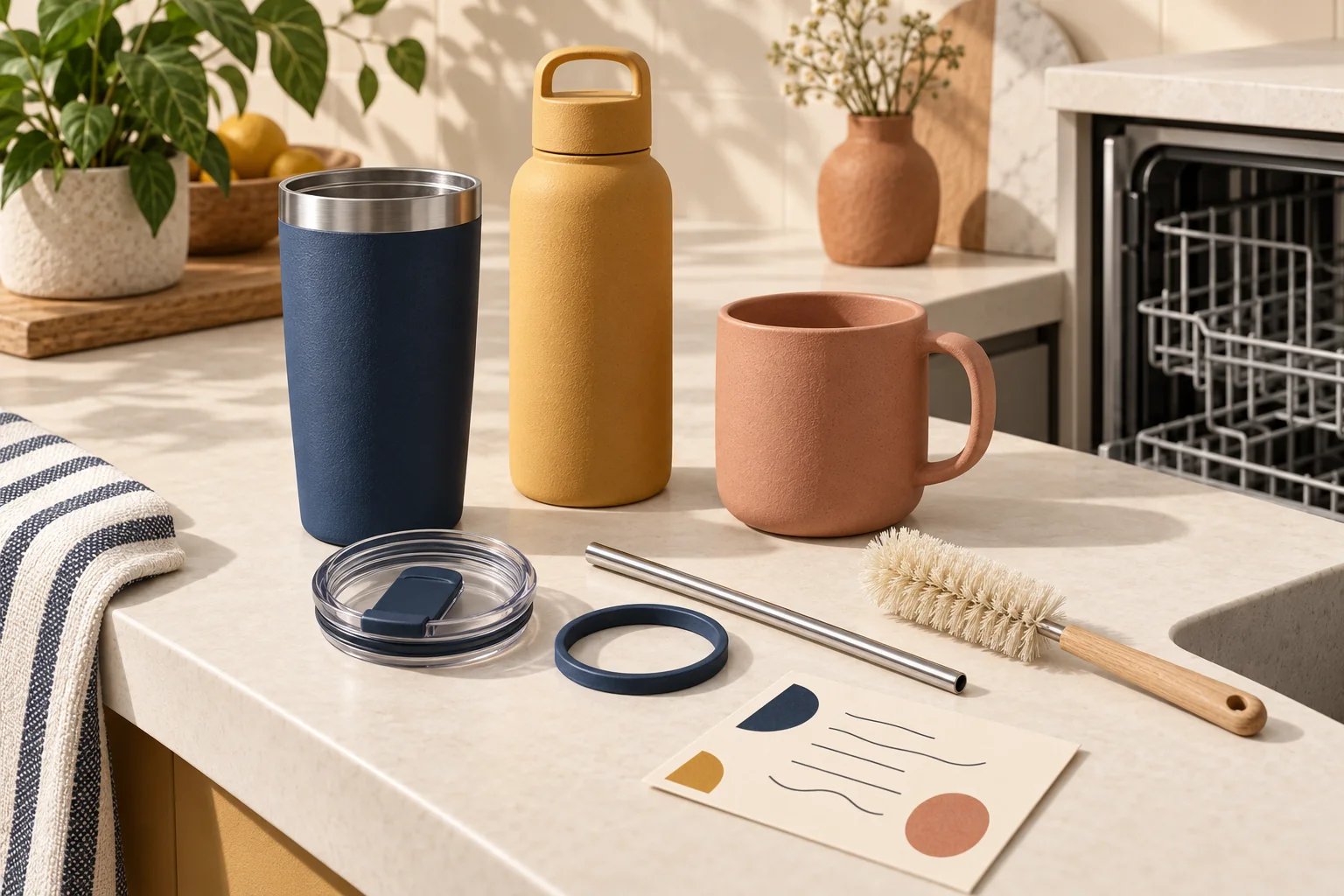
Brand Sauce publishes this guide from a company-store provider's perspective. Manufacturer examples were checked October 4, 2026; they illustrate differences, not a ranking, hands-on test or claim of Brand Sauce availability. The hero is a conceptual illustration, not a photograph of the named products.
Approve a combination, not a material
“Stainless steel,” “insulated” and “premium” are not complete washing instructions. Neither is “laser engraved” or “full color.” A purchase specification needs to identify the vessel, finish, decoration and accessories that will actually ship. Otherwise, a substitution can quietly change the answer while the company-store page keeps displaying the original care badge.
Our recommended record has five parts. Keep the evidence attached to the order specification rather than relying on a salesperson's recollection.
| Part of the supplied gift | Record before approval | Unresolved question that blocks the claim |
|---|---|---|
| Body | Manufacturer, model, capacity and product generation | Does the cited instruction apply to this model? |
| Exterior finish | Exact color or finish code | Are special finishes treated differently? |
| Decoration | Decorator, process, artwork version and placement | Does the finished decoration share the body’s care approval? |
| Lid and small parts | Supplied cap, straw, gasket and accessories | Which parts must be separated or washed differently? |
| Recipient instructions | Approved insert and matching product-page copy | Can the recipient follow one consistent instruction set? |
If artwork appearance is still undecided, use our laser engraving versus color printing guide first. Here, the question is narrower: once the design is chosen, what evidence permits the care claim?
Three manufacturer examples show why scope matters
YETI's U.S. Rambler FAQ states that Rambler drinkware is dishwasher-safe and gives different placement instructions for bodies, lids or caps, and gaskets. It also directs users to remove gaskets for thorough cleaning and dry them separately before reassembly. That is more useful than a single dishwasher icon: the components have a procedure. Apply the instructions to the identified product, and obtain confirmation for any separately applied decoration.
Hydro Flask's U.S. cleaning guide distinguishes eligible bottles and tumblers from Trail Series bottles and older products identified by a trademark symbol beside the logo. It also describes mugs as hand-wash products. The procurement lesson is to identify the actual model and generation; a brand-wide assumption can be wrong. An old stockroom bottle and a new purchase should not automatically share one care card.
Tervis's Traveler stainless-steel care page specifically connects its DuraPrint technology with protecting printed designs and dishwasher suitability. This is an example of a manufacturer addressing the decoration as part of the product system. It does not establish that every printed stainless-steel cup, every Tervis line or a third party's additional decoration has the same approval.
These examples are not a shopping shortlist. Obtain a current quote and confirm model, decoration, availability and destination before selecting products for your own program. Where a supplier's product page, carton insert and manufacturer instructions disagree, ask for a written resolution tied to the supplied item. Do not choose whichever sentence is most convenient.
Choose the store's care policy before choosing the cup
Make washing convenience an assortment criterion, alongside appearance and capacity. A product can be well made and still be a poor fit for a program whose recipients expect to put everything in a dishwasher.
| Program context | Recommended buying requirement | Tradeoff to accept explicitly |
|---|---|---|
| Office gifts intended for routine machine washing | Written approval for the finished configuration and understandable component instructions | A narrower assortment or different artwork treatment |
| Employee-choice collection with varied preferences | Care requirement visible before selection, with a suitable alternative | Different items may need different care routines |
| Special-design keepsake selected for its appearance | Clearly stated hand-wash instructions if required | Convenience is exchanged for the chosen design |
| Shared workplace drinkware washed by facilities staff | Approval for the actual equipment and procedure the workplace uses | Consumer product guidance may not answer the operational brief |
For the last case, do not infer approval for commercial equipment from an unqualified consumer dishwasher statement. Describe the equipment and cycle to the supplier and request an answer. If that answer is unavailable, choose a different item or keep the product out of that shared washing system.
Hand-wash-only is not automatically a rejection. It is a disclosed product constraint. The failure is presenting a convenience-oriented gift and revealing its extra care requirement only after delivery. Care also complements, rather than replaces, the lid and transport requirements for employee drinkware.
Use a six-question supplier approval record
Send the same questions with each shortlisted configuration. A useful response identifies what is known, what is excluded and what still needs confirmation. A generic catalog screenshot should not close an unresolved decoration question.
- What exact item will ship? Record the model, capacity, finish, lid, accessories and any permitted substitutions.
- Who applies the company artwork? Identify the decorating party and process, including additional names or second-side marks.
- What washing instructions cover the finished item? Ask for written confirmation, source date and any component-specific restrictions.
- What conditions limit the claim? Record specified rack placement, cycle or temperature restrictions, cleaning products to avoid and disassembly steps. Do not invent conditions that the supplier has not provided.
- What evidence supports those instructions? Distinguish manufacturer documentation, decorator confirmation and any test report. For a report, ask which product and process were evaluated and what the result actually establishes.
- What happens if the delivered item differs? Require reapproval before replacing the model, finish, lid or decoration process. Identify who corrects mismatched care copy.
Use a short decision line at the bottom: approved for the stated routine / approved with clearly disclosed hand washing / unresolved, do not list yet. Include the approver, date and evidence location. “Probably fine” is not a fourth status.
Keep service commitments separate. A washing instruction tells the recipient how to care for the item; it does not, on its own, promise a replacement for every mark or failure. Our branded gift warranty and support guide covers the different product and decoration responsibilities.
Review a decorated sample without inventing a certification
A sample helps you check whether the supplied instructions are usable and whether the delivered configuration matches the specification. It cannot establish years of durability simply because it looks good after one wash.
First photograph the sample, including the base identifier, lid parts and decoration. Compare it with the approved configuration. Then read the included care instructions as an employee would. Can you tell what comes apart, which pieces go where and how to reassemble them? If a component requires a diagram, include the manufacturer's relevant instructions rather than leaving recipients to guess.
If you perform a practical wash check, follow the approved instructions and record the actual machine, selected cycle, detergent, rack positions and number of cycles. Note visible changes to the finish, artwork and parts, as well as any difficulty using the item afterward. Keep an unwashed comparison sample when useful.
Call this a buyer's sample observation, not a certified dishwasher test. Do not translate five observed cycles into a five-year lifespan, a failure-rate estimate or a blanket claim about every unit. If the purchasing requirement specifies documented durability testing, request relevant evidence from the supplier or arrange appropriate testing; a staff member's kitchen trial does not replace it.
An illustrative approval decision
Hypothetical scenario—not a Brand Sauce customer result or a product recommendation. An employer wants one drinkware choice for a recurring welcome program. The brief requires a machine-washable finished gift because that is how the intended recipients expect to clean it.
- Option A: the body has manufacturer dishwasher instructions, but the proposed decorator has not confirmed the added print. Keep the listing on hold; the attractive mockup does not resolve the care requirement.
- Option B: the supplier confirms the exact body, decoration and lid combination for the specified routine. The sample and care insert match. Approve that configuration, with substitutions subject to review.
- Option C: the supplier clearly specifies hand washing. It may suit a separate choice collection, but it does not satisfy this particular welcome-program brief.
The buyer has not declared one decoration method universally better. The decision follows the requirement and evidence. If Option B exceeds the available budget, change the assortment, artwork or brief openly; do not silently relabel Option A.
Publish the care rule where the choice happens
Put the resolved care instruction beside the product description, not solely behind a general FAQ. State whether it applies to the decorated item. Include a matching insert or accessible instruction link with the shipment. Avoid a store-wide dishwasher-safe badge when individual products differ.
For an ongoing store, retain the approved configuration and evidence date in the product record. Recheck when the supplier changes the blank, finish, decoration process or lid. Archive earlier instructions so support can identify what an employee actually received rather than applying today's guidance to an older order.
The production model does not remove this work. On-demand fulfillment can accommodate recurring individual selections, but each offered configuration still needs approval. A bulk order can make sense for a fixed event with one approved item and known quantities. A hybrid program can keep that event item separate from the always-on assortment. Choose the order model around timing, demand and complete costs—not an assumption that one method always produces better care performance.
Drinkware care approval FAQs
Does laser engraving automatically make a bottle dishwasher-safe?
No. A decoration method does not establish the care suitability of the body, coating, lid and accessories. Approve the complete configuration using the applicable manufacturer guidance and decorator confirmation.
Does full-color printing always mean hand washing?
No. Some manufacturers expressly support dishwasher use for particular printed product systems, as the Tervis example shows. That permission is specific; it cannot be transferred to an unrelated printed cup.
What if the packaging says hand wash but the store says dishwasher-safe?
Pause the dishwasher claim and ask the seller to resolve the discrepancy for that exact item. Correct the listing and instructions together. Do not tell recipients to disregard the supplied care label based on a general brand page.
What is the minimum useful approval record?
The exact item and decoration, written finished-product care instructions, evidence source, review date and an owner for changes. Add the sample record and recipient copy so the purchase decision, delivered gift and public promise stay aligned.