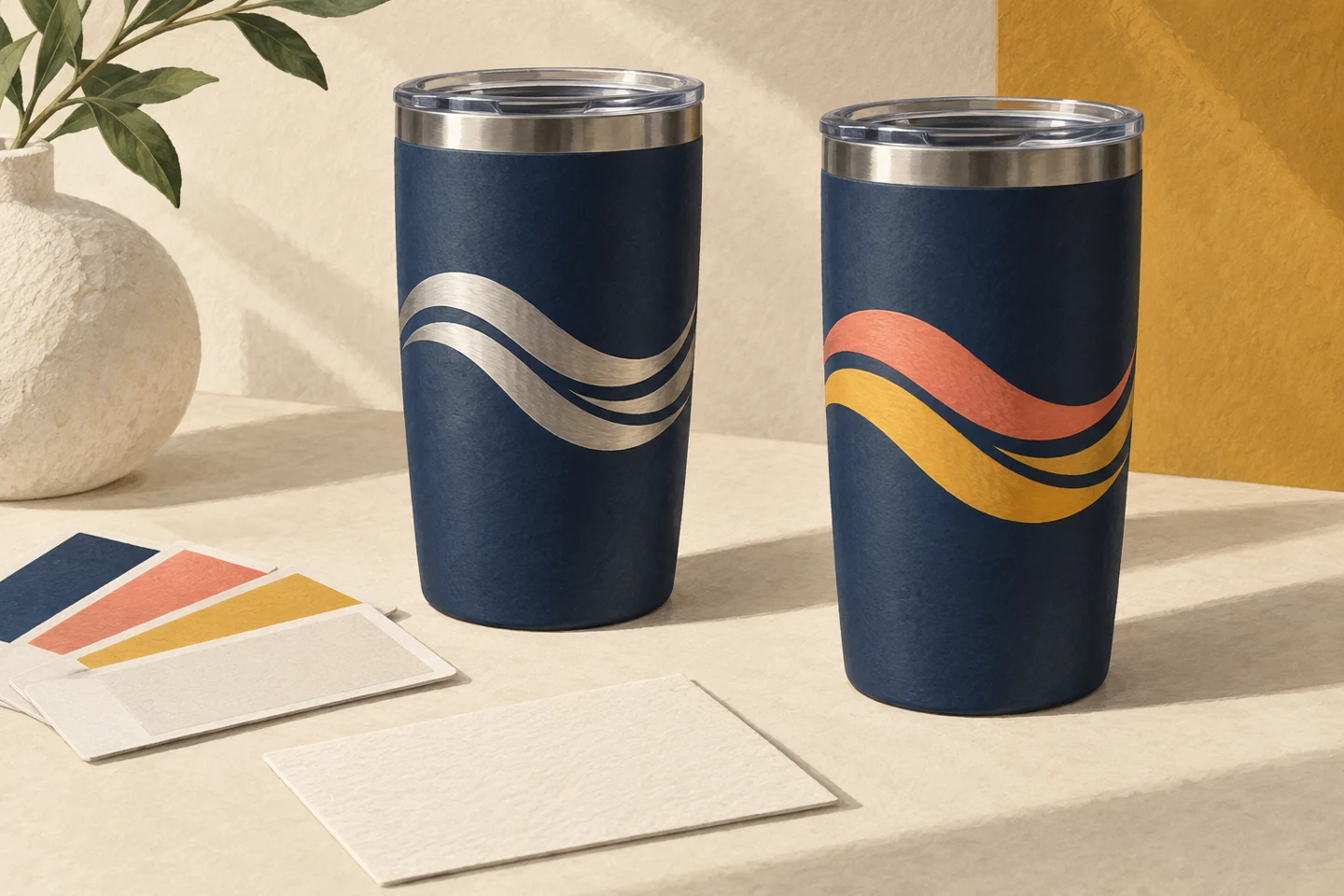
Choose laser engraving when an approved one-tone mark suits the gift. Choose color printing when the artwork needs brand colors, a gradient or an illustration. In either case, approve the exact decorated product—not just a method name—because appearance, washing instructions, imprint area and reorder options depend on the blank and the supplier's process.
A navy tumbler with a silver mark and a white tumbler with a multicolor design can both be good company gifts. They solve different visual problems. The wrong decision is to promise a full-color identity through a process that removes a coating, or to assume that any decoration on stainless steel is dishwasher-safe.
Publisher perspective: Brand Sauce provides company-store services. This is an editorial buying framework, not a claim that every method or example is available through our stores. Manufacturer and decorator examples were checked October 2, 2026; obtain a current quote for the exact product, destination and order pattern.
First, unpack what the supplier means by “engraved” or “printed”
These words describe families of processes, not identical results. Ask the supplier to name the process and show the finish on your chosen color.
For example, Epilog's drinkware engraving guidance describes removing powder coating to expose stainless steel beneath it. That creates contrast through the underlying material, not by applying your chosen ink color. The equipment manufacturer also distinguishes this from marking bare metal with a fiber laser.
YETI's U.S. corporate drinkware FAQ gives a concrete product-program example: black laser marking on its stainless line and ablation on its DuraCoat color line. The latter removes color to reveal the metal below. A colored vessel therefore does not mean a full-color logo. These are YETI's stated options, not a rule for every decorator or every country.
For a different process, Printful's Stainless Steel Tumbler listing specifies UV printing: inkjet-applied artwork cured using ultraviolet light. It also specifies a protective varnish layer and hand-washing only. This is a useful example of why “printed stainless steel” is not a complete specification.
If a quote says only “full color,” ask whether it means direct UV printing, sublimation, a transfer or another process. Do not apply the sample, care instructions or color expectations from one process to another without confirmation.
Choose by the requirement you cannot compromise
| Your non-negotiable requirement | Route to investigate first | Approval question |
|---|---|---|
| A restrained, single-tone logo | Laser engraving or marking | Does the actual finish have enough contrast on this vessel color? |
| Several logo colors or a full illustration | A compatible color-printing process | Can the supplier reproduce the artwork on this exact blank and show a physical sample? |
| Mandatory brand-color fidelity | Color printing with a documented approval standard | What matching method and tolerance will the supplier accept? |
| Dishwasher use is essential | Only a finished-product combination explicitly approved for it | Do the body, decoration and removable components have compatible instructions? |
| An employee name on each item | A supplier offering controlled variable personalization | Who checks spelling, character support and name-to-order matching? |
| One item at a time throughout the year | A confirmed small-order workflow for the selected method | Will later orders use the same blank, artwork and finish? |
Use the table as a shortlist filter, not a quality ranking. A vivid printed design may be a better gift than an elegant engraved logo that no longer looks like your brand. Conversely, forcing a complex campaign graphic onto a small drinkware panel can make a simpler approved mark the more readable choice.
Approve the artwork translation before choosing vessel colors
Ask the brand owner for two usable artwork versions: the preferred color design and an approved one-tone alternative. The second must be a deliberate adaptation. Automatically converting a multicolor logo to one shade can merge shapes that depended on color to remain distinct.
Review the smallest lettering, thin lines, enclosed spaces and fine details at the proposed physical size. Do not judge from a zoomed-in screen. Request an actual-size proof with measurements and ask the decorator to identify anything below its production limits. There is no useful universal minimum letter size for every machine, material and artwork combination.
For engraving, clarify the expected mark color and surface appearance. “Silver” in a mockup is a visual shorthand, not a metallic ink specification. Ask for a sample on the intended coating color; approving black and then ordering pale gray may change how visible the mark feels.
For printing, ask how the supplier handles the background, white areas and any needed underbase. Confirm whether quoted color matching is process-color reproduction, a spot-color system or simply a visual approximation. Our brand-color consistency guide explains how to keep approvals tied to physical materials instead of treating a screen value as a universal match.
Specify the view, not just the imprint dimensions
A tall narrow mark can fit a template but still look awkward when someone holds the cup. A wrap can look complete in a flat proof while placing important details near a join or outside the normal front view. Handles, taper and existing manufacturer marks also affect the usable composition.
Ask for front, back and side views that identify the lid opening or handle orientation where relevant. If the tumbler has a handle, decide which outward-facing view matters and whether a two-sided design is worth quoting. Do not assume “front” means the same thing to the designer, factory and recipient.
Keep the functional choice separate. A beautiful decoration does not make a straw lid appropriate for carrying loose in a laptop bag. Select the vessel using the drinkware lids and everyday-use guide, then evaluate the branding within that shortlist.
Treat care and durability as product-specific questions
Removing a coating and depositing a printed image create different surfaces. That does not establish a universal lifespan ranking across all drinkware. A supplier's description of a permanent mark is not proof that the entire vessel, seal and lid tolerate every cleaning method.
Request written care instructions for the finished decorated item and identify any differences from the undecorated blank. If the supplier's page and the product manufacturer's instructions appear inconsistent, resolve the discrepancy before approving the order. Do not simply publish whichever instruction is more convenient for employees.
Build a sample check around permitted everyday use. Photograph the new sample, handle it normally and clean it according to the supplied instructions. Look for changes in readability, edges, finish and overall appearance. Agree on the evaluation period before testing. This is a purchasing acceptance check, not a laboratory durability claim or a promise about years of service.
If an office requires dishwasher-compatible gifts, make that an entry requirement. Do not choose a hand-wash-only printed model and rely on a small care card to fix the mismatch. If recipients willingly prefer the color design and accept hand-washing, printing remains a legitimate option.
Compare complete decorated-item quotes
Neither engraving nor printing is automatically cheaper. Compare proposals for the same quantity, destination pattern and approval scope. If the blanks differ, acknowledge that you are comparing two finished gifts, not isolating the cost of decoration.
Ask each supplier to separate or explicitly include:
- The exact blank, color, capacity and lid configuration.
- Artwork preparation, setup and physical sample costs.
- The number of decoration locations and any wrap or oversized-art charges.
- Per-name personalization, proofing and correction responsibility.
- Packaging, shipping, tax and any storage or pick-and-pack services.
- Minimum quantity, repeat-order pricing and charges for changing artwork.
- Production timing measured from the stated approval or payment milestone.
Illustrative calculation, not supplier pricing: suppose one proposal charges $24 per finished cup plus $120 in setup, while another charges $27 per cup with setup included. Before shipping and tax, 40 cups cost $1,080 either way: 40 × $24 + $120 versus 40 × $27. At 10 cups, the totals are $360 and $270. At 100 cups, they are $2,520 and $2,700.
This does not tell you which decoration process wins. It shows why a lower unit figure can be misleading when order size changes. Replace every assumed number with an actual quote, then include fulfillment and samples. Do not spread an initial setup charge across future purchases unless the supplier confirms how reorders are priced.
Choose bulk, on-demand or hybrid separately from decoration
A predictable event with one design and one delivery address may favor a bulk run. The buyer can approve a production sample, consolidate freight and inspect items before handout. The tradeoff is ownership of leftovers and the work of storing or distributing them.
An ongoing recognition program with uncertain participation may favor ordering after employees select their gift. That reduces the need to guess demand, but only if the exact blank and decoration process are available at the required order size. Individual delivery, repeated setup and production timing still belong in the comparison.
A hybrid can reserve a bulk run for an annual event and maintain an approved on-demand option for late arrivals or later hires. Do not describe the two items as identical unless they really are. If the replenishment route changes the blank or decoration, show it as an approved alternative and obtain a separate sample.
For more on the economic and operational tradeoffs, use our on-demand versus bulk decision guide. Decoration is one input to that decision, not a reason to predetermine it.
A seven-point approval card for your next order
Save this information alongside the purchase order so a future buyer can reproduce the decision:
- Product identity: manufacturer or supplier, exact model, color and components.
- Decoration identity: named process, number of locations and approved artwork version.
- Appearance: physical sample reference, mark color or color target, size and placement.
- Care: written instructions for the finished item and a plan to show them before selection.
- Personalization: approved text source, character limitations, proof owner and correction policy.
- Commercial scope: delivered quote, minimums, schedule, packaging and replacement route.
- Reorder rule: what can be repeated without approval and which substitutions require a new sample.
Assign a brand approver and a purchasing approver. The first signs off on representation; the second confirms the order, delivery and support terms. A mockup approved by marketing should not silently become acceptance of an unknown care requirement or shipping arrangement.
Frequently asked questions
Can a laser-engraved tumbler reproduce our full-color logo?
Do not assume so. Coating-removal engraving typically reveals the material underneath rather than applying the logo's colors. Ask about the exact offered process. If multiple colors are essential, evaluate a compatible printing option and approve a physical sample.
Is engraved drinkware always dishwasher-safe?
No blanket rule is reliable. Confirm care for the whole decorated product, including its lid and seals. A durable mark does not override the vessel manufacturer's cleaning instructions.
Should employee names use the same method as the company logo?
They can, but ask the supplier to quote and prove the complete combination. Confirm spelling, character support, placement and how each personalized item reaches the correct recipient. Adding names changes the approval and fulfillment work, even when the decoration method stays the same.
What should we send Brand Sauce to start a drinkware brief?
Send the preferred vessel style, color and one-tone artwork options, required care standard, quantity, destinations and timing. For a recurring program, include the expected order pattern. Our managed company-store service is a place to discuss curation and ordering; exact products, methods, country availability and prices need confirmation in the proposal.