Approve embroidered company apparel from the inside as well as the front. Ask for the exact garment with the proposed stabilizer, trimming and any soft cover in place; then evaluate contact, movement and care. Visible backing is not automatically a defect, and removing it is not automatically an improvement.
A neat chest logo answers the brand team's question. It does not answer the wearer's question: what will touch me all afternoon? For a company store, that second question deserves its own release decision, especially when employees choose lightweight polos or shirts they intend to wear without another layer.
Publisher perspective: Brand Sauce publishes this buying guide. These are recommended approval requirements, not claims about a universal Brand Sauce finishing process. Confirm the exact garment, decoration route, country availability and finishing options with your supplier. Samples, additional finishing and delivered prices are quote-needed. Manufacturer references were checked November 1, 2026; the hero is a conceptual AI-generated illustration, not a photograph of tested merchandise.
Backing and a soft cover solve different problems
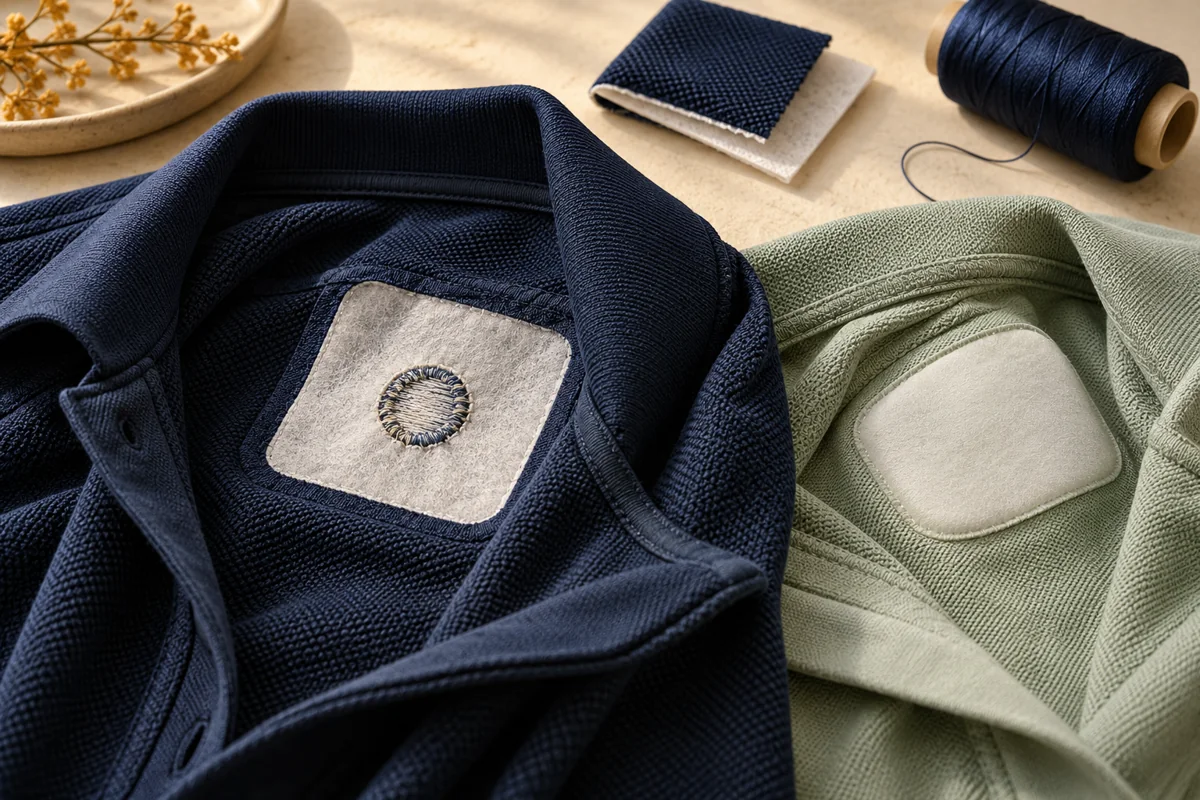
The stabilizer helps support the embroidery. A cover, when specified, provides a different surface over its reverse. Do not use “soft backing” as shorthand for both: the decorator may understand it as a request to change the stabilizer, while the buyer expects a separate finishing layer.
Madeira USA's backing overview distinguishes cut-away materials that remain with the garment from tear-away options commonly used with stable woven fabrics. It identifies fabric stability, design density and laundering among the selection considerations. Its performance range also includes thin cut-away options for lightweight stretchy garments. The practical implication is to ask for a fabric-and-design-specific recommendation, not to demand that all backing disappear.
A separate covering product is another possible route. Sulky describes Tender Touch as a permanent, lightweight iron-on material for covering the reverse of embroidery. That establishes a product category worth discussing; it does not establish that every embroidered polo needs it or that it will suit every wearer.
Heat application also creates a compatibility question. Madeira's Comfort Wear instructions require testing with the actual fabric and equipment and checking that the garment tolerates the application temperature. Let the decorator establish the process. A buyer should not copy a setting from one material's instructions and apply it to a different cover or garment.
Choose a response to the actual problem
Start with the observation, not a predetermined remedy. “The embroidery is uncomfortable” can describe an exposed thread end, a rough perimeter, a stiff area or a decoration location that repeatedly contacts the body. A cover may address one observation without solving another.
| Sample observation | Request from the decorator | Evidence before release |
|---|---|---|
| Backing is visible, but the garment feels comfortable | Explain its function and intended finished outline | Approved inside photograph and acceptable wear/care review |
| A particular edge or thread end catches during movement | Review trimming and finishing at that exact location | Corrected finished sample, not just a promise to tidy production |
| The decorated area feels too stiff | Review the design, garment and support combination | Comparison sample with the proposed change identified |
| The reverse feels uncomfortable against the intended wearing layer | Assess a compatible soft cover or another decoration placement | Finished sample after agreed care, plus wearer feedback |
| A cover edge lifts after washing | Investigate the material, application and care combination | Revised sample that passes the agreed review |
| One wearer still dislikes an otherwise accepted finish | Offer a suitable alternative item or decoration | A choice that does not require the wearer to alter the garment |
These are procurement decisions, not instructions to operate an embroidery machine. Do not ask employees to cut away support, trim close to stitches or iron on an improvised patch. Return the issue to the production partner with photographs and the order reference. If the team is reconsidering decoration altogether, use our embroidery versus printing guide to compare the broader options.
Request a comparable sample, not a loose patch
A small material swatch can help explain a proposed cover. It cannot demonstrate the complete inside finish on a shirt. Request the actual garment style and color with the proposed logo dimensions, placement, stitch design and finishing sequence. Identify any difference between the sample and the production proposal before review.
For a useful comparison, change one meaningful variable at a time. If the first sample is a lightweight polo and the second is a thick sweatshirt with a smaller logo, a comfort preference does not tell you whether the cover helped. A better comparison keeps the polo and logo constant while showing the proposed finishing change.
Ask the supplier to label samples with neutral references such as A and B and provide the specifications separately. Have reviewers describe what they notice before reading which version costs more. This is a practical way to keep a purchasing discussion focused on the finished garment rather than the assumed value of an upgrade.
Record the intended wearing arrangement. A jacket normally worn over a shirt presents a different contact situation from a polo worn directly against the body. Neither is a universal shortcut: review the proposed use rather than accepting “nobody will feel that” as the test result.
Run a contact, movement and care review
Use the following sequence as an internal approval protocol. It is not a laboratory method, a medical assessment or a standardized durability certification. Agree on the scope with the supplier and stop a wearer review if the person finds the garment uncomfortable.
- Inspect both faces before wear. Photograph the front and reverse in ordinary light. Note backing shape, exposed ends, cover edges and any visible distortion. Preserve one unwashed reference when the sample budget permits.
- Try the intended wearing arrangement. Ask willing reviewers to use the item with the layer they would ordinarily wear beneath it. Do not require personal health information; ask about the garment experience.
- Check ordinary movement. Sitting, reaching and walking may reveal contact that a flat-table inspection misses. Record the movement and location associated with the concern rather than simply assigning a star rating.
- Follow the agreed finished-item care instructions. Have the supplier reconcile the garment and decoration requirements. Record what was actually done, including drying, so the comparison is repeatable.
- Review again after care. Compare the inside edges, cover attachment, fabric shape and wearing feel with the original observations. A smooth new sample is not the whole approval.
- Close each concern explicitly. Accept the configuration, request a specific correction or select another option. Do not convert “we received the sample” into production approval.
Choose the number of wear and wash reviews according to the program's use, timeline and risk. One satisfactory wash is useful evidence about that sample, not proof of a garment's lifetime performance. Equally, an elaborate testing plan that nobody completes is not a better release gate. Define a realistic review, finish it and state its limits.
Keep this inside-finish check alongside the broader branded-apparel sample approval process. The logo still needs to look right. Improving the reverse should not silently approve a different front appearance, fit or care requirement.
Use an inside-finish approval card
The record should let a future buyer distinguish “the same polo” from the same finished configuration. Store it with the approved sample photographs and production reference, not solely in a buyer's inbox.
| Field | What to record |
|---|---|
| Application | Garment style/color, decoration placement, logo size and artwork revision |
| Structural support | Supplier's stabilizer identification and agreed finished appearance |
| Additional cover | Material identification, color and coverage, or explicitly none |
| Use and care | Intended wearing layer, finished-item instructions and review performed |
| Evidence | Front/reverse photographs, dated observations and retained sample location |
| Release | Named approver, accepted configuration, unresolved exclusions and revision date |
Useful purchase wording is: “Supply the inside finish shown in approved sample B and its attached specification. Do not substitute the stabilizer or optional covering material without review. Provide finished-item care instructions and identify any production route that cannot reproduce this configuration.” Ask the supplier to confirm this wording is achievable before attaching it to a purchase order.
Illustrative example: A consulting firm compares two otherwise identical navy polos. Reviewers accept the front of both, but one reports an uncomfortable edge on sample A. Sample B uses the supplier's proposed finishing revision. The buyer checks B after the agreed care cycle and approves that specific version, while keeping an alternative garment available. This is a hypothetical decision sequence, not a client result or evidence that one finish works for everyone.
Keep bulk and individual reorders consistent
Ask whether the extra finishing step is available through both the initial production route and future one-item orders. An approved launch batch does not establish that a different fulfillment partner will reproduce it. If routes differ, require a sample or other explicitly agreed acceptance evidence for each.
Bulk can be sensible when a known team needs the same approved configuration by a shared date and the supplier can execute the finishing consistently. On-demand can fit uncertain sizes and recurring individual needs when that exact configuration is supported. A hybrid might use a planned batch for a launch and an approved individual-order route afterward. None is automatically cheaper or more comfortable.
Compare complete quotes: garment, decoration, additional finishing, samples, freight and any minimum quantities. If a covered version cannot be reordered individually, decide whether to hold a limited finished reserve, select a different compatible item or use another approved method. Do not leave that decision to the employee who orders six months later. Our embroidery production-file handoff guide covers the complementary record needed to preserve the design itself.
Frequently asked questions
Should embroidered polos have no backing left inside?
Not necessarily. Some support materials are intended to remain. Ask the decorator to explain the selected configuration and approve its finished appearance and feel rather than treating absence of material as the quality standard.
Does every embroidered shirt need a soft cover?
No. Evaluate the actual garment and intended use. An additional cover is an option to assess when appropriate, not a universal requirement or a guaranteed solution to discomfort.
Can we promise that a covered logo will never irritate anyone?
No. Describe the verified finish without making a universal comfort or health promise. Maintain a practical alternative for people who do not want that item.
What if the sample is comfortable but a reorder is not?
Compare the order with the approved configuration and retained evidence. Ask the supplier to investigate differences in materials, finishing or production route. Resolve the specific issue before approving further affected orders.
The buying standard is a repeatable finished garment: acceptable on the front, acceptable on the inside and supported by a care-and-reorder plan. Turn the sample over before you sign it off.