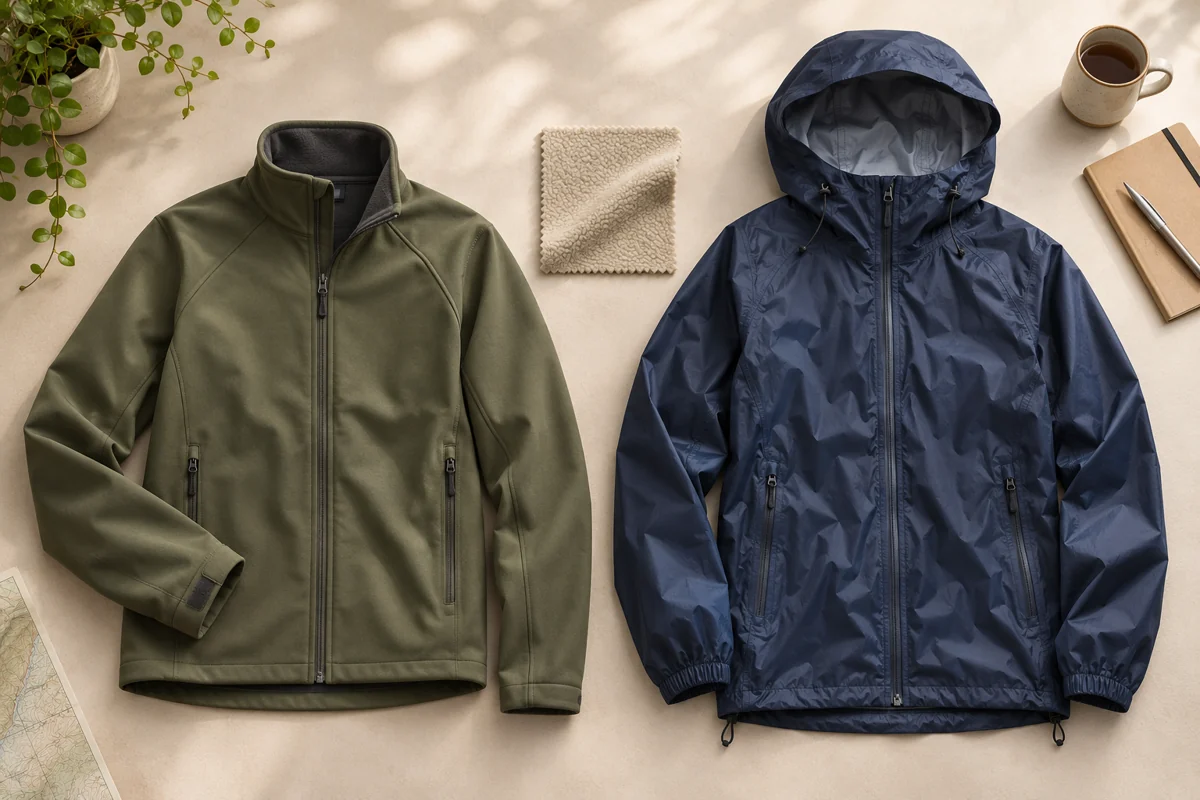
Choose a softshell when the main job is comfortable everyday wear in mostly dry conditions. Choose a verified waterproof rain shell when staying outside through rain is part of the brief. If employees have different needs, offer two clearly explained options instead of treating the more expensive jacket as a universal upgrade.
The important company-store decision is not which jacket wins an outdoor-gear contest. It is which promise you are making to the recipient: an easy daily layer, a rain barrier, or a coordinated layering system. A smart-looking softshell and a lightweight rain shell can both be good gifts while solving different problems.
Publisher perspective: Brand Sauce provides company-store services. This is an editorial buying framework, not a claim that every example is available through our stores. Manufacturer references were checked November 5, 2026. Exact style, size, color, destination, decoration and delivered pricing need confirmation; prices are quote-needed. The hero is conceptual imagery, not a photograph of the cited products.
Define the jacket’s job before choosing its construction
Write one sentence that describes the longest normal outdoor exposure, the activity and the clothing underneath. “A presentable layer for moving between office buildings over a shirt” is a different assignment from “a rain barrier for a walking commute over a winter midlayer.” Neither sentence requires a prestigious brand name to be useful.
Ask whether the wearer can simply go indoors when the weather changes. An optional lunchtime walk and a scheduled outdoor assignment have different consequences if the jacket is wrong. For required work clothing, have the responsible workplace owner define the specification; an employee-gift assortment should not quietly become the source of approved protective equipment.
| Recipient situation | Starting shortlist | Decision to resolve |
|---|---|---|
| Office-to-car and short building-to-building trips | Everyday softshell | Does it feel comfortable over normal office clothing? |
| Walking commute with unavoidable rain | Waterproof rain shell | Does the finished garment provide the specified coverage and room for layers? |
| Active outdoor recreation in mostly dry weather | Softshell, with a separate rain option if needed | Does the wearer prefer mobility and ventilation over a single weather barrier? |
| Mixed-climate employee gift program | Two role-based choices | Can employees understand the tradeoff without decoding technical ratings? |
| Cold, wet conditions | Rain shell plus an appropriate insulating layer, or a separately specified insulated jacket | Who is supplying the warmth as well as the rain protection? |
This table is a proposed selection framework, not a performance rating. Use the broader company-jacket climate and fit guide if you have not yet decided whether outerwear belongs in the assortment at all.
Read the specification, not just “soft” or “hard”
REI’s rainwear guide describes softshells as generally emphasizing stretch, breathability and movement, while hardshells emphasize waterproof/breathable protection. It also distinguishes surface water repellency from the barrier beneath it. Beading on the outside is not, by itself, proof that a finished jacket is waterproof.
Do not turn those category tendencies into absolute rules. Gore’s Soft GORE-TEX Shell Jacket concept document describes a construction combining a soft feel with waterproof weather protection. It is an example of why a buyer should inspect the exact construction rather than assume that a soft hand means limited protection. It is not evidence of current stock, a particular decorated style or country availability.
A concrete merchandising example is the Port Authority J317 Core Soft Shell. Its official description lists a water-resistant film insert, microfleece lining and a 1,000 mm fabric waterproof rating, while describing the jacket as wind-resistant and water-repellent. Those words should not be rewritten on a company-store card as “fully waterproof rain jacket.” A fabric measurement and a finished-garment promise are different kinds of information.
For each candidate, ask the supplier to identify the claim being made about the finished garment, including seams, closures and any decoration. Keep the original specification with the approval record. When two descriptions appear inconsistent, resolve the inconsistency before publishing the product card instead of choosing the stronger-sounding wording.
Separate weather protection from warmth
A rain barrier is not automatically an insulating gift. REI notes that an uninsulated hardshell relies on layers underneath for warmth. Conversely, a softshell with a fleece lining may fit an everyday-layer brief without replacing a dedicated rain jacket.
Build the outfit in the approval room. Ask sample wearers to bring the sort of shirt, sweater or midlayer they expect to use. Photograph the approved combination for the private buying record, and note the layers used. Approving the shell over a T-shirt and advertising it later as a winter layering piece leaves a gap in the evidence.
If the gift allowance covers only one item, explain that limitation plainly. “Uninsulated rain shell; choose your size with your usual layers in mind” is more useful than “all-season performance.” If employees need a warmer garment instead, a different product lane may be the right answer. Do not force that requirement into a shell comparison.
Build two useful choices, not a good-better ladder
For a mixed workforce, name the options by use rather than status. “Everyday layer” and “rain-ready outer layer” help recipients choose. “Standard jacket” and “premium jacket” encourage people to select the apparent reward tier even when it does not fit their routine.
Use the same product-card structure for both choices:
- Best suited to: one normal-use sentence.
- Weather claim: the supplier’s supported finished-garment description.
- Warmth: whether insulation or a lining is present and what must be supplied separately.
- Fit reference: the exact size chart and the layers used for sample approval.
- Practical details: hood, cuffs, pocket access and storage format.
- Care and branding: instructions approved for the finished decorated item.
Do not invent a temperature range or rainfall-duration limit to make the comparison look precise. If a manufacturer does not substantiate the metric for that product, a plain-language description of the intended use is better.
Keep the two lanes comparable in access as well as presentation. Check the needed size range before finalizing either option. A supposedly equal choice is not equal if one group can order the rain shell and another sees only an unavailable size. The apparel gift size-range parity guide explains how to handle that assortment decision without treating a different fit as a lesser gift.
Run a two-part approval trial
Separate documented weather claims from your practical wearer review. A comfortable sample does not prove waterproof performance, and a technical sheet does not prove that the pockets work for your team. Both need their own acceptance gate.
| Gate | Evidence to collect | Reason to hold approval |
|---|---|---|
| Specification | Exact style, current supplier sheet, weather claim and finished-item decoration guidance | Only a fabric rating is available, but the planned card promises a waterproof garment |
| Layered fit | Sample size, clothing underneath, seated and standing observations | Zipped sample restricts the intended clothing combination |
| Daily movement | Reach forward, bend and use ordinary pockets | Wearers must unzip or remove the jacket to perform the intended routine |
| Hood and closures | Adjustments operated by sample wearers; visibility and access observations | Intended users cannot comfortably manage the closure or hood |
| Care handoff | Final garment and decoration instructions supplied together | Supplier and decorator directions conflict without a resolved instruction |
| Order readiness | Required variants, quote, delivery plan and approved fallback | The approved sample cannot be ordered in the needed range |
Record observations rather than turning them into invented laboratory results. “Two sample wearers preferred the softer collar” describes a limited review; it does not establish that all employees will prefer that jacket. A sink spray, a photographed bead of water or a brief outdoor try-on should not be promoted into a waterproof certification.
Approve the decorated sample, not only the blank. Ask what decoration method and placement are supported for that exact garment and whether any additional finishing is needed. Do not assume a method approved for a softshell can be transferred unchanged to a rain shell.
Choose bulk, on-demand or a hybrid after the product decision
On-demand ordering can be useful when employees select between jacket types and sizes over time, provided the exact decorated products support that workflow. It does not eliminate the need to verify stock, production time or delivery destinations.
Bulk can be the better operational choice for a confirmed group, a fixed handout date and a known size mix. Quote the actual approved garment and decoration, not an attractive substitute that has not passed the review. Include distribution work and replacement arrangements in the comparison.
A hybrid can combine an initial confirmed order with later individual replenishment. The question is whether the two ordering routes deliver the same approved specification. A matching color name is insufficient if the replacement has a different lining, cut or weather claim.
Illustrative planning example: suppose 80 recipients are invited and 50 choose a softshell, 20 choose a rain shell and 10 have not replied. That is evidence for 70 selections, not permission to assign the remaining 10 to whichever product has a bulk discount. Close the choice window under the communicated policy, resolve the nonresponses and then obtain the final quote. These numbers are hypothetical, not Brand Sauce results or a forecast.
A copyable supplier brief
We need two employee outerwear choices: an everyday softshell and a waterproof rain shell. Please quote the exact proposed styles, colors and size ranges for our stated destinations. Identify the finished-garment weather claims, lining or insulation, size charts, care instructions and supported decoration method/location. Confirm any difference between blank and decorated performance guidance. Provide sample availability, production and shipping assumptions, replacement options and all quote-needed charges. Do not substitute a style or change the product-card weather wording without approval.
Add your audience, intended layers and required delivery date. If the project is for required workwear, append the responsible team’s approved specification rather than asking the merchandise supplier to infer it from a job title.
Frequently asked questions
Is a softshell always more breathable?
No universal ranking follows from the category name. Compare the exact products and any published test methods, then review comfort during the intended activity. Do not rank unlike manufacturer ratings as if they came from one test.
Does a waterproof fabric rating mean the whole jacket is waterproof?
Do not make that inference. Ask for the finished-garment claim and construction details, and confirm the proposed decoration. Keep the product-card language within the evidence supplied.
Should every employee receive both jackets?
Only if the program has a justified need and budget for both roles. A two-choice gift assortment is different from a two-piece clothing issue. Decide which you are operating before setting the allowance.
What happens when a rain shell stops beading water?
Do not automatically replace it or tell the wearer to apply a treatment. Identify the garment, follow its approved care guidance and distinguish surface wetting from suspected leakage. Use the rain-jacket maintenance, repair and replacement workflow for the service decision.
The buying rule: approve the jacket for a defined use, communicate its limits and let the ordering model follow the need. A clear, accurate choice is worth more than a technical-sounding product name.