A company rain jacket that stops shedding water does not automatically need replacing. First distinguish a saturated outer fabric from suspected leakage, confirm the exact garment and decoration care instructions, then route it to approved maintenance, repair or replacement. Do not use a water-beading demonstration as proof that a whole jacket is waterproof.
For a company-store owner, this is a service-policy decision as much as a fabric question. Replacing every jacket with a dark, wet-looking sleeve can discard usable clothing. Telling every employee to apply a spray can miss damage, a decoration problem or a jacket that was never intended for sustained rain. A useful program needs a short investigation and a clear owner—not a universal cleaning recipe.
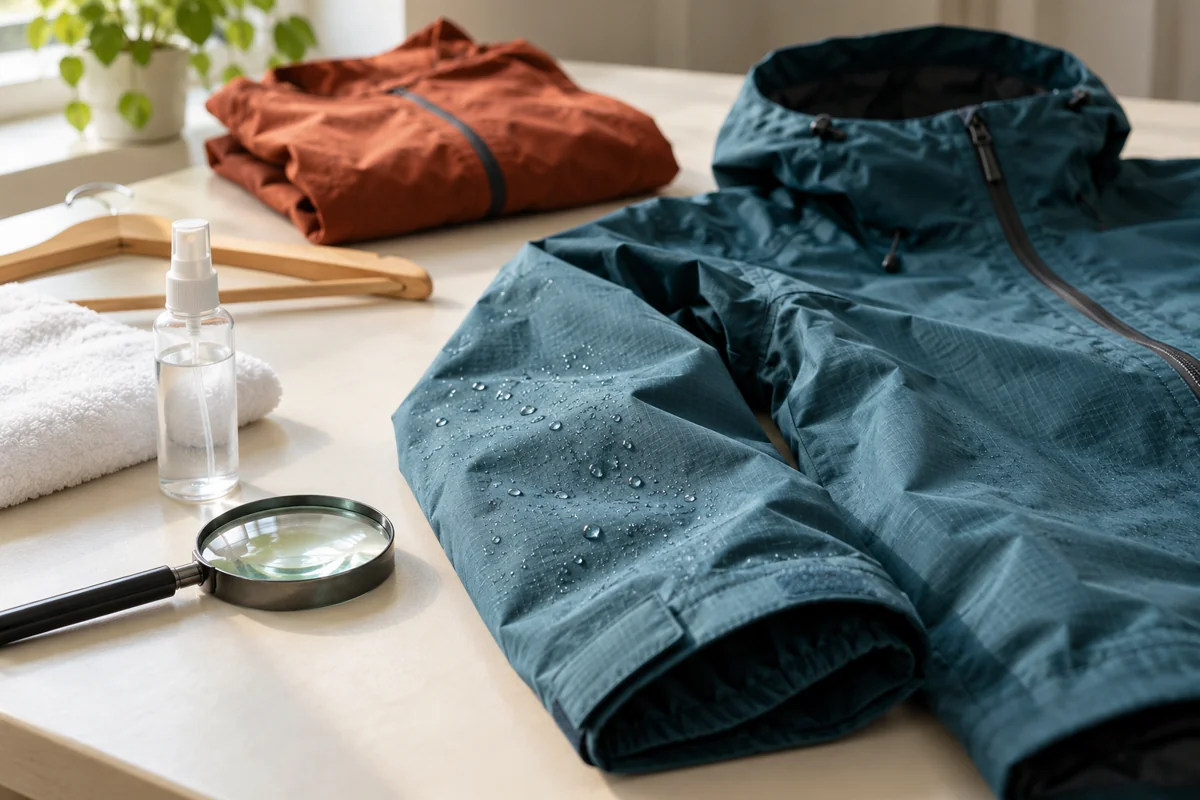
Publisher perspective: this is Brand Sauce editorial guidance, not a laboratory test, warranty decision or description of included Brand Sauce services. Manufacturer guidance was checked October 25, 2026. The image is AI-generated conceptual artwork, not a product demonstration. This guide concerns everyday company merchandise; required occupational protective clothing needs its own responsible procurement and safety process.
Separate water repellency, waterproof construction and comfort
Durable water repellent, usually shortened to DWR, is a surface treatment. It helps water bead and move off the outer textile. It is not interchangeable with the waterproof barrier in a waterproof garment. GORE-TEX's DWR guidance explains that the outer fabric can become saturated while its waterproof membrane continues functioning; the garment may nevertheless feel cold or clammy. That distinction is important when interpreting a complaint.
Do not apply a membrane explanation to every company jacket. Start with the actual style's specification. A lightly water-resistant wind layer, a waterproof shell and an insulated jacket with a water-repellent finish are different purchases. If the store promised more than the manufacturer did, the corrective action includes fixing the description—not merely maintaining the garment.
The procurement question is therefore: What function was purchased, what changed, and what evidence identifies the next action? Our company-jacket selection guide addresses the initial use-case decision. This guide addresses what happens after a jacket is issued and someone reports a problem.
Use a complaint-routing table, not an instant diagnosis
Ask the recipient what they observed in ordinary use. Do not ask them to stand in heavy rain or conduct an improvised pressure test. Photos of the garment and relevant areas can help, but a photo alone does not establish where moisture came from.
| Reported observation | Useful next question | Initial route |
|---|---|---|
| Water no longer beads; outside fabric looks darker | What style is it, and what care has it received? | Check the manufacturer's maintenance instructions before deciding on replacement |
| Localized wet area inside, repeatedly in the same place | Is it near a seam, fastening, damaged area or decoration? | Supplier or manufacturer assessment; do not assume DWR is the cause |
| General damp or clammy feeling during activity | What were the conditions, layers and activity? | Review the use case and request support if the cause remains unclear |
| Visible tear, peeling area or lifting seam tape | When did it appear, and is the garment still needed for its intended task? | Repair or replacement assessment, not a spray-only remedy |
| New jackets show the same issue near the logo | Do they share a decoration method, placement or production batch? | Escalate the affected group to the decorator and supplier |
These are routing suggestions, not diagnoses. Keep the employee's original description in the case record. Rewriting “inside of left shoulder wet” as “DWR failure” prematurely turns an observation into an unsupported conclusion.
Create a small case record with enough evidence to act
One support owner should collect the style number, order reference, issue date if known, garment size and color, and decoration method or production reference. Add the care-label instructions and the supplier's approved instructions for the finished decorated item. A stock photograph of a similar jacket is not a substitute for identifying the actual garment.
Then record the symptom, location, first occurrence, normal use and any washing or treatments already attempted. Keep the request neutral: the goal is to find the next step, not make recipients defend their laundry habits. Ask only for information needed to resolve the garment issue, not medical details or unrelated personal information.
Use distinct statuses such as “awaiting style identification,” “care instructions confirmed,” “supplier assessment requested,” “repair authorized” and “replacement approved.” “Closed” should include the outcome and who communicated it. Otherwise the same employee may repeatedly explain the same jacket to different departments.
For a company with several approved shells, maintain a style-level reference so support does not rediscover instructions every time. Update it when the product, decoration or instructions change. Do not quietly apply a new style's instructions to previously issued garments.
Approve care for the finished garment
GORE-TEX's outerwear care instructions distinguish normal care, restoration of water repellency and special product exceptions. They also tell users to follow the garment manufacturer's instructions. That is a useful reason not to publish one temperature, drying cycle or treatment rule across every jacket in a company store.
Decoration adds another approval dependency. Ask the supplier to reconcile the blank garment's care label with the finished logo application. If they recommend heat to restore the finish, obtain confirmation that the proposed method is suitable for that decorated garment. If instructions conflict or are unclear, stop and get written guidance; choosing whichever instruction seems gentler is not a verified resolution.
Build the care card around five fields:
- Identity: exact garment style and applicable decoration.
- Cleaning: the approved method and any product restrictions.
- Drying or reactivation: only the method allowed for that finished garment.
- Re-treatment: whether it is appropriate, and the approved product type or reference.
- Escalation: who to contact if the issue remains or damage is visible.
Do not supply a generic unlabelled treatment bottle with a kit and assume it suits every layer. If recipients cannot perform the approved care at home, decide whether the company can arrange a supported service or offer another resolution. A technically correct instruction is not an operational solution if nobody can carry it out.
Define what maintenance success does—and does not—mean
After approved care, record what changed. Improved surface beading is evidence about surface behavior, not a certificate of waterproofness, proof that a seam is intact or a guarantee about future comfort. If the original complaint was localized internal moisture, do not close it solely because droplets now roll off the sleeve.
Ask whether the reported issue has been resolved in the recipient's normal intended use, without requiring deliberate exposure. If it remains unclear, send the observations to the supplier's support or repair team. For a garment with visible damage or a persistent problem, repeated home treatments should not become an indefinite substitute for assessment.
Also distinguish “usable again” from “approved to return to shared stock.” If company-owned jackets are reissued, they still need the organization's cleaning, condition and identity checks. Our returned-merchandise inspection guide covers that separate inventory decision.
Compare maintenance, repair and replacement on the same basis
Obtain the proposed remedy, expected turnaround and total cost before choosing. Include transport, assessment fees if applicable, authorized cleaning or treatment, repair, temporary cover and administrative effort. Compare that with the replacement's actual decorated price, delivery and availability—not an old blank-garment catalog price.
Illustrative calculation, not a supplier quote or measured result: suppose an approved care service costs $18, round-trip transport costs $14 and administration is budgeted at $8. The care route totals $40. If a confirmed replacement would cost $110 delivered, care may be worth pursuing when the assessed issue is maintainable. But if another $35 of temporary cover is needed, the immediate outlay becomes $75. None of those numbers establishes that maintenance will succeed or that replacement is environmentally preferable.
A repair quote should identify the work, any remaining limitations and who stands behind the outcome. A warranty claim should follow the actual seller or manufacturer's process. Our gift warranty and support guide explains ownership of that handoff; a company budget decision does not establish warranty eligibility.
Use a pre-agreed approval threshold to keep small cases moving, but allow escalation. A cheap remedy that returns too late for the intended use may be the wrong operational choice. Conversely, an employee who does not need the shell immediately may prefer a repair over a replacement in a different fit.
Choose a replacement supply model separately
Maintenance policy does not determine the best ordering model. On-demand replacement can make sense for irregular individual cases when the exact approved item, decoration and delivery window are confirmed. It avoids committing to a broad finished-size stock solely because replacements might occur.
Bulk or hybrid provision can be better when a team needs immediate continuity, has predictable issue quantities or uses a consistent decorated style. A modest stock of approved replacements may cover urgent cases while less urgent orders are produced as needed. The tradeoff is funding, storage, size coverage and the risk that stock no longer matches the active specification.
Do not promise an identical replacement forever. Record what counts as an acceptable successor: function, fit options, approved care, branding and recipient consent where the original was a personal gift. If the current style disappears, revisit those requirements instead of treating the closest color as an equivalent.
A release checklist for the next outerwear program
- The store description matches the exact manufacturer's weather-protection claim.
- The finished decorated sample has an approved care instruction set.
- A named owner receives complaints and can retrieve the style and order reference.
- Maintenance, repair, warranty and replacement routes are distinct.
- Employees know how to obtain help without diagnosing the garment themselves.
- Temporary cover and urgent replacement rules are documented where needed.
- Repeated complaints can be grouped by style and decoration batch for investigation.
- The replacement budget uses current quotes; unknown service costs remain quote-needed.
When briefing a company-store provider, ask which of these responsibilities it actually accepts and which remain with your team. Brand Sauce's company-merch-store solution is a starting point for that discussion, not proof that every maintenance or repair service is included.
Frequently asked questions
Does losing water beading mean the jacket is leaking?
No. Surface saturation and water passing through the garment are different issues. Identify the jacket's construction and the reported symptom before choosing a remedy. A wet-looking exterior alone is not enough to justify either a warranty claim or a dismissal of the complaint.
Should we tell everyone to use the same DWR spray?
Only if the exact treatment and method have been approved for every included garment and decoration. A mixed assortment needs style-specific instructions. Re-treatment is not a substitute for assessing damaged construction.
How often should company jackets be treated?
Use the relevant manufacturer's guidance and the garment's condition, not an invented universal calendar. Build reminders around checking the care information and reporting issues; do not instruct people to add chemicals simply because a quarter has ended.
Should we replace the whole batch after one complaint?
Not automatically. Start with the affected garment and look for a shared pattern. If multiple reports point to the same style, seam or decoration location, pause new commitments while the supplier investigates. Let evidence determine the scope of the response.