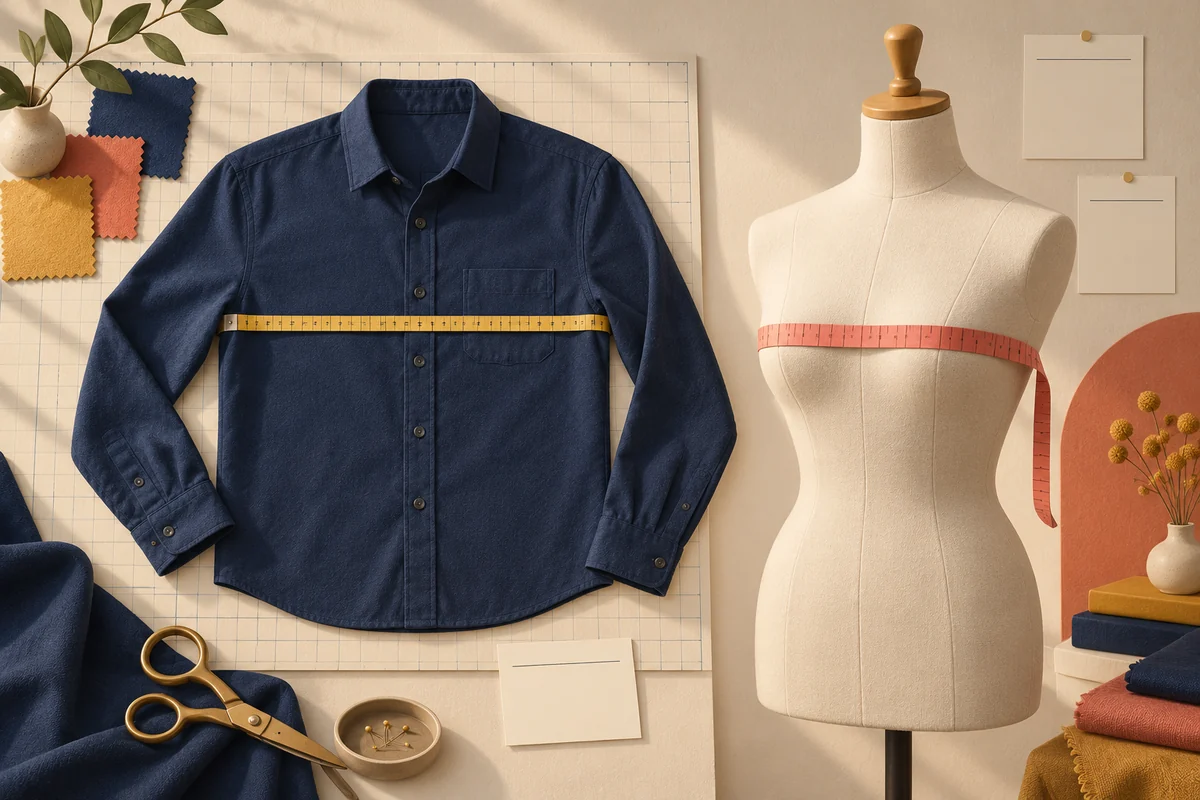
A company-store size chart must say whether its numbers describe the employee’s body or the finished garment. A flat chest width is not a body chest circumference, and doubling that width does not create a reliable size recommendation. Publish the exact style’s measurement instructions, units and fit context together, then test that the right chart follows every selectable variant.
This guide answers a catalog-management question: how do you turn supplier sizing information into a usable, correctly mapped product-page decision? It is not an exchange policy or a plan for circulating try-on samples. The deliverable is a size-chart record that a merchandising owner can approve and a store administrator can maintain.
Brand Sauce publishes this guide as a company-store provider. The release process below is our recommended operating approach, not a promise that every store includes automated chart controls. Manufacturer examples were checked October 15, 2026; they explain measurement conventions, not current Brand Sauce availability or authorized decoration access.
Start with two different questions
A body chart answers, “Which labeled size does the manufacturer suggest for these body measurements?” A garment chart answers, “How large is this item at specified measurement points?” Both can help. Trouble starts when a spreadsheet removes the headings and leaves one column called “chest.”
| Information | What is measured | Useful comparison | Unsafe shortcut |
|---|---|---|---|
| Body chest or bust | A circumference around the person, using the brand’s instructions | The matching body-size guide for that style or range | Comparing directly with a flat shirt width |
| Flat garment chest width | Across the laid-flat item at a defined position | A comparable garment measured at the same position | Calling the value a wearer’s chest size |
| Garment length | Between specified points on the item | The same length definition on a comparable item | Assuming front, back and center-back lengths match |
| Sleeve measurement | A route specified by the supplier | Another measurement using that same route | Mixing shoulder-to-cuff and center-neck-to-cuff values |
The product’s label size is a lookup key, not a measurement unit. Keep “M” as the label supplied; do not silently translate it into another brand’s medium, a numeric size or a different fit block.
Read a real supplier page without merging its tables
The SanMar specification page for Port Authority J323 shows why table context matters. Its medium product chest measurement is 24½ inches, measured flat below the armhole. Its separate medium size-chart chest range is 38–40 inches, with instructions to measure around the body. Both values can be correct because they describe different things.
The same page defines back length from the high point of the shoulder and sleeve length from the center of the neck. Copying the numbers without those reference points removes information needed to use them. Keep the measurement definitions attached to the data, even if the store displays them in an expandable guide rather than beside every cell.
Do not calculate a new recommended body range from that jacket’s flat dimension. Outerwear construction and intended fit are part of the product design. The manufacturer’s body-size guidance and the garment dimensions serve different roles; one is not an arithmetic correction to the other.
Preserve fit context instead of inventing a universal ease rule
Patagonia’s men’s size guide explicitly identifies its chart values as body measurements and separates sizing from intended fit. It also advises considering the hip measurement when it is larger than the chest for tops. That is a useful reminder that a single chest value cannot explain every person’s preferred fit.
Carhartt’s men’s guide likewise distinguishes body measurements from its fit descriptions and supplies its own measuring and between-size advice. Preserve such guidance as brand- and range-specific. Do not turn one manufacturer’s instruction into a rule for every garment in your company store.
For catalog purposes, keep three separate fields: size label, measurement data and manufacturer fit description. “Relaxed” should not replace a number, and a number should not erase the intended silhouette. If a supplier changes a fit name, ask whether the underlying cut changed before telling employees their previous selection will fit the same.
In this guide, ease means the difference between body dimensions and garment dimensions that helps shape the intended fit. We do not recommend a universal allowance. A stretchy base layer, a woven overshirt and an insulated jacket should not be forced through the same subtraction rule.
A two-number error that survives a tidy spreadsheet
Illustrative example only—not a product specification or measured result: imagine a supplier file containing a medium shirt with a 22-inch flat chest width and a separate 38–40-inch body chest range. An importer labels both rows “Chest” and retains only 22. The product page now appears to recommend medium for a 22-inch body circumference.
Doubling 22 to 44 does not fix the problem. It converts a flat width into an approximate around-garment dimension for a simple flat comparison, but it does not recover the manufacturer’s 38–40-inch body recommendation. The missing information is the measurement type, not a multiplication step.
A separate unit error is easier to hide. Twenty-two inches converts to 55.88 centimeters using 2.54 centimeters per inch. Relabeling the original value “22 cm” changes its meaning dramatically. If the display rounds to 55.9 cm, retain the original value and conversion rule in the record. Extra decimals do not make the underlying garment measurement more precise.
The release decision should therefore check semantics before arithmetic: what is measured, where, in which unit, for which style and variant? Only then check whether any conversions are correct.
Build a chart record, not a loose image attachment
Assign one merchandising owner to approve each chart record. An administrator may load it, but someone must resolve ambiguous supplier wording. A screenshot called “size-chart-final” is not enough to establish which products it covers.
| Record field | Required content |
|---|---|
| Product identity | Manufacturer, exact style identifier and covered fit or length variants |
| Source | Official page or supplier document, retrieval date and retained version reference |
| Measurement type | Body circumference, flat garment dimension or another explicitly defined measurement |
| Method | Reference points, posture or garment position from the supplier |
| Values and units | Original labels, numbers, ranges and units; separately identified display conversions |
| Mapping | Exactly which orderable variants use this chart, including regular/tall or other distinctions |
| Limitations | Missing values, unverified variants and any supplier-specified tolerances |
| Release control | Approver, approved version, review trigger and support route |
Do not fill a missing 4XL measurement by extending the difference between 2XL and 3XL. A plausible progression is not supplier evidence. Ask for the missing information or clearly state that the measurement is unavailable while providing an appropriate help route. Likewise, do not invent a manufacturing tolerance because another product happens to publish one.
Make the employee’s next action clear
Put the chart near the size selector and give it an informative heading: “Body measurements— inches” or “Finished garment measurements—laid flat, inches.” If both are supplied, keep them as separate tables. Present measurement instructions in readable text, not only tiny labels embedded in an image.
For a body chart, direct employees to the brand’s matching measuring method. For a garment chart, explain that comparison requires a similar item measured in the same way. Comparing a fitted tee with a padded jacket may create confidence without a useful like-for-like reference.
Keep personal measurements with the employee wherever possible. Publishing a helpful chart does not require managers to collect chest or hip dimensions. A support conversation can begin with the product, chart version and point of confusion; ask only for information genuinely needed to help.
When charts cannot resolve the choice, a planned apparel try-on kit may provide additional evidence. It should supplement the product information, not conceal a wrong chart. Make the size-exchange and fit-resolution policy visible before ordering as well.
Run seven acceptance tests before release
- Type test: ask someone unfamiliar with the source to explain whether each table measures a person or an item. If they cannot, fix the heading and instructions.
- Variant test: change between every distinct fit or length option. Confirm the chart changes when required and never retains another variant’s heading.
- Unit test: check a small, middle and large size against the original source. If conversion is offered, verify both the value and the unit label after switching.
- Boundary test: inspect the smallest and largest orderable sizes. Confirm there are no missing rows, invented values or truncated labels.
- Measurement-route test: confirm that length and sleeve instructions remain attached to their values. Do not accept a generic diagram with different reference points.
- Mobile test: open the actual product page on a narrow screen. Check that row labels and units remain understandable while scrolling the table and that the guide can be closed to resume selection.
- Uncertainty test: follow the help route for an employee whose measurements span different recommendations or who cannot use the measuring instructions. Confirm a real next step exists.
Save the outcome against the chart version. These are proposed acceptance checks, not results from testing a Brand Sauce implementation. A store provider should demonstrate the actual behavior of your configured store before you rely on it.
Treat substitutions and reorders as mapping checks
A replacement polo that occupies the same catalog slot may need a different chart. Require a chart review whenever the style, cut, length variant or source specification changes. Do not carry over a previous employee’s size selection automatically when the underlying product changes.
Bulk, on-demand and hybrid programs all need accurate sizing information. Bulk can be appropriate for a known group with confirmed selections and a fixed distribution date. On-demand supports individual ordering without requiring the same finished-stock commitment, but does not make the sizing data correct. In a hybrid program, verify that a replenishment item really matches the original rather than inheriting its chart by name.
Use the company-store assortment framework to keep the range maintainable. Each additional cut creates another information obligation. A smaller selection with trustworthy charts can be more usable than many near-identical options whose fit distinctions nobody can explain.
Frequently asked questions
Should employees always size up between sizes?
No universal instruction belongs across the whole catalog. Preserve the exact manufacturer’s guidance and consider the intended garment use. If the source does not answer the question, request clarification or offer a sample route instead of inventing advice.
Can we use one chart for all products from a brand?
Only when the manufacturer or supplier confirms that it applies to those exact products and variants. A shared logo or similar product name is not evidence that the measurements and fit guidance are interchangeable.
Should we publish both body and garment measurements?
When both are supplied and clearly explained, they answer complementary questions. Do not create a second table from unsupported calculations just to make the page look complete. A clearly labeled authoritative chart is better than two ambiguous ones.
Does a correct chart guarantee the employee will like the fit?
No. It helps the employee make an informed selection, but preferences and proportions still matter. Keep the help and fit-resolution routes clear. The operational goal is an accurate decision aid, not a guarantee that a size letter produces the same experience for everyone.
The hero is an AI-generated conceptual illustration, not a manufacturer measuring diagram or a photograph of a tested product. Official sources checked October 15, 2026.