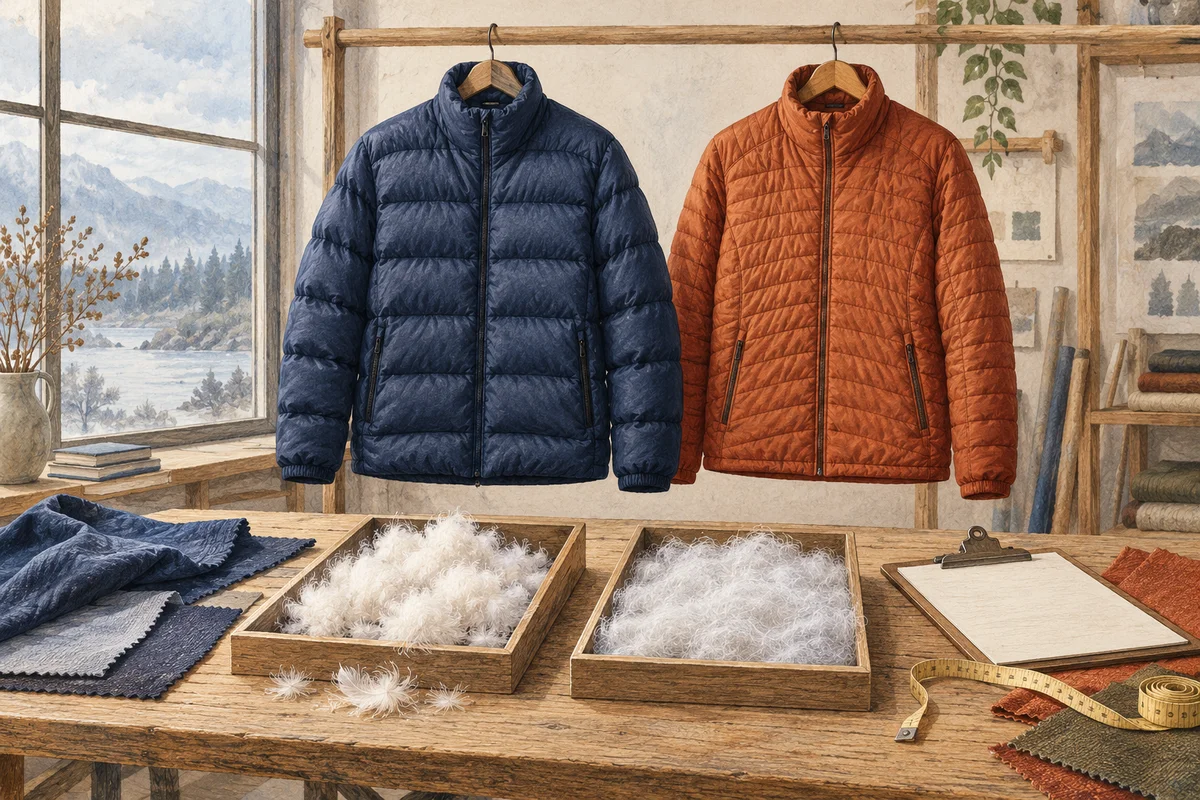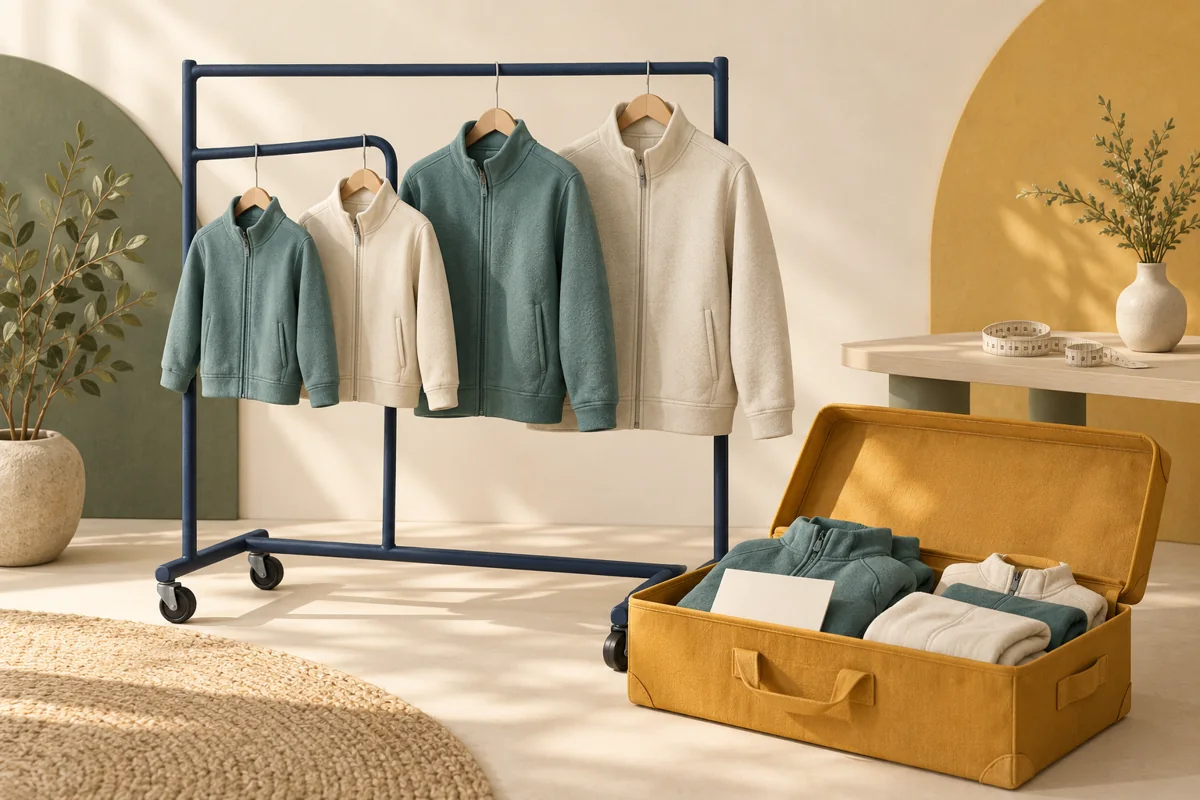
A company apparel try-on kit is worth considering when employees will repeatedly order the same styles, the cost of a poor fit is meaningful, and you can give people access before they choose. Use product-specific size guidance without a shared kit when the audience is scattered, the assortment changes frequently or circulating samples would delay the gift. A hybrid—local fit kits for recurring sites, plus remote sizing support—often deserves a quote alongside both options.
The decision is not simply whether physical samples are helpful. It is whether a maintained, reachable set of garments will improve decisions enough to justify purchasing, cleaning, tracking and moving it. A forgotten rack at headquarters does little for people at another location.
Brand Sauce publishes this guide from a company-store provider’s perspective. The operating model below is an editorial recommendation, not a promise that sample loans, fittings or returns are included in a Brand Sauce program. Confirm the exact style, country availability, sample terms and quote-needed costs with your provider. This guide covers ordinary company apparel, not protective-equipment fitting.
Separate a fit kit from a production approval sample
A fit kit helps an employee choose a style and size. A production approval sample helps the buyer approve the finished garment and decoration. Keep those jobs separate even if both involve the same jacket.
A useful fit kit contains the actual orderable styles in the sizes it claims to cover, with clear identifiers and current measurement guidance. It does not need every logo variation. A retained approval sample, by contrast, should preserve the agreed finished configuration. Repeated try-ons, cleaning and travel make it a poor untouched reference.
Before building a library, complete the separate branded-apparel sample approval process. Then decide which garments can circulate and which must remain with the production owner. Do not send the only approved reference around several offices and discover it is missing when a quality question arises.
Choose among charts, a traveling kit and local kits
| Model | Strongest fit | Main operating cost | Reason to reconsider |
|---|---|---|---|
| Product-specific charts and support | Dispersed recipients; infrequent apparel orders | Maintaining instructions and answering questions | People repeatedly struggle with the same style |
| One traveling kit | Several sites with staggered selection windows | Freight, cleaning, handoffs and schedule buffer | Sites need access simultaneously |
| Permanent local kits | Recurring hiring or repeated uniform orders at stable locations | Duplicate samples, storage and local ownership | Low use or frequent assortment changes |
| Hybrid access | A few large sites plus remote employees | Local kit upkeep plus a separate remote support route | Remote staff receive materially worse help |
Start with the selection calendar, not the headcount. One hundred people who order during the same week may need more simultaneous access than several hundred who join throughout the year. A traveling kit cannot be in two places at once; that constraint belongs in the launch plan before anyone promises a date.
For a voluntary gift, keep a credible non-apparel option available. Someone should not have to wait for a circulating jacket to receive recognition. For required work clothing, handle unresolved fit through the program owner rather than treating another gift as a substitute for the garment.
Buy coverage of real decisions, not a rack of display pieces
Choose the styles first. A large in one cut is not evidence that another cut in the same brand will fit the same way. Keep regular, tall and differently shaped cuts distinct wherever they are offered. Ask the supplier whether a color or fabric variant introduces a difference that matters to the sample plan.
For a core style, price a full run of the sizes you intend to offer. If the budget cannot cover it, identify the gaps explicitly and provide a route to request the missing size. Do not call a small-medium-large assortment a complete fit kit while selling a broader range online.
SanMar’s sample-program page distinguishes returnable samples from grommeted samples. That distinction matters when buying a usable try-on library: ask what physical modifications a discounted presentation sample has and whether it is suitable for wearing. A sample offer is not automatically a long-term lending arrangement.
Keep an inventory record for each physical garment: kit ID, style number, cut, labeled size, color, supplier reference, received date and current condition. Attach an identifier without covering the original size or care label. The record should distinguish two otherwise identical samples so a missing item does not disappear into an approximate count.
Make the chart usable even when a sample is available
A kit supplements sizing information; it does not replace it. Employees who cannot attend still need the same product-specific guide, and someone between sizes may want to compare the sample with a garment they already like.
SanMar’s District DM104L specification page provides a concrete example of two different measurement systems. Its product measurements define chest as a flat measurement below the armhole, while its size chart uses a body bust measurement. Those values answer different questions; they should not be placed in one unlabeled column.
For each style, link the current guide and state whether the measurements describe the body or the garment. Preserve the supplier’s measurement points and units. If suggesting a comparison with a favorite garment, explain how to lay it out and use the same reference points. Do not convert one flat width into a confident promise about fit.
Invite people to try the intended layer underneath, close the garment and check ordinary movements relevant to its use. Present this as a personal comfort check, not a certification. A sample can help someone choose; it cannot guarantee every future garment or every wearer’s preference.
Give the kit a circulation plan before it leaves
Name one program owner and one receiving contact per site. For a traveling kit, book an arrival window, try-on period, cleaning step and dispatch date. Include transport buffer between sites rather than scheduling the next fitting for the morning after the previous one ends.
- Before dispatch: check every garment against the manifest, note missing sizes and confirm the next site can receive the package.
- At receipt: reconcile the contents and condition before announcing that the full kit is available.
- During access: provide private, voluntary try-ons and a clear route for employees who work different shifts or cannot attend.
- Before repacking: complete the agreed cleaning and inspection process, let garments dry fully and update the record.
- At handoff: share tracking and the current manifest with the next custodian; escalate missing items immediately.
Separate clean, available garments from items awaiting cleaning or inspection. Use the finished garment’s confirmed care instructions and the workplace’s applicable procedures; do not invent a universal cleaning temperature for a mixed kit. Record cleaning history because the sample’s condition is part of what an employee is trying on.
Keep personal size selections out of the shared circulation sheet. That sheet tracks objects and locations. Employees can submit their order through the normal private ordering route; the custodian does not need to publish everyone’s chosen size.
Design the remote route as part of the same program
Do not make headquarters access the unofficial standard and leave everyone else with “pick your usual size.” Offer product-specific measurements, a named support contact and an explanation of the remedy if the selected size is unsuitable.
An individual sample shipment may be sensible for an expensive, recurring garment, but quote the return freight, handling and time first. Confirm who owns the sample and whether it must remain unworn beyond a try-on, unwashed or otherwise in a specified condition. A supplier’s return policy is not automatically compatible with a repeatedly used employee library.
For example, SanMar’s current terms describe a sample-return window and customer-paid related shipping, while also setting restrictions on returns of altered or embellished merchandise. Those are supplier-specific terms, not a Brand Sauce employee-return promise. Obtain written terms for your actual arrangement before washing, decorating or circulating anything you expect to return.
Publish the company’s size-exchange policy alongside the sizing guidance. Trying a sample should not quietly remove a remedy that the program otherwise provides. Conversely, do not imply every correctly produced personalized garment can go back to the supplier.
Calculate the cost per useful fitting, not just sample cost
Use a full-period estimate: sample purchases plus transport, cleaning, custodian time, replacement and storage costs, less only confirmed recoverable value. Divide by the number of people expected to use the kit before its styles or condition become obsolete.
Illustrative calculation, not a quote or measured result: suppose samples cost $360, circulation freight $120, cleaning $60 and six hours of administration at an assumed $30 per hour costs $180. The total is $720. At 90 useful fitting sessions, that is $8 per session; at 30, it is $24. The calculation does not establish that a kit saves money.
If the employer’s assumed incremental cost of a fit-related replacement is $60, the $720 kit would need to avoid 12 such replacements merely to match that cost. That is a break-even threshold, not a forecast. Count only costs genuinely avoided, and do not count the same replacement garment twice under separate headings.
There can still be a service reason to offer fittings when the financial case is uncertain. State that reason honestly. A practical pilot can track sessions, unanswered fit questions, missed access and subsequent fit-related replacements without claiming every difference was caused by the kit.
Keep the sample decision separate from bulk versus on-demand
A small maintained fit library can support an on-demand store without requiring a closet full of finished employee stock. It still creates physical assets someone must manage. “No inventory” should not be interpreted as “no samples, ownership or maintenance.”
Bulk can be sensible for a fixed-date clothing rollout after recipients have selected sizes, especially when the approved style and quantities are stable. On-demand can suit staggered hiring and replenishment. A hybrid can use the same verified fit information for a launch order and later individual purchases—provided the actual style remains the same. See our bulk versus on-demand decision guide for the broader comparison.
Use this six-point kit release card
- Scope: exact styles, cuts and sizes; documented gaps and their support route.
- Ownership: purchaser, custodian, return conditions and replacement budget.
- Access: sites, shifts, remote employees and selection deadlines.
- Condition: care instructions, cleaning responsibility and inspection record.
- Information: matching charts, private ordering instructions and exchange policy.
- Retirement: review date and triggers such as a discontinued style, changed specification or damaged sample.
Before launch, walk through one missing-size scenario and one delayed-handoff scenario. If neither has an owner and a practical next step, the kit is not ready. Review the library whenever the store’s garment selection changes; an old sample should not continue representing a new product because both are navy.
Frequently asked questions
Does every fit sample need the company logo?
Not necessarily. Blank samples can help with size selection, while a separate decorated reference shows the finished treatment. If decoration affects feel or flexibility in a relevant area, include evidence of that finished configuration and explain what the blank sample cannot show.
Can employees keep the sample they try?
Only under a deliberate transfer policy. Otherwise the kit gradually loses its coverage. Confirm ownership, condition, any sample modifications and replacement arrangements before converting a library item into someone’s final garment.
When should a company skip a fit kit?
When it cannot provide timely, representative access or maintain the garments. Clear sizing support and a funded, understandable remedy may serve employees better than an incomplete kit that arrives after ordering closes.
Primary supplier documentation checked October 11, 2026. The hero is a conceptual illustration, not a photograph of a supplied kit. No product availability, sample price or service inclusion is implied.