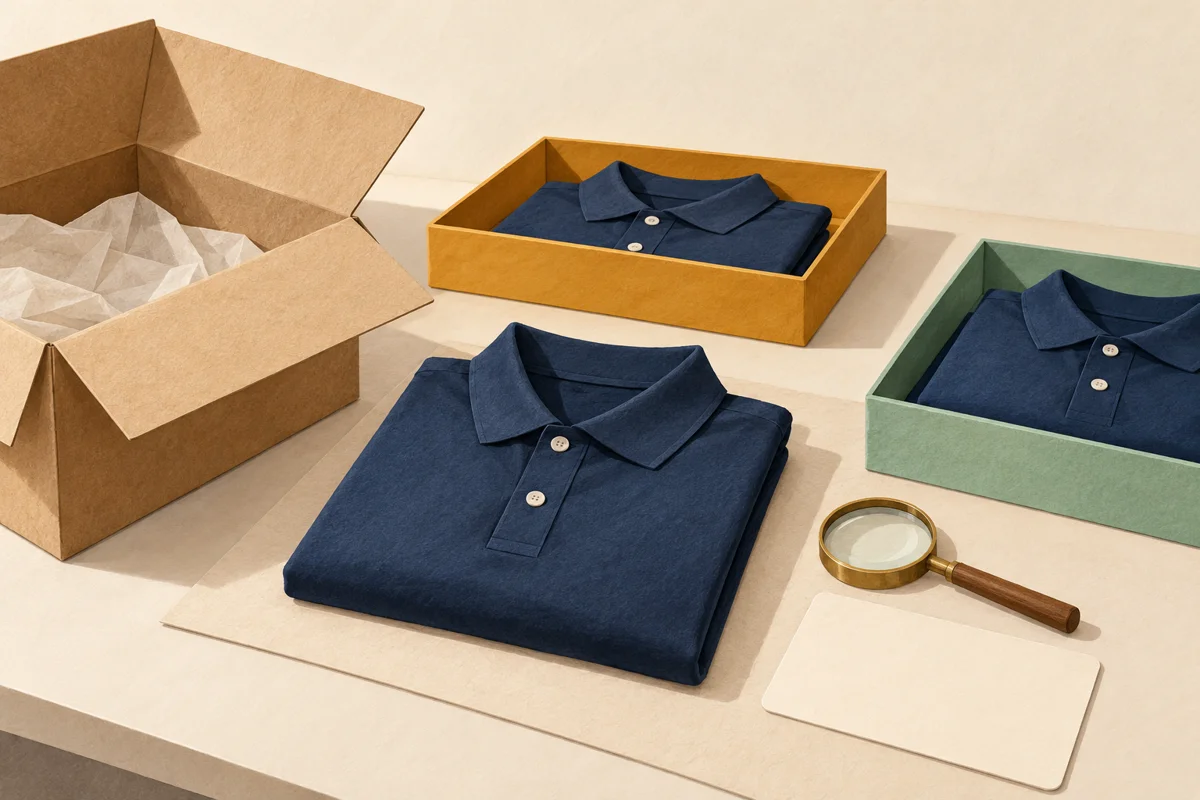
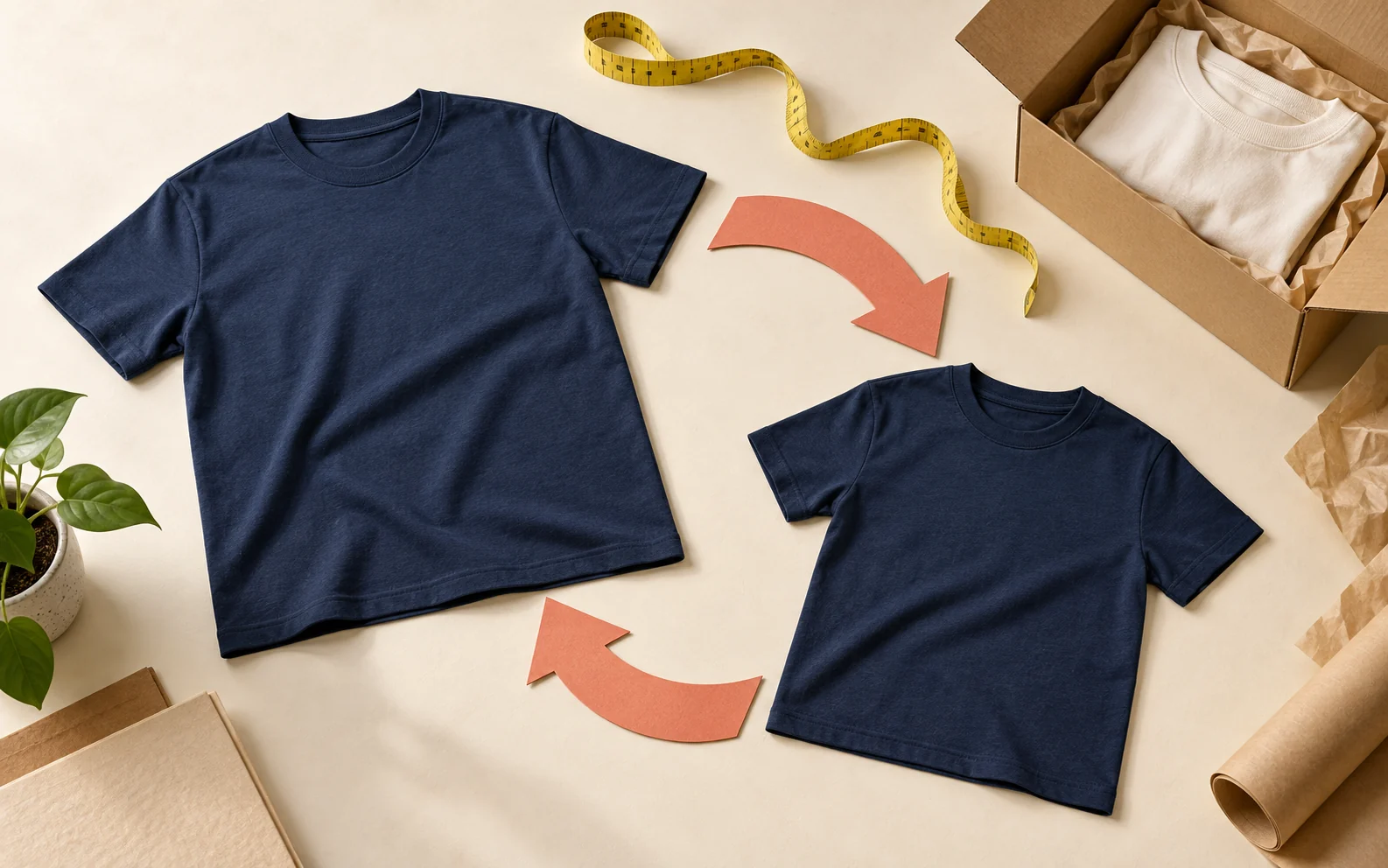
A company swag size-exchange policy should separate a fulfillment mistake from a correctly made garment that does not fit. Confirm what the supplier will accept, decide what the employer will fund, and give employees one clear support route before they order. A replacement can be a new production order, not a return of the original shirt.
That distinction matters most when apparel is decorated or personalized. A generous employee experience is possible without pretending every garment can go back on a shelf. The program needs a funded remedy, an owner and an honest timeline—not just a reassuring “contact us.”
This is Brand Sauce’s editorial framework for planning a company-store program, not a statement of the return terms for any particular Brand Sauce order. Agree the actual policy with your provider. The examples below concern ordinary employee merchandise, not safety equipment or mandatory-uniform compliance.
Start with four different cases, not one returns bucket
“My shirt is wrong” can describe several problems. Asking the employee to select the nearest explanation helps the support team find the right remedy without assigning blame. Compare the order confirmation, garment label and actual issue before deciding whether the case is a size preference, a picking error or a production concern.
| What happened? | What to check | Resolution to arrange |
|---|---|---|
| The ordered size was large; medium arrived | Order record and garment label | Provider investigation and correction under the agreed error process |
| The ordered size arrived but feels too tight | Exact style, fit guidance and replacement preference | Employer-funded or otherwise approved fit remedy |
| The garment or decoration appears defective | Photos of the issue, production record and supplier instructions | Quality review, with the item retained until disposition is confirmed |
| The employee wants a different color or product | Whether this is a preference change or an unsuitable fit | Apply the stated change-of-mind policy; do not disguise it as a defect |
Keep an “I’m not sure” option. A label can be correct while the measurements appear inconsistent with the published specification. Support should investigate rather than make the recipient prove a manufacturing cause.
Also distinguish a request made before production from one made after delivery. An order-change request should prompt an immediate status check, not an automatic promise to stop work already underway. Record when the provider actually confirms the change.
Separate the supplier’s return rules from your employee promise
Do not assume a blank garment’s returnability survives decoration. For example, SanMar’s terms say returns need advance authorization and that altered or embellished garments, excluding irregulars, are not returnable. That is a specific supplier policy, not a universal rule for every company store.
Get the terms for the actual purchasing and decoration arrangement. Ask who receives a claim, whether photos are enough to begin review, what deadlines apply, and whether return freight or a new production charge is involved. Confirm the answer for personalized names as well as standard company logos.
Then make a separate employer decision: if a correctly supplied item does not fit, will the program pay for a replacement? A supplier declining a preference return does not by itself answer that question. The company can budget for an employee remedy without expecting reimbursement from the supplier.
Document three lanes: provider corrections, employer-funded fit replacements, and changes the program does not normally fund. Assign an exception owner for cases that do not fit neatly. Employee-paid purchases need their own clear payment and refund handling; do not casually copy the rules from a free recognition-gift program.
Make the size decision understandable before checkout
Use the chart for the exact style. A familiar size letter is not enough information to compare garments with different cuts. Explain whether the chart describes the person or the finished item, and identify the measurement units beside the values.
Patagonia’s men’s size guide, for example, explicitly identifies its chart values as body measurements. SanMar’s K320 specification page provides both a size chart and product measurements, explaining that the garment’s chest measurement is taken across it while laid flat. Those are different measurement methods; their numbers should not be presented as interchangeable.
A useful product page should provide:
- The manufacturer style identifier and a link to its current sizing guidance.
- A plain-language explanation of body versus garment measurements.
- Available cuts and lengths, with their own charts where applicable.
- A way to get help before ordering when no offered size looks suitable.
- The fit-replacement rule close to the size selector, not only in a footer.
For a recurring uniform or frequently ordered staple, consider a try-on sample set where practical. Decide who owns it, where remote employees can get equivalent help, and how to keep sample styles current. Do not tell everyone to size up as a shortcut for missing information. If the cut itself is unsuitable, the next size may not solve the problem.
For broader assortment decisions, see our guide to choosing company jackets for climate and fit. The exchange policy is the backstop, not a substitute for offering workable choices.
Write the policy as six decisions employees can understand
1. Contact window. State when employees should report an issue and what starts the clock. Delivery-based wording is easier to interpret than a date hidden in an order batch. Align it with supplier claim requirements and identify a route for exceptional circumstances.
2. Item condition. Explain whether a fit request requires an unworn item, tags or packaging. Treat suspected defects as a separate review rather than dismissing every issue discovered after use as ineligible.
3. Covered remedy. Specify whether the program offers another size of the same style, an alternative cut, a different approved item, or a case-by-case decision. Never promise the next size is in stock without checking.
4. Payment owner. Name who funds the garment, decoration, outbound shipping and any return shipping. If program credit is restored or a replacement order is issued outside the normal allowance, explain which happens so the employee does not accidentally spend twice.
5. Original-item instructions. Tell the employee to wait for directions before mailing it anywhere. The decorator, blank supplier, warehouse and employer may have different addresses. A return label is not evidence that a replacement has been ordered.
6. Timing and escalation. Give a support-response expectation your team can meet, then provide a replacement estimate after availability and production are confirmed. Include an escalation owner when the item was needed for a dated event.
Write these rules in ordinary language. A concise starting message might be: “Something wrong with the item or fit? Contact the program support team with your order number and a brief description. Please keep the item and wait for return instructions. We’ll confirm the available remedy, any cost and the expected timing before arranging the next step.” Add your real contact details and agreed terms before using it.
Give support a short, repeatable resolution workflow
- Identify the order. Find the ordered style, size, decoration and destination. Ask only for missing information, not a second copy of the entire employee record.
- Classify the issue. Use the four-case table above. For quality questions, follow the provider’s evidence instructions. A garment-label photo is different from a photo of someone wearing the garment; do not routinely request the latter.
- Confirm a usable replacement. Let the recipient choose the new size or approved alternative. Do not automatically send the next size up.
- Authorize the cost. Record the funding owner and any provider credit separately. A pending supplier claim should not be mistaken for confirmed reimbursement.
- Place and link the replacement order. Associate it with the original case so two support agents cannot unknowingly create duplicate replacements.
- Close the loop. Share shipment information, confirm the original-item instructions and record whether the fit problem was resolved.
If a requested replacement is unavailable, use a recipient-approved alternative rather than substituting silently. Our gift substitution playbook explains how to separate budget approval from recipient approval.
For a support form, use explicit labels such as “Order number,” “What needs fixing?” and “Preferred replacement size.” The W3C’s form-labeling guidance explains how associated labels identify controls, including for assistive technology. Do not make an unlabeled photo-upload box the only way to request help.
Budget for replacements without inventing a benchmark
Do not borrow an online apparel return percentage and treat it as your employee-store forecast. Your assortment, fit guidance, order volumes and remedy policy define a different situation. Start with an explicit planning allowance and replace assumptions with your own resolved-case data.
Illustrative calculation—not a supplier quote or measured result: suppose a campaign delivers 200 apparel items and the planner reserves funding for 10 fit replacements. At an assumed $35 per decorated replacement plus $8 outbound shipping, that allowance is $430. If six originals also need a prepaid return at an assumed $7 each, add $42, for a total of $472 before tax, support time or other applicable charges.
The assumed 10 cases are a scenario, not a predicted return rate. Do not count a supplier credit as a saving until confirmed, or add the original purchase cost again when calculating only the incremental replacement budget. For broader funding ownership, connect this allowance to your department-level company-store budget process.
A spending cap should trigger review, not silently close the support channel. If cases exceed the allowance, investigate whether one style, inaccurate chart or picking problem explains the cluster before restricting everyone’s access.
Choose on-demand, bulk or hybrid with the remedy in mind
On-demand can suit ongoing programs because the company does not have to predict every employee’s size before orders arrive. It does not make fit problems disappear. A replacement may require another production cycle, and its single-item shipping cost belongs in the plan.
Bulk can be sensible for a known group, an approved style and a shared event deadline. A controlled stock of spare sizes may allow quick exchanges, provided someone manages counts and the remaining garments have a useful future destination. Do not build that reserve around unsupported guesses about the workforce.
A hybrid approach can combine a small local replacement pool for a repeat staple with on-demand ordering for the wider assortment. Decide how stock-based exchanges are recorded so the physical count and order history do not drift apart. A named employee’s personalization may make an item unsuitable for reassignment even when the fit and condition are otherwise fine.
Assess the original item separately from the replacement. If returns cost more than their likely useful value, discuss an approved keep, local reuse or other disposition route with the program owner. Do not claim environmental savings simply because an item was not mailed back.
Measure the cause—and test the policy before launch
Track fit cases separately from wrong-item shipments, decoration concerns and preference changes. Record the style, case reason, remedy, incremental cost and resolution time. Report counts alongside denominators: three fit cases among ten delivered units deserves a different discussion from three among hundreds, without declaring either a universal benchmark.
Before the next launch, walk through four hypothetical tickets: wrong size shipped, correct size with unsuitable fit, replacement size unavailable, and a suspected defect. Confirm that support can find the order, identify the funding owner and explain the next step without improvising policy. If the original can neither be returned nor reused, the workflow must still say who decides its disposition.
Frequently asked questions
Can employees exchange embroidered or printed swag?
It depends on the purchasing arrangement and the employer’s policy. A decorated garment may be ineligible for a supplier preference return while the employer still funds a new size. Confirm both parts before promising an exchange.
Should employees pay for a size replacement?
Decide that before launch and distinguish fit preferences from provider errors. For a company-funded gift, a replacement allowance can preserve the intended experience. If any employee payment is required, disclose it before authorizing the replacement.
What if no offered size fits?
Offer a support route to an approved alternative cut, style or non-apparel option when the program allows it. Repeatedly sending larger versions of an unsuitable cut is not a useful resolution. Record the assortment gap so future employees do not face the same problem.
Does a no-inventory store need a returns policy?
Yes. No inventory describes how products are supplied, not what happens when a delivered item is wrong or unsuitable. Define the remedy, funding, original-item handling and communication even if the company holds no stock.
The goal is a usable garment and a clear next step. Build the policy around that outcome, then choose the production and support arrangements that can deliver it.