Choose ceramic-lined drinkware when the exact lining and care routine offer a benefit your recipients value. Choose a bare stainless interior when it meets the drinking job without adding a lining-specific maintenance requirement. Neither is automatically the better company gift. Compare the actual vessel, lid, interior and finished decoration—not the words “ceramic” and “stainless” as if they described two complete products.
The important distinction is that a ceramic-lined steel mug is still a steel vessel. Its interior surface is a separate specification from its insulation, closure and exterior logo. Buying the lining does not automatically buy better flavor, longer temperature retention, easier dishwasher care or a microwave-safe cup.
This guide focuses on the inside surface decision. It provides a sample-review method, a supplier approval record and a way to offer meaningful recipient choice without inventing a premium-versus-basic hierarchy.
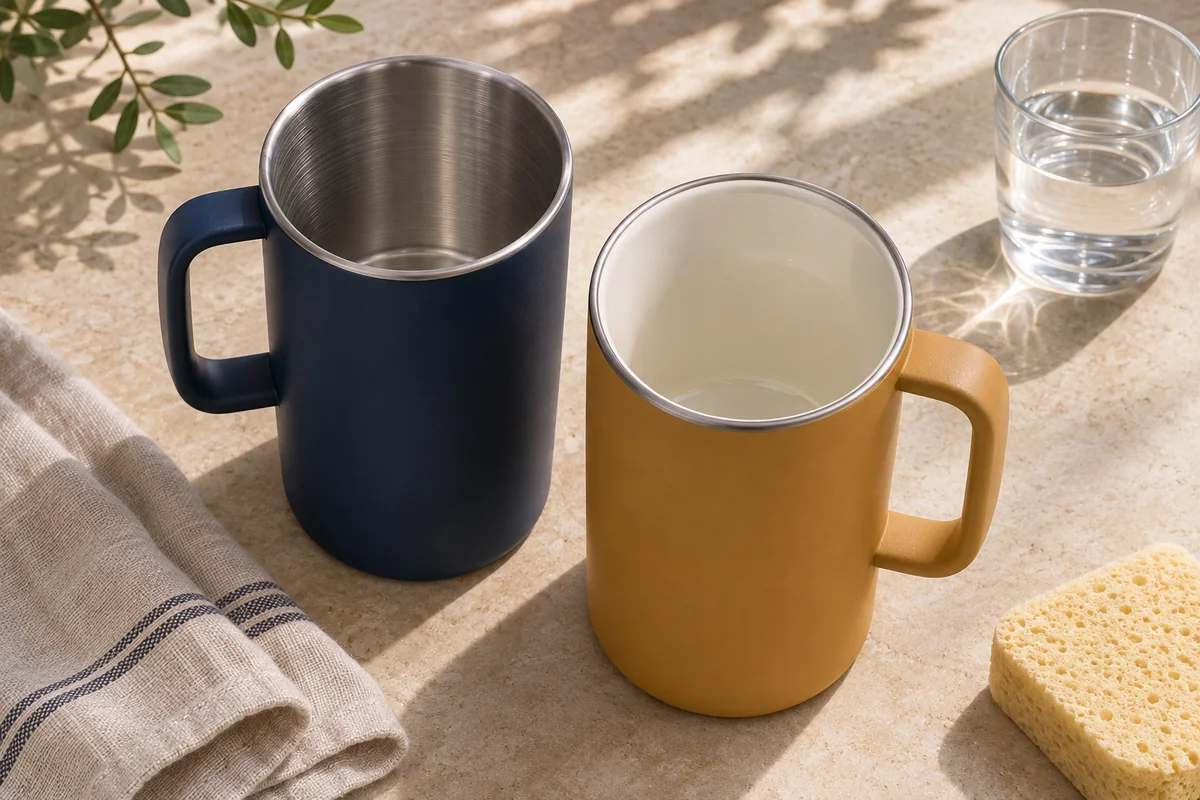
Brand Sauce publishes this guide from a merchandise-program perspective. Manufacturer examples were checked November 4, 2026; they illustrate documented differences, not hands-on test results or confirmed Brand Sauce catalog availability. Exact model, decoration, destination availability and delivered price require a current quote. The image is a conceptual illustration of generic drinkware.
Separate the contact surface from the vessel
A useful purchasing brief names four layers: the material holding the drink, the interior finish touching it, the construction controlling heat transfer and the closure used to drink or carry it. The exterior decoration adds another approval task. A product can satisfy one layer and fail another.
| Description | What to establish | What not to infer |
|---|---|---|
| Bare stainless interior | The specified metal is the exposed interior surface | Every lid, cleaner or beverage is suitable |
| Ceramic-lined stainless vessel | The named lining is applied to the metal interior | The entire mug is ceramic or microwave-safe |
| Ceramic mug | The actual body material and its own care instructions | It behaves like an insulated steel travel mug |
| Vacuum-insulated | The documented wall construction | A particular interior lining or leakproof closure |
| Branded exterior | The final decoration method and care limits | The blank's cleaning permissions automatically cover the logo |
YETI explains in its DuraSip ceramic-lining FAQ that the lining is bonded to an 18/8 vacuum-insulated stainless vessel and is not removable. That is a useful example of why “ceramic-lined” should not be shortened to “ceramic mug.” It describes a specific construction, not a replaceable insert or a universal material standard.
Ask the supplier to identify the interior on the exact capacity and version being quoted. A family name or a photograph of a pale interior is not enough. If the construction changes between sizes or generations, give each orderable version its own approved description.
Buy a defined benefit, not an assumed taste upgrade
Start with the problem your program is trying to solve. Is the priority a surface that recipients find pleasant to drink from, easier removal of everyday residue, or continuity with a mug they already enjoy? Those are different requirements. “Better coffee” bundles them together without identifying what has improved.
The same YETI FAQ says its ceramic lining helps resist stains and supports cleaning, but does not claim that it makes coffee or wine taste better than stainless. That limitation matters: a supplier's surface feature should not become an employer's unsupported promise of superior flavor.
Recipients can still have genuine preferences. Treat those as preferences, not proof of a material-wide performance claim. In a small sample review, ask whether participants like the drinking experience and whether they would choose the item. Record the answer without turning a handful of responses into a satisfaction statistic for the workforce.
Also separate cleaning from taste. A comparison between a newly washed mug and one with residue in the lid is not a useful lining comparison. Differences in lid opening, drink temperature and shape can affect the experience being judged. If those differ, describe the exercise as choosing between complete mugs rather than isolating the effect of a coating.
Care instructions can reverse the buying decision
Do not use “ceramic-lined means hand-wash only” as a procurement shortcut. Fellow's current Carter dishwasher guidance says Carters are top-rack dishwasher-safe. That is model-family guidance from the manufacturer, not permission to apply the same rule to every coated interior.
Fellow's care guide for Carter Wide specifies a nonabrasive cloth or sponge with warm soapy water for the interior. It also describes removing the lid's silicone ring for separate cleaning and storing the vessel with its lid off between uses. The practical buying question is whether that routine fits the recipient and the workplace.
Bare steel is not a free pass for any cleaner or washing process either. Stanley's official FAQ directs users to check the product's dishwasher marking and recommends nonabrasive cleaning approaches. Use the instructions for the item being purchased; do not transfer a stain-removal recipe between brands or interior finishes.
For a shared office kitchen, ask who actually washes the mugs, which equipment they use and whether parts will remain together. A household top-rack instruction does not establish suitability for the office's particular commercial washing process. If that use is essential, get written confirmation for it or choose a different product.
The final decorated item needs its own consistent care message. Resolve discrepancies between the blank manufacturer's instructions and the decorator's limits before an employee sees the product page. Our branded drinkware dishwasher-approval guide addresses that separate release decision.
Run a routine-fit review with two independent gates
Use one gate for documentation and a second for usability. A pleasant sample cannot make missing instructions disappear. Complete paperwork cannot make an awkward cleaning routine appealing. Neither gate requires pretending that an internal sample review is a durability certification.
- Identify each sample. Record the model, capacity, lining name, lid, color and decoration. Photograph the interior and retain the applicable care sheet. Mark an undecorated sample as provisional.
- Define the real routine. Write down the intended beverage, where it is consumed, how the vessel is carried and who cleans it. Keep the proposed use within the manufacturer's instructions.
- Inspect before use. Check the rim and interior for visible irregularities. Quarantine a questionable sample for supplier review rather than using it to establish normal performance.
- Compare ordinary use. Prepare the approved drink consistently and note the conditions. Ask about the complete drinking experience without telling participants which finish they should prefer.
- Complete the cleaning cycle. Follow each product's instructions, including lid disassembly where specified. Record practical difficulties: reaching the bottom, handling small seals, drying parts or reassembling the lid.
- Repeat the routine. Choose a short, documented review period appropriate to your decision. Reinspect after normal use; do not improvise scratch, impact or chemical tests outside the product guidance.
- Decide and retain the limits. Record approved, rejected or pending clarification. A short review supports a program choice; it does not establish a service-life guarantee.
If a surface develops an unexplained mark, distinguish your observation from a diagnosis. Photograph it, identify the cleaning method and ask the supplier what to do. Do not call it harmless residue, coating failure or a warranty-covered defect without support. Keep the affected sample out of the approval pool until the question is resolved.
Use a decision matrix that reflects the workplace
| Program situation | Reason to consider ceramic-lined | Reason to consider bare stainless | Release condition |
|---|---|---|---|
| Employee-selected desk gifts | Recipients want that interior feel and accept its care | Recipients prefer the exposed steel surface or a different complete mug | Clear interior photos and comparable practical information |
| Shared office mugs | The documented cleaning process matches the actual kitchen | The chosen model fits shared handling and care without lining-specific uncertainty | Approved washing process and parts-management plan |
| Travel-oriented gifts | The complete lined vessel meets the carrying requirement | The complete steel-interior vessel meets it with fewer unresolved questions | Correct lid and documented transport suitability |
| Repeat annual replenishment | The exact lined version remains supportable | The exact bare-interior version remains supportable | No silent substitution between interiors |
Notice that the travel row does not award a winner based on lining. Closure remains an independent decision; use our employee drinkware lid guide to distinguish carrying requirements. Likewise, evaluate thermal construction separately with the double-wall versus vacuum-insulation guide.
Offer choice without creating an artificial status tier
For an employee-choice assortment, show the inside of each vessel instead of relying on an exterior lifestyle photograph. Describe the interior, capacity, closure and cleaning routine in parallel fields. A recipient should be able to understand the difference without knowing a manufacturer's lining trademark.
Do not label the lined item “premium” and the bare-steel option “basic” solely because of the surface. One recipient may value a particular lining; another may choose the other mug for its lid, shape or simpler routine. Keep any price difference separate from claims about personal taste or product quality.
Illustrative program: a company invites 120 employees to select a desk or travel vessel. Before launch, it approves two complete configurations and their care instructions. It does not order 60 of each merely because there are two choices. It first obtains the supplier's quantity rules and timing, then uses actual selections where the purchasing model permits. These numbers describe a hypothetical planning exercise, not measured demand.
If one item becomes unavailable, a similar exterior is not an equivalent substitute. A change from ceramic-lined to bare stainless—or the reverse—changes the approved choice. Reconfirm the replacement with the recipient or offer another approved option rather than hiding the difference in fulfillment notes.
Choose the purchasing model after the product
A bulk run can make sense for a known selected quantity, a specific decoration process or a fixed delivery event. Compare the full quote, including samples, freight, distribution and any unassigned units. The interior material does not establish a price advantage.
On-demand can suit continuing individual selection when the exact vessel and decoration are supported. Confirm actual minimums, production timing and destination coverage; retail availability does not prove one-unit branded availability. A hybrid can use a selection window to build a bulk order while keeping a separately approved ongoing option for later recipients.
Use current quotes for all three approaches. Do not assume that removing finished inventory automatically produces the lowest total spend, or that bulk is economical if it forces employees into a vessel they would not choose.
Keep a compact approval record
- Exact manufacturer, model, capacity, interior surface and supplied lid.
- Approved beverage and carrying use; unresolved restrictions.
- Current care-document link, date checked and finished-decoration instructions.
- Sample identification, review observations and decision owner.
- Quoted quantity, decoration, destination, price and delivery assumptions.
- Recipient-facing copy, interior photo and substitution approval rule.
- Support route for surface concerns and the applicable supplier warranty terms.
Keep this record with the orderable item, not only in an email about the original sample. Review it when the supplier changes the model, finish, decoration or instructions. That is how a good sample decision survives replenishment.
Frequently asked questions
Does ceramic-lined mean microwave-safe?
No. A lining does not change the underlying steel vessel into a ceramic cup. Follow the exact product's instructions; YETI expressly prohibits microwaving its Rambler drinkware.
Is ceramic-lined drinkware always better for coffee?
No universal winner follows from the lining label. Compare documented benefits and recipient preferences for the actual mugs. Avoid promising better flavor without product-specific evidence.
Can ceramic-lined mugs go in the dishwasher?
Some can. Check the current instructions for the exact product, parts and final decoration. Do not treat one manufacturer's permission as a rule for the whole category.
Should we pay more for a lining?
Only when the complete product offers a benefit worth the quoted difference for your program. Resolve care, recipient preference and supply continuity before paying for an interior feature as an abstract upgrade.
The buying rule: approve the surface people will drink from, the routine they will maintain and the complete item you can actually supply. The useful distinction is not ceramic versus steel prestige—it is a supported choice versus an unexplained label.