Double-wall describes construction; vacuum-insulated describes what is between the walls. They are not interchangeable claims. For employee drinkware, buy the temperature performance your recipients need in the exact vessel-and-lid combination they will receive—not the biggest hour count on a comparison chart.
A desk cup used between kitchen refills and a bottle carried through a long day away from a sink have different jobs. Either can be a thoughtful gift. The buying mistake is treating every insulated product as the same system, then paying for a feature that does not solve the employee's actual problem.
This guide provides a specification and sample-review process for company-store buyers. Brand Sauce publishes it from a branded-merchandise perspective. Manufacturer examples explain claims, not a tested ranking, endorsement or confirmation that a particular model is available through Brand Sauce. Exact model, decoration, country availability and delivered pricing need a current quote.
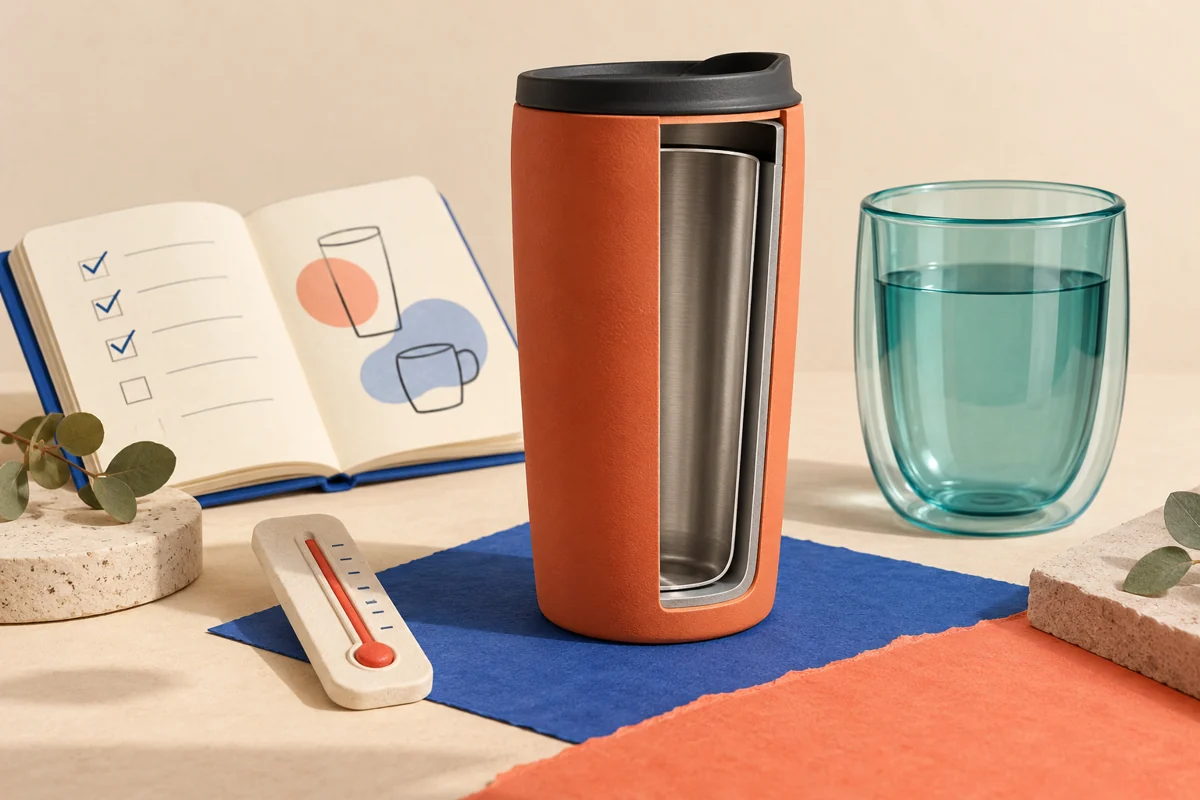
What double-wall and vacuum-insulated actually tell you
A double-wall vessel has an inner wall and an outer wall. That description alone does not tell you whether the intervening space contains air, another insulating material or a vacuum. Ask for the manufacturer's explicit construction statement rather than inferring it from stainless steel, a thick rim or a premium-looking finish.
Vacuum insulation uses an evacuated space to limit heat transfer between the walls. The University of Sydney's thermos-flask teaching sheet explains the roles of reduced conduction and convection across the gap, reflective surfaces and remaining conduction paths where parts connect. The practical implication is straightforward: the wall system matters, but the whole vessel is not an impenetrable thermal barrier.
| Specification wording | What it establishes | What still needs evidence |
|---|---|---|
| Double-wall | Two-wall construction | What occupies the gap; actual temperature performance |
| Double-wall vacuum-insulated | An evacuated insulating space is specified | Performance for the exact size, closure and use pattern |
| Stainless steel | A material claim | Whether the vessel is single-wall or insulated; permitted beverages |
| Keeps drinks hot or cold | A general intended benefit | Starting conditions, duration and definition of hot or cold |
| Leakproof or splash-resistant | A separate containment claim | Applicable lid, closure position and restrictions |
Do not turn that table into a universal quality ladder. A non-vacuum cup can be appropriate for nearby refills, an open-desk setting or a preferred drinking feel. Vacuum insulation deserves more weight when maintaining temperature between refills is an explicit requirement. Neither construction label tells you whether someone will like the handle, mouth opening or cleaning routine.
Define the drinking job before setting an insulation requirement
Write a one-sentence use case before requesting samples. For example: “Recipients want cold water available during a three-hour afternoon away from their desks, and the bottle will travel upright in an external bag pocket.” This is a hypothetical requirement, not a product performance claim. It is much more useful to a supplier than “premium insulated bottle.”
Separate three questions: how long the drink should remain appealing, how it will be carried, and how often it can be refilled. Then identify whether the same item must serve hot and cold drinks. A gift assortment can offer different solutions instead of forcing one vessel to satisfy incompatible routines.
| Recipient situation | Priority to establish | Reason to reject a candidate |
|---|---|---|
| Desk use beside a refill station | Comfort, access and easy cleaning | Awkward drinking or a cleaning burden that outweighs longer retention |
| Cold water between distant refill points | Capacity and temperature over the actual interval | The tested configuration misses that interval |
| Coffee on a commute | Hot-beverage approval, closure and handling | The supplied lid is not approved for the intended drink |
| Travel inside a bag | Documented containment suitability | Good insulation paired with only splash resistance |
For a mixed workforce, present the choice as “desk cup,” “cold-drink bottle” or “hot-drink travel option” only when the underlying specifications support those descriptions. Avoid implying that one is a lesser gift merely because its headline retention claim is shorter.
Compare thermal claims without inventing a league table
A printed duration is not automatically a comparable test result. Request the conditions behind it: vessel capacity, fill amount, starting liquid temperature, room temperature, ice quantity if applicable, lid configuration, opening frequency and the endpoint used to define success. Missing information is a comparison limit, not proof that the product is poor.
YETI's official Rambler FAQ explicitly declines to guarantee a precise ice-retention time because of the variables involved. It also says its Straw Cap and Straw Lid are not intended for hot beverages. These are useful reminders that retention claims and permitted use must be checked separately; they do not establish how a different manufacturer's product performs.
Keep “ice remaining” separate from “water stays below our chosen temperature.” Do not convert a cold-drink duration into a hot-drink duration. Do not transfer a claim from one capacity to another because the products look alike. If the exact configuration lacks comparable evidence, describe it in the shortlist as performance not yet compared under our use conditions.
Marketing copy should remain narrower than the evidence. “Vacuum-insulated stainless-steel bottle with the listed screw cap” may be supportable when “ice-cold all day for every employee” is not. A supplier's generic description is not permission to add your own guarantee.
Run a useful sample review, not a pretend laboratory certification
A small internal review can answer whether a candidate meets your program's needs. It cannot establish a universal ranking or validate every unit in a future shipment. Label the exercise as an internal usability and temperature check, preserve the observations and avoid publishing the results as independent product testing.
- Identify the sample. Record manufacturer, model, capacity, lid, finish and decoration method. Photograph the product and its care instructions. If the final decoration is unavailable, mark approval as conditional.
- Choose the endpoint first. State the use interval and preferred temperature range before seeing results. These are your acceptance criteria, not universal definitions of hot or cold.
- Make the comparison fair. Use matching starting conditions where practical. Record actual fill, ice, ambient conditions and any manufacturer-recommended preparation. If capacities differ, disclose that limitation instead of presenting the outcome as an insulation-only comparison.
- Keep opening behavior consistent. Decide when lids will be opened and readings taken. Record deviations. An unopened bottle and a frequently used cup are different test situations.
- Measure and document. Use an appropriate thermometer consistently, within manufacturer use limits. Record readings at the start and agreed checkpoints rather than relying on how the exterior feels.
- Review handling and cleaning separately. Check grip, opening effort, drinking comfort, part removal and reassembly. Do not allow a strong temperature result to cancel a usability failure.
- Repeat unexpected outcomes. Check the setup, request another sample where needed and ask the supplier about possible defects. One unusual result is a reason to investigate, not a basis for broad claims.
Keep the review within the product's instructions. Do not improvise with boiling liquids, altered closures or heating methods the manufacturer has not approved. A cold-water comparison may answer a cold-drink requirement without running a hot-drink test at all.
A simple record can use these columns: candidate identifier; intended job; approved beverage and lid; setup; start reading; checkpoint readings; opening events; handling notes; care notes; decision; unresolved evidence. Assign one owner to resolve the final column before ordering.
Approve the lid, finish and care instructions as one system
The vessel body is only part of the purchase. A different lid may change the intended use and recipient experience. Keep the approved configuration together on the quote, product page and packing instructions. For the separate containment decision, use our drinkware lid selection guide.
Care also cannot be inferred from insulation type. Tervis's Classic Insulated and Symglass use-and-care guidance directs buyers to the bottom-of-vessel microwave marking and explains that metallic elements in the vessel or decoration can make it unsuitable for microwaving. That is a specific manufacturer's instruction, not permission to microwave other double-wall products.
For branded merchandise, request instructions for the finished item, including its decoration. Resolve any mismatch between the blank's care sheet and the decorator's requirements before launch. Our dishwasher-safe branded drinkware approval guide explains that separate approval task in detail.
Do not use condensation as your sole pass/fail test for vacuum construction. Ask for the construction specification and assess performance under recorded conditions. A visual symptom can support a service inquiry, but it is not a substitute for identifying the exact product and checking the manufacturer's troubleshooting guidance.
Choose bulk, on-demand or a hybrid after approving the product
Insulation does not determine the fulfillment model. Confirm whether the approved model, finish and decoration are actually orderable in the required quantities and destination countries. An available retail product is not automatically available as a one-unit branded company-store item.
Bulk can fit a fixed event or a known group that has selected the same vessel. It may make a particular decoration process or packaging treatment practical. Include freight, storage, distribution and unused units in the comparison, not just the product price.
On-demand can fit ongoing recipient choice where the supplier supports the exact item and decoration. It avoids committing to a finished quantity upfront, but production timing, individual shipping and available models may change the decision. Obtain quotes rather than assuming lower total cost.
A hybrid can reserve a tested bulk option for a dated event while offering other approved drinkware through an ongoing store. Keep model identifiers clear so a substitute is not silently described with the original item's performance claim. Our on-demand versus bulk decision guide covers the broader cost comparison.
An illustrative decision: choose for the interval, not the biggest claim
Suppose a company wants one gift option for desk-based employees and another for people away from refill points for three hours. This is a hypothetical program, not a Brand Sauce client result.
Candidate A is a comfortable double-wall desk cup with clear care instructions but no comparable retention data. Candidate B is vacuum-insulated with a lid approved for the intended beverage. Candidate C has an impressive headline duration, but the supplier cannot establish which lid or capacity the claim describes.
The sensible next step is not to rank C first. Review A for the desk job, run the agreed temperature check on B for the longer interval, and hold C pending clarification. If B misses the requirement, reject or revise the selection; “vacuum-insulated” is not an automatic pass. If A works well for short refill cycles, it does not need to win a long-duration contest to remain useful.
Frequently asked questions
Is all double-wall drinkware vacuum-insulated?
No. Double-wall alone identifies two walls. Require an explicit vacuum-insulation specification if that construction is part of your buying requirement.
Does vacuum insulation mean a bottle is leakproof?
No. Thermal performance and containment are separate questions. Verify the exact closure and its permitted use rather than deriving a leakproof claim from the body construction.
Should we always choose the longest hot-or-cold rating?
No. Choose a product that meets the real use interval and handling requirements. Compare ratings only when their conditions and endpoints are understood; otherwise request evidence or run a limited internal review.
What should go on the supplier brief?
Include the intended beverage, refill interval, capacity, carrying method, approved lid, desired temperature endpoint, care expectations, decoration, quantity, destinations and delivery date. Ask the supplier to identify unsupported requirements and quote the exact finished configuration.
The buying rule: confirm the construction, define the job, verify the complete configuration and preserve the evidence. A useful employee gift is the one that works in the recipient's routine—not the one with the most impressive unexplained number.