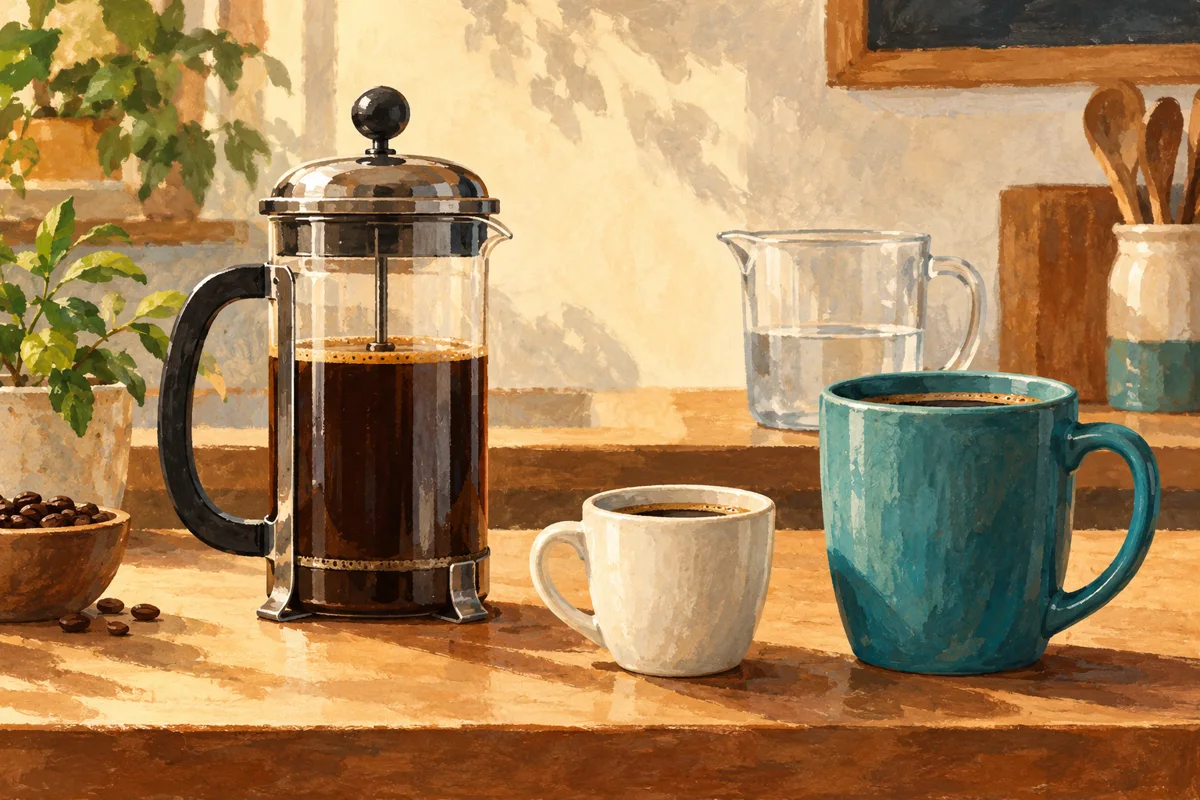
No: an “eight-cup” French press is not a promise of eight full office mugs. Before pairing a coffee press with branded drinkware, translate the maker’s capacity into the amount of coffee the recipient actually pours. Then check the smallest batch the press is designed to brew. A larger gift can be the wrong size for a one-mug morning.
Three numbers that should not share one label
Keep the manufacturer’s cup count, the stated liquid capacity and the intended serving size separate. The word “cup” on a coffee maker is not necessarily the volume of the mug going into your gift box.
For example, Bodum’s BRAZIL 10938-04B listing describes an eight-cup press as 1.0 liter / 34 ounces and explains that its coffee and tea makers use European cup sizes of about four ounces. Its directions also require at least an inch of space at the top when adding water. That is a reason to follow the actual instructions—not fill the vessel to the rim to make a serving-count claim.
Do not assume every manufacturer uses that same convention. ESPRO’s P7 specifications explicitly list brew capacity and minimum brew size: 18 ounces with a 15-ounce minimum, or 32 ounces with a 24-ounce minimum. Those lower limits matter when the intended recipient only wants a small batch. Read the current manual for the version supplied before deciding how to use it.
These are examples of specification wording, not a Brand Sauce catalog shortlist. Decoration, supply to the destination country and current availability require separate confirmation; branded-order pricing remains quote-needed.
Work backward from the mug, not forward from “eight”
Ask how much coffee goes into each serving, leaving whatever room the recipient wants for milk and comfortable carrying. A mug’s advertised brimful volume is not a required drink portion. Use the same unit throughout the calculation; do not mix fluid ounces, weight ounces and milliliters.
Illustrative planning example—not a product test: a client thank-you set contains two mugs, each intended to receive 250 ml of coffee. The required poured batch is 2 × 250 ml = 500 ml. Four such servings need 1,000 ml. A press labeled one liter does not, on that label alone, establish that it delivers four complete 250 ml servings after brewing. Ask what the capacity describes and verify the intended pour using the supplied instructions.
The useful calculation is required poured coffee = number of servings × coffee per serving. It is a requirement for selection, not a prediction of the yield from every press. Keep water added and coffee poured as separate observations when reviewing a sample.
A small capacity card for the purchase request
Send this card with the proposed mug-and-press combination. It gives a supplier a specific question to answer instead of “Will this be big enough?”
Gift use: [one person / two people / shared serving]
Press: [manufacturer, exact model and size]
Stated capacity: [number, unit and whether it means vessel or brew capacity]
Allowed batch range: [minimum and maximum from current instructions]
Target pour: [servings] × [coffee per serving] = [required total]
Paired mug: [exact model and intended fill level]
Sample observation: [water added, coffee poured and complete servings achieved]
Release decision: [fits the intended use / change size / change pairing]
For the sample observation, use the manufacturer’s recipe, fill limits and operating instructions. Do not overfill or force the plunger to reach a target volume. Record the conditions so that a different press cannot inherit the original approval just because both boxes say “eight cups.” This is a proposed review method; Brand Sauce has not performed the test described here.
Choose for the morning the recipient actually has
- One small serving: prioritize a documented minimum batch that fits the routine. Do not upgrade to the largest press simply because it looks more generous.
- Two people sharing breakfast: confirm the poured amount covers both intended servings in one batch. Approve the mugs and press together.
- A meeting table: specify the number and size of portions before calling the press suitable for a group. A small-cup count is especially easy to misread in this setting.
- Unknown coffee habits: make the press an optional gift choice rather than adding one to every box. A useful pairing depends on someone wanting to brew coffee this way.
For the broader set-versus-single-item decision, see when a coordinated gift bundle makes sense. If the alternate option is tea, use the separate infuser-and-mug fit check; a vessel that holds enough liquid can still be the wrong physical pairing.
Bottom line: approve a press by the batch it needs to make, including the minimum—not by the largest number printed beside “cups.” Put the serving assumption on the order so the gift, mug and recipient instructions agree.
Illustration: AI-generated editorial concept, not a catalog product or test result. Manufacturer sources checked October 18, 2026.