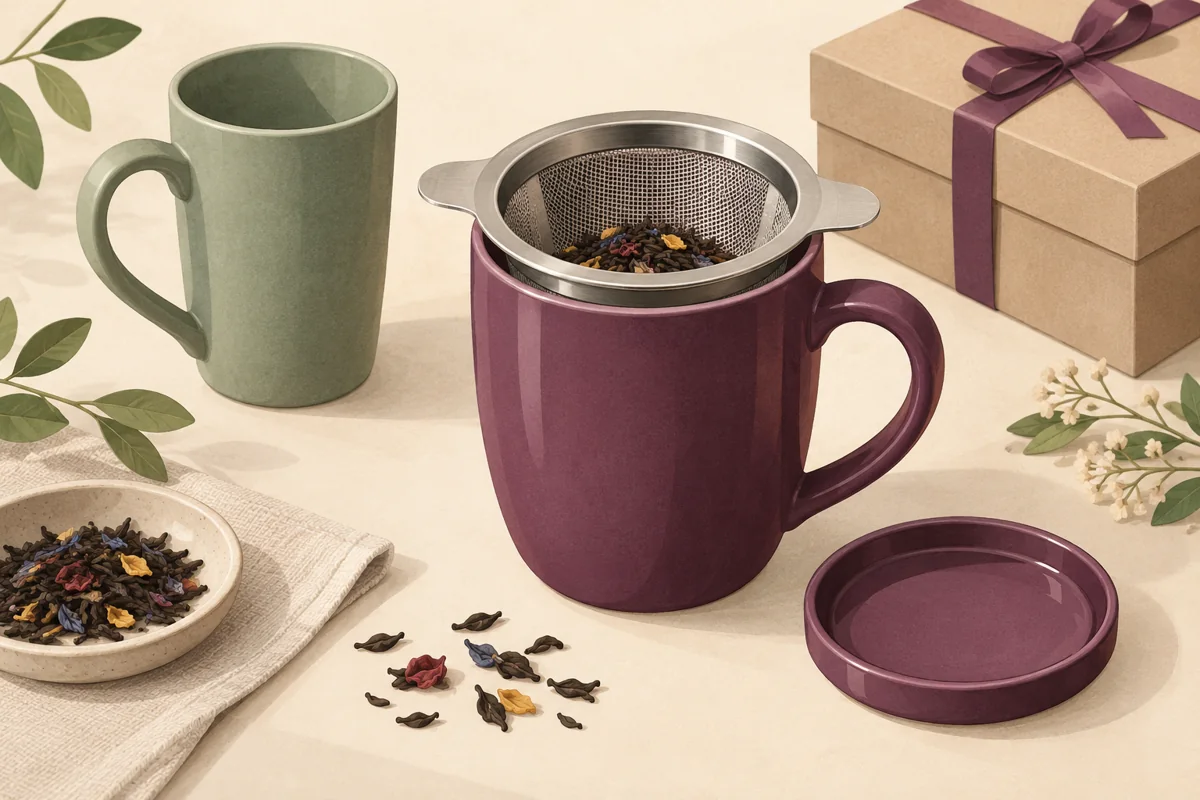
A tea infuser and a branded mug should be approved as a pair. The mug’s ounce capacity does not tell you whether a basket will enter the opening, hang securely above the base or reach the water. For a client thank-you kit or hotel team gift, specify the actual mug, infuser and tea together—not three attractive items from separate pictures.
Measure the opening, then check the resting position
For a basket that hangs from the mug’s rim, ask for three dimensions: the basket body’s widest external diameter, the overall span of its supporting rim or arms, and its depth below those supports. On the mug, measure the clear inside opening and the usable interior depth. A tapered mug also needs a clearance check farther down, where the basket will sit.
The body must enter without forcing, while the supports must stay on top rather than slip inside. The basket should hang as intended without bottoming out. Finally, check the intended serving level: a basket can fit mechanically yet leave much of the tea above the water. A nominal mug volume answers none of those questions.
Illustrative screening example—not a product specification: a mug has an 80 mm clear opening and 90 mm interior depth. A basket with a 65 mm body, 95 mm support span and 70 mm hanging depth looks worth sampling. A 78 mm support span would not reliably bridge that opening. Even the first combination is not approved from arithmetic alone: taper, rim shape and manufacturing variation still need a physical check.
Match the filter to what recipients will brew
Room for the leaves and a suitable filter are separate requirements. finum’s Brewing Basket M uses fine stainless-steel mesh and is designed to leave space for leaves to open. Its lid also works as a drip tray. Those are useful design features to request; they do not establish compatibility with your chosen mug.
OXO’s Tea Infuser Basket uses a large stainless-steel basket with an etched filtering pattern and a lid that doubles as a drip tray. These are manufacturer examples, not a verified Brand Sauce assortment or a promise that either item can be customized or delivered to every country.
Ask the tea supplier which filter suits the exact blend you plan to include. A visually open novelty infuser may be a poor pairing for a finely cut blend; a small enclosed infuser may not suit a generous portion of large leaves. Do not promise a sediment-free drink from a product image. Trial the intended tea at the tea maker’s stated dose, temperature and time, then inspect the cup and the cleanup.
The sample walkthrough
Use the following acceptance card with one complete sample set. This is a proposed buyer check, not testing Brand Sauce has performed.
- Seat it empty: insert and remove the basket. It must sit securely without wedging, rocking or slipping through the rim.
- Check the serving level: using the mug’s intended fill level, confirm that the leaves will be immersed while leaving appropriate headroom. Do not solve poor immersion by filling a mug to the brim.
- Brew the supplied tea: follow its instructions, observe leaf space and note any escaping particles. Have the person approving the gift judge the actual combination.
- Remove and park it: follow the infuser’s hot-handling instructions. Identify where the wet basket goes after steeping. A supplied drip tray completes a desk gift; a loose wet basket needs another landing place.
- Empty, clean and repack: confirm that spent leaves can be removed and the basket cleaned according to its maker. Check mug-decoration care separately; an infuser’s dishwasher claim does not cover the printed mug.
When to change the gift
If the intended mug is a narrow travel vessel, do not assume a desktop basket belongs inside it during transport. Verify the complete body-and-lid arrangement using the employee drinkware selection guide. If the pair does not work, change the mug, source a specifically compatible infuser or offer a different gift—not an instruction telling recipients to improvise.
For kits that include tea, keep ingredients and brewing instructions with the sealed product and provide a meaningful alternative for recipients who do not want it. Our food-versus-nonfood gift guide covers that choice. Before ordering, request written confirmation of exact components, decoration placement, destination-country supply and delivered cost; unresolved prices remain quote-needed.
Image: AI-generated editorial illustration, not a catalog photograph or a product-test result.