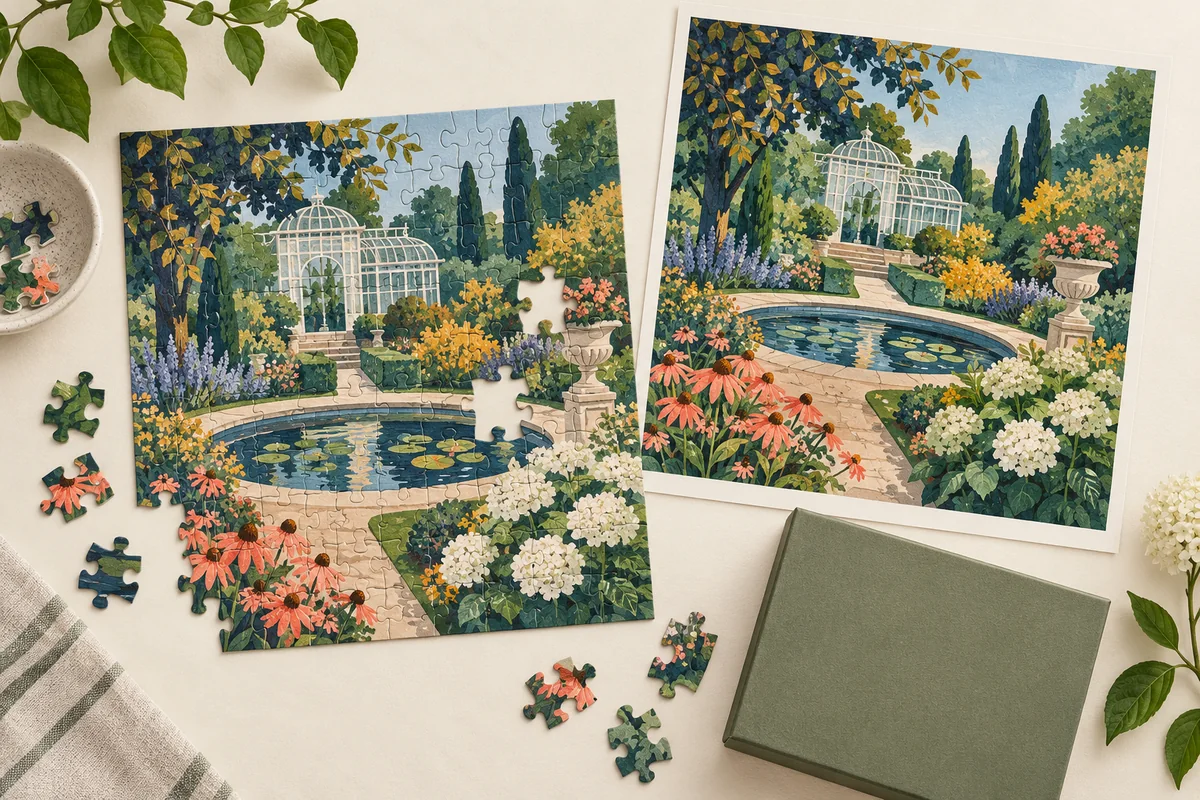
A logo that looks sharp in a slide deck is not automatically ready for a custom jigsaw puzzle. Approve the artwork at the puzzle’s finished shape and size, check what the crop removes, and review the box separately. A file passing an upload check is only one part of that decision.
For a museum membership gift or a visitor-center souvenir, the image is also the activity. A beautiful photograph with a tiny landmark surrounded by empty sky may communicate the location well but offer few visual clues across much of the puzzle. Treat that as a design choice, not a printing defect.
Gate 1: does the picture survive the crop?
Ask for the exact finished dimensions, orientation, artwork template, bleed and safe area before your designer exports a file. Do not borrow these measurements from a different piece count or supplier. A safe area protects essential content from trimming; bleed extends the background beyond the intended trim. They are not interchangeable.
Ravensburger’s US custom-puzzle FAQ recommends keeping important elements away from the edges because manufacturing may trim them. Its current upload requirements specify JPEG and RGB, with different recommended pixel dimensions for different piece counts. Those are that provider’s requirements, not a universal puzzle specification.
Preview the crop with the actual image—not a placeholder. Check faces, artwork signatures, the institution’s name and any building detail that makes the picture recognizable. If the crop cannot preserve the subject, change the composition, orientation or product format. Shrinking everything into a border is another design option, but first decide whether that border belongs in the finished puzzle.
A worked crop calculation
Illustrative example, not a supplier specification: suppose your approved print area is 20 by 15 inches and your original photograph is 4,000 by 3,000 pixels. Its 4:3 shape matches that print area. Dividing pixels by inches gives 200 pixels per inch in both directions.
Now suppose the proposed format changes to 24 by 16 inches. To fill that 3:2 shape without stretching, the same photo needs a crop to approximately 4,000 by 2,667 pixels. That removes about 333 pixels of height—roughly 167 from the top and bottom for a centered crop—and leaves about 167 pixels per inch at the new size.
The buyer’s decision has changed twice: some of the photograph disappears, and the remaining image is enlarged more. Whether that resolution is acceptable depends on the selected supplier’s specification. Ask the designer to account for the actual template and bleed too. Changing a file’s resolution label alone does not add original image detail.
Gate 2: will the design work as a puzzle?
Print the proposed artwork at its intended physical size, using tiled sheets if necessary. This is a layout check, not a contract color proof. Look for small text that becomes unimportant at normal viewing distance, dark areas that merge, and large stretches with few distinguishable features.
For an approachable souvenir, our editorial recommendation is to favor a composition with recognizable areas: different buildings, flowers, objects or colors that give people places to start. A monochrome image or large plain background can be an intentional challenge for experienced puzzlers. Neither choice guarantees a completion time, and piece count alone should not be used to promise one.
puzzleYOU’s design instructions make an important distinction: the editor can check whether an uploaded image is large enough, but that does not check its sharpness. A high-pixel-count file may still contain blur. Inspect the original, not just the thumbnail preview.
If a name or small logo must remain legible, ask how the cut interacts with it. A digital mockup with decorative puzzle lines does not prove the production cut will land there. Request a finished sample when the result is important, and distinguish approval of image placement from approval of color, surface finish and piece fit. We have not physically tested a puzzle for this post.
Gate 3: does the box match the approved experience?
Review the box as its own artwork file. puzzleYOU, for example, permits box designs that do not show the puzzle image; its instructions note that this keeps the design a surprise and makes completion more challenging. Decide deliberately whether recipients should have a reference picture. Do not assume the puzzle-face proof approves the box title, crop or layout.
Use this compact release record for the order:
- Product: supplier, exact model, piece count, finished dimensions and destination country confirmed.
- Face artwork: filename/version, crop, pixel dimensions and supplier’s acceptance confirmed; reproduction permissions recorded.
- Essential content: names, logos and signatures inside the supplier’s safe area; any cut-line uncertainty resolved or accepted explicitly.
- Box artwork: filename/version, title and reference-image choice approved separately.
- Proof scope: record what the digital proof establishes and what still needs a physical sample. Name the approver and keep the approved files.
These manufacturer examples explain artwork checks; they are not a verified Brand Sauce product shortlist or a promise of catalog availability. Confirm decoration, destination-country supply and production timing for the actual order. Pricing is quote-needed.
Preparing the logo component? Use our logo-file handoff guide, then export to the puzzle supplier’s required format. If the souvenir will be mailed, also separate the presentation box from the protective shipping packaging using our gift-box versus shipping-box guide.
Image: AI-generated editorial illustration, not a product photograph or production cut template. Manufacturer guidance checked October 7, 2026.