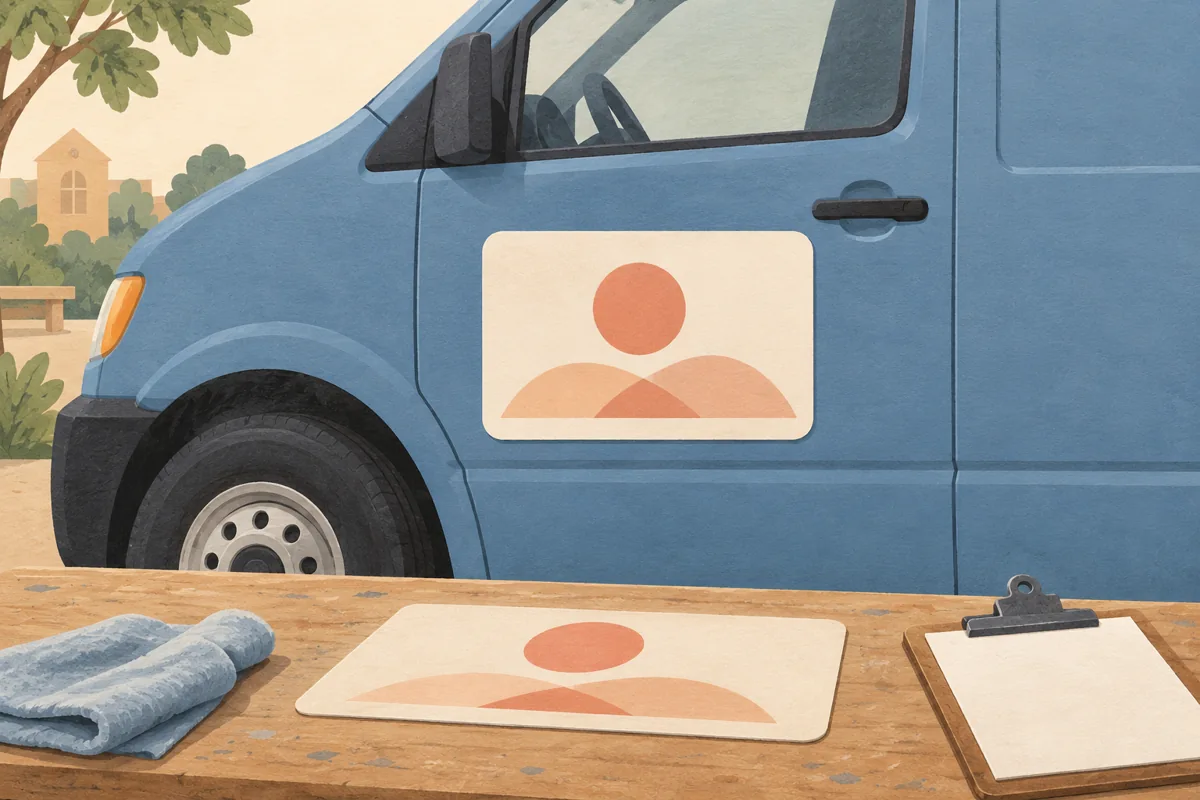
A branded vehicle magnet will not work on every vehicle—or every panel of the same vehicle. Before ordering signs for a community nonprofit’s vans or volunteers’ cars, confirm the intended panel, the sign’s full-size fit and who will remove and clean it. A logo proof cannot answer those questions.
The useful buying unit is vehicle + exact panel + sign size, not simply “one sign per driver.” Start with a small fit-check list before collecting artwork or quantities.
Check the panel, not the vehicle’s name
Magnum Magnetics’ flexible-material care guide notes that its product will not work on aluminum or plastic panels. It also excludes repainted surfaces and non-metallic body fillers. A door that looks like the neighboring steel bodywork is not enough evidence.
Ask the vehicle owner to identify the proposed location and disclose repairs, repainting or a wrap. Have the sign supplier resolve uncertain surface compatibility before applying a sample. Do not assume a stronger magnet solves an unsuitable panel.
Then check the complete proposed footprint. Magnum calls for contact across the entire magnet, without gaps over molding, decals, protrusions or recesses. A small test piece that sticks in the center does not demonstrate that a much larger finished sign fits around the door’s contours.
Decide who owns removal and cleaning
Removable does not mean maintenance-free. Master Magnetics recommends weekly removal to check and clean vehicle applications, and removal before a car wash. It warns that trapped dirt can damage the finish and that a sign must sit flat, not across molding. For repositioning, lift it off and reapply rather than dragging it.
Care intervals are not identical across suppliers: Magnum’s guide specifies daily removal and cleaning for vehicle-mounted signs. Follow the instructions for the actual material you order; do not substitute the most convenient schedule from a different manufacturer.
For a shared van, name a role—such as the driver returning the keys—not “everyone.” For volunteers’ personal cars, explain the care commitment before asking them to accept a sign. If nobody can reliably own it, a magnetic sign may be the wrong format.
Copy this vehicle-by-vehicle approval card
Complete one record for each intended placement. This is a proposed purchasing checklist, not a Brand Sauce test result or a road-use certification.
- Vehicle and permission: internal vehicle ID, owner’s approval and any restrictions on displaying organization branding.
- Exact location: panel and side, with a photo showing its edges, handle, trim and surface condition. Ask the supplier to review unresolved compatibility questions.
- Finished sign: quoted material, dimensions and supplier’s written suitability for the intended vehicle application. Do not substitute a refrigerator giveaway magnet.
- Full-size fit: use a paper outline to identify space conflicts, then inspect the actual sign sample on an approved surface. Record any lifted edge, air pocket or obstruction. A paper outline checks space only, not holding performance.
- Care handoff: attach the selected material’s instructions; name the cleaning/removal owner, required interval and storage location.
- Decision: approve this placement, revise dimensions and recheck, or exclude this vehicle. Keep unresolved records out of the order quantity.
Request the sample and care sheet before the final production approval. Once the placement is settled, use our logo-file checklist for the artwork handoff. If the sign includes a QR code, also use the physical QR scan checklist; keep the intended interaction to a safely parked vehicle and a stationary viewer.
A mixed-fleet decision, not a bulk assumption
Illustrative example: a nonprofit has six volunteer drivers. Its review finds two suitable placements, two panels the supplier rules out, one placement needing a smaller sample, and one owner unwilling to handle the care routine. That is two approved placements—not an automatic order for six identical signs. The smaller version stays pending; the others need a separate identification approach.
Those numbers are hypothetical. The point is to buy against approved placements, not attendance or headcount. A successful sample on one van does not approve all volunteers’ cars.
Keep signage separate from what volunteers wear: our volunteer T-shirt planning guide covers that different identification need. For any magnetic-sign quote, confirm destination country, production availability, delivered cost and the exact material. This checklist is not a claim that a particular sign is currently stocked in the Brand Sauce catalog; pricing remains quote-needed.
AI-generated editorial illustration, not a customer vehicle or product test. Manufacturer guidance checked October 2, 2026.