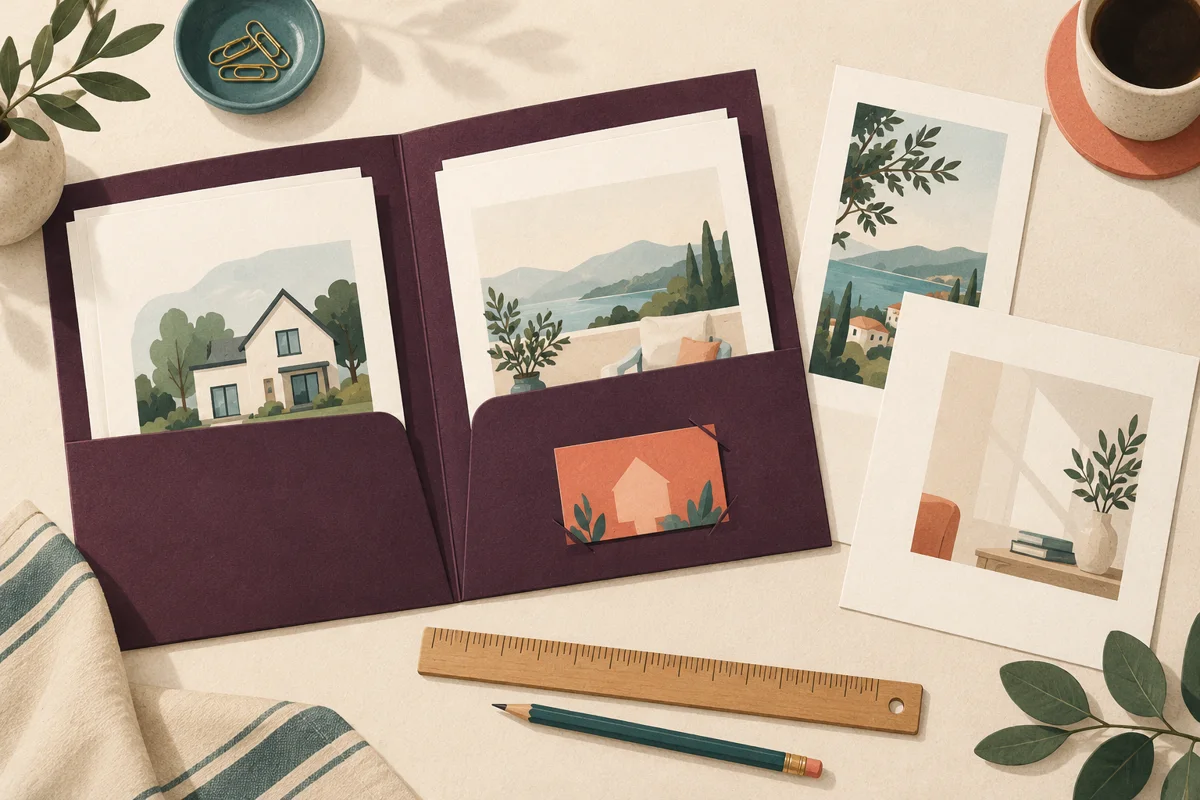
Order branded presentation folders around the finished inserts, not the label “standard folder.” A4 is taller and narrower than US Letter, and a folder’s outside dimensions do not tell you how much usable space remains inside its pockets. For a real-estate welcome packet, that means approving the property sheets, brochure and contact card together before printing the folders.
A folder can pass the cover-art proof and still fail when someone packs it. The useful approval is a loaded sample: the exact contents, in the intended pockets, with the folder closed.
Primary sources checked October 13, 2026. The hero is an AI-generated conceptual illustration, not a product photograph or a scale drawing. The checks below are a proposed buying procedure, not results of Brand Sauce product testing.
A4 and Letter: check both dimensions
Adobe’s paper-size guide gives A4 as 210 × 297 mm and US Letter as 8.5 × 11 inches. Converting Letter to millimeters gives 215.9 × 279.4 mm. So A4 adds 17.6 mm of height, while Letter adds 5.9 mm of width. Neither format is simply smaller in every direction.
Do not choose by the office’s country alone. A US agent may receive an A4 property brochure from an overseas partner; a regional office may print a Letter-format PDF locally on A4. Ask for the actual finished sheet size after printing and trimming, including any protruding tabs or document sleeves.
Printing for Less describes its standard 9 × 12-inch presentation folder as designed for 8.5 × 11-inch sheets. It also offers different pockets, card slits and increased-capacity constructions. That is a useful manufacturer example—not confirmation that every 9 × 12 folder fits every A4 packet, or an offer from the Brand Sauce catalog.
Make the choice in this order
- One paper format, a few loose sheets: request a folder explicitly specified for that insert size. Confirm the usable pocket width and the document height the closed folder accommodates.
- Mixed A4 and Letter: send both finished samples. Require approval with the wider Letter sheet and the taller A4 sheet loaded together. Do not use the fit of one to approve the other.
- A booklet, multiple folded brochures or a thick packet: request a capacity recommendation based on the complete stack. A larger front cover alone does not resolve thickness at the fold; ask whether an expansion pocket or spine is needed.
- An oversized or legal-size insert: change the folder specification or intentionally redesign the insert. Do not leave folding or trimming decisions to whoever assembles the packet.
Count physical sheets and objects, not just PDF pages. A duplex eight-page document may be four sheets; a folded brochure adds layers in a smaller area. For any quoted sheet capacity, ask which paper stock and pocket allocation that figure assumes.
The loaded-proof check
Request a physical construction sample matching the proposed size, pockets and capacity. An undecorated sample can answer fit questions, but it cannot approve final color or finish. Review those separately using the supplier’s production proof and the logo-file preparation checklist.
- Pack the maximum planned contents in their assigned pockets. Include the thickest brochure, card and any sleeve or tab.
- Close the folder without forcing it. Check that inserts stay within the intended cover boundaries and do not buckle at the center fold.
- Remove and replace each item as a recipient would. Reject a layout that requires bending a sheet or tearing a pocket to retrieve it.
- Insert the real business card. Confirm its size and portrait or landscape orientation match the slits; check that essential contact details remain visible.
- Inspect the artwork with the folder assembled and loaded. Pockets and inserts should not hide information intended to be read at that stage.
- Put the completed folder in the actual handoff tote or mailing package. If it will be shipped, review presentation versus shipping packaging rather than treating a paper folder as shipping protection.
Copy this into the print brief
Folder fit approval: Finished insert dimensions: __. Maximum physical contents and paper stocks: __. Left-pocket contents: __. Right-pocket contents: __. Card dimensions and orientation: __. Required pocket/capacity construction: __. Final tote or shipping package: __. Sample reference and approved proof version: __. Approver/date: __. Recheck fit if insert size, stock, quantity, folding or folder construction changes.
Illustrative decision: a brokerage packet contains two Letter property sheets, an A4 neighborhood guide and one folded brochure. The buyer should not approve it using an empty 9 × 12-inch folder mockup. Send all four physical pieces plus the agent’s card, assign the pockets, and approve the loaded construction. If it fails, choose a different folder or revise the packet before authorizing the run.
Keep the order quote-specific: folder construction, printing, assembly, destination-country availability and delivery timing all need confirmation. No price or country availability is established by this dimensional checklist.