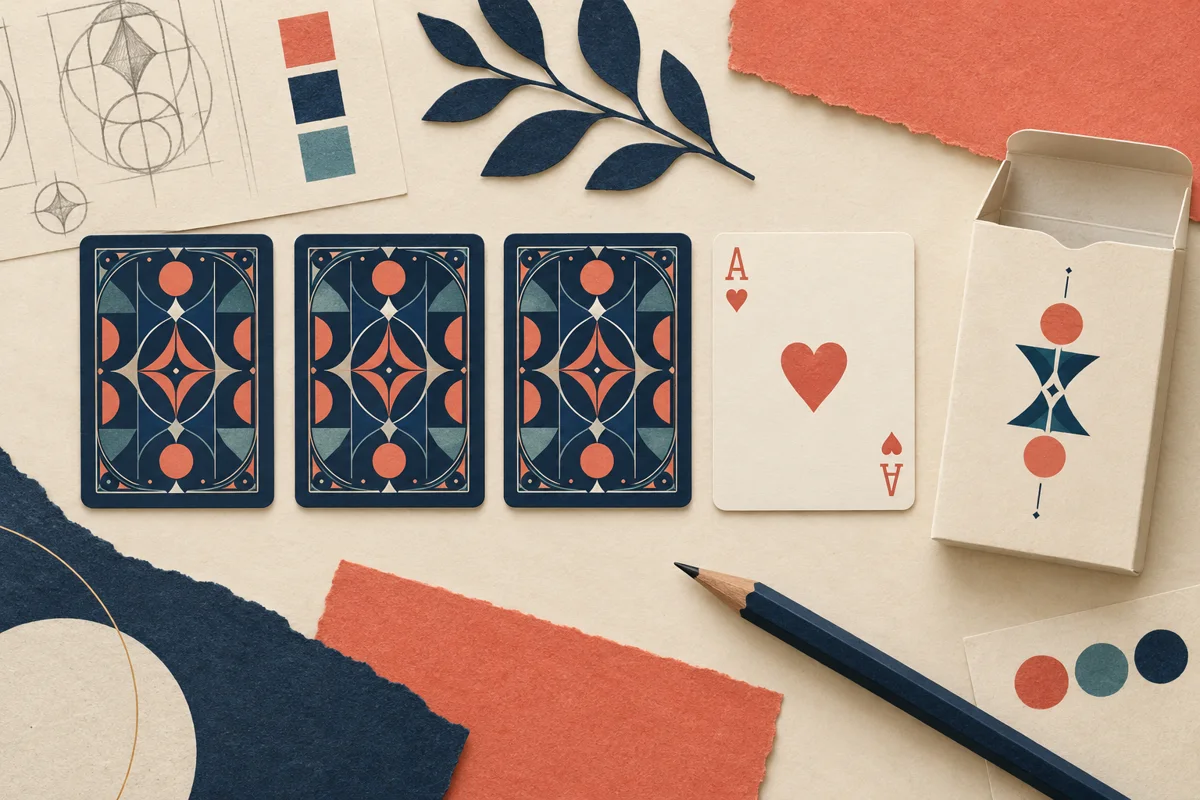
For a branded deck people will actually play with, start with familiar card faces and one consistent back design. Customize the tuck box for the longer brand story. Redesigning every face is a separate creative project—not a necessary part of putting your brand on playing cards.
That distinction matters for a boutique hotel ordering lobby-shop souvenirs or guest gifts. A beautiful deck can still be frustrating if players cannot quickly read their hands, or if the back artwork gives away which card someone holds.
Choose what “custom” should include
- The box only: useful when the souvenir presentation matters more than branding during play. Ask whether the quoted product uses a printed tuck box, a sleeve or just a sticker; these are different deliverables. Check what branding remains on the cards inside.
- The box and every card back: our starting recommendation for a conventional guest-gift deck. Keep the same back artwork throughout, including jokers if they will be used. Put the hotel illustration, logo or pattern here without changing the familiar game information on the faces.
- The box, backs and faces: choose this when the illustrated faces are the point of the souvenir and you have time to review the entire deck. Preserve readable rank and suit indicators. If you replace playing-card information with conversation prompts, describe the result as a prompt deck—not as a deck suitable for ordinary card games.
These are purchasing routes to request, not promises that every supplier offers all three. Bicycle’s custom-printing page describes customization of backs, faces, colors and tuck boxes. It also distinguishes production programs: its promotional section says orders below 5,000 decks are digitally outsourced and are not printed on Bicycle card stock. Do not assume a small custom order has the same stock or production route as a familiar retail deck. Confirm the quoted construction in writing.
Do not turn the card backs into an answer key
MakePlayingCards lists back-art options ranging from one image for the whole deck to different images by suit, number or individual card. That is design flexibility, not a recommendation for every game.
For games where cards are meant to remain hidden, an image associated with a suit or rank can disclose information before a card is turned over. Keep hotel-room photographs or landmark illustrations on the faces, packaging or a separate insert if you want several images without that problem. Deliberately distinct backs can make sense for a teaching activity or a game designed around them; they are not interchangeable with an ordinary deck.
A two-way back pattern is also worth requesting: turn it 180 degrees and see whether it looks the same. This avoids an obvious “up” direction, although it is not a guarantee against manufacturing differences or wear. Do not describe a promotional deck as casino-approved or suitable for professional magic without separate evidence.
Send this brief before anyone builds the artwork
Copy the following into the quote request. Resolve the blanks before approving production.
- Intended use: ordinary card games / souvenir display / custom activity: ______.
- Deck contents: confirm the complete rank-and-suit set, joker count and any separate advertising or instruction cards: ______.
- Custom surfaces: box ______; backs ______; faces ______. One identical back across the playable deck: yes / intentional exception explained ______.
- Exact specification: finished card dimensions, stock, finish, corner shape, box construction and production route: ______.
- Artwork handoff: supplier template and version ______; required file format/resolution ______; separate card and box files ______. Identify who supplies and approves any stock face artwork.
- Proof review: check every face for missing or duplicate cards; fan a printed mock-up to assess corner readability; rotate the back; review the box folds. Approver and dated file version: ______.
- Physical approval: request a sample matching the proposed stock and finish, then agree whether a decorated preproduction sample is available. A digital proof checks content and layout, not shuffle feel or durability.
- Order conditions: quantity ______; destination country ______; decorated sample/production/shipping charges ______; confirmed delivery requirement ______. Unconfirmed pricing stays quote-needed.
Use the printer’s template, not a generic rectangle
MakePlayingCards’ artwork guidance separates bleed from the safe area: background artwork extends into the trim allowance, while important text and imagery stay inside the marked safe boundary. Its upload dimensions vary by card format. Follow the exact template for the selected product rather than transferring measurements from another printer or another size.
The same principle applies to your logo: a clean source file still needs the right placement and margin. The logo-file handoff guide helps prepare the source artwork; the card printer’s template determines its final layout. If the deck is mailed as a gift, review presentation packaging versus shipping protection separately—a tuck box is not automatically a mailing box.
Illustrative decision: a hotel wants four landmark illustrations on a deck intended for guests to play with. Instead of assigning a different landmark to each suit’s back, it selects one repeated back and places the four scenes on the tuck box and an insert. The brief preserves the standard faces and names the exact extra-card count. That solves the hidden-information issue without commissioning 52 new faces.
Manufacturer pages here document design options, not verified Brand Sauce catalog listings. Availability, decoration, country supply, timing and price require confirmation for the proposed SKU. No supplier has been contacted and no deck has been tested for this article.
Illustration: AI-generated editorial artwork, not a product photograph or print-ready proof. Primary sources checked October 6, 2026.