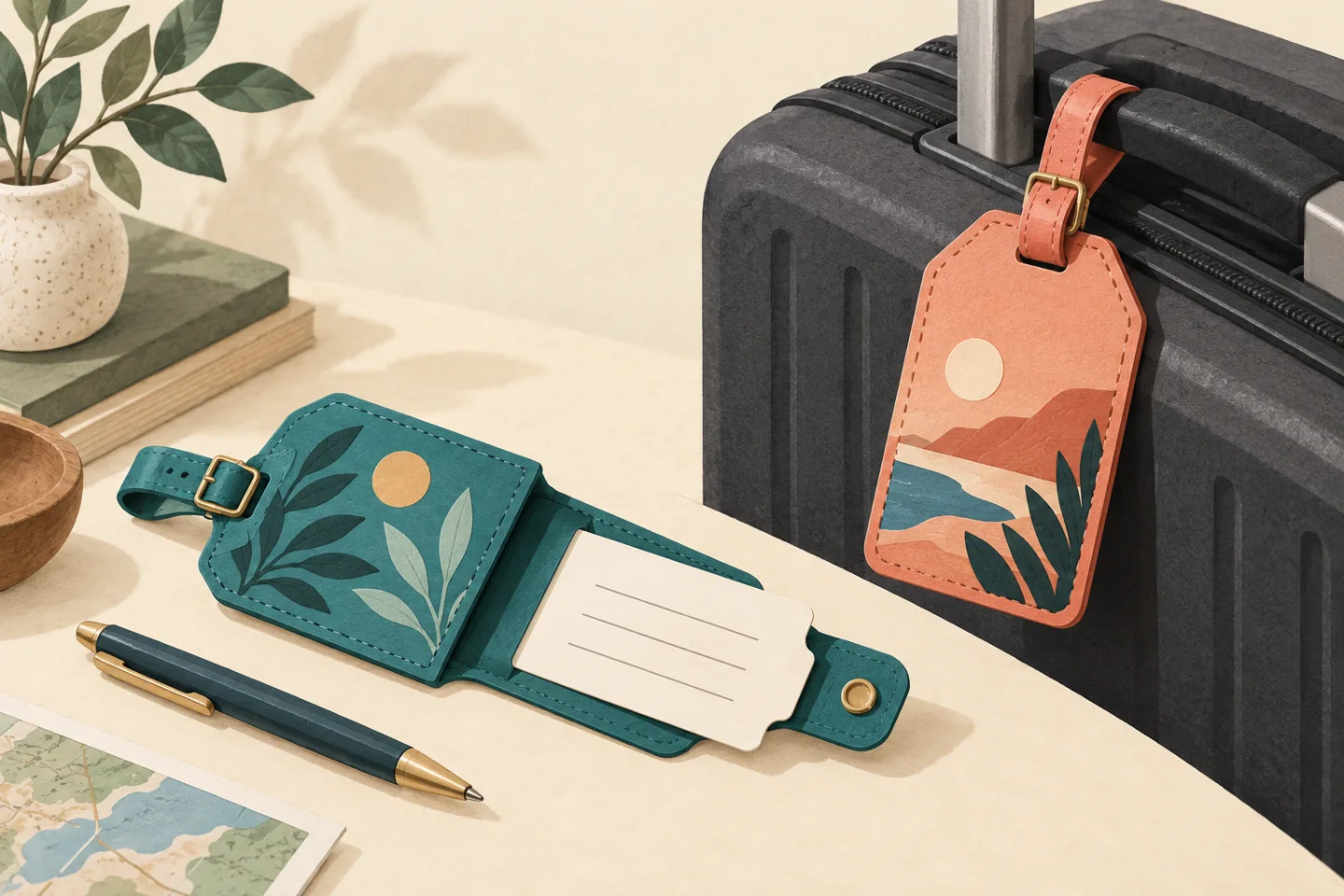
Put the brand on the outside and leave a usable, updateable space for the traveler’s contact details. For employee travel gifts, our recommended starting layout is a name, a phone number with country code and an email address behind an easy-to-open cover. Check the traveler’s airline requirements before treating those fields as sufficient; a branded accessory is not a substitute for the airline’s own baggage label.
The buying decision is less about how large the logo looks and more about whether someone finding the bag can reach the right person. A beautiful tag with only a company website does not identify which employee owns the suitcase.
Separate the logo’s job from the contact card’s job
Delta’s baggage FAQ requires outside personal identification on checked baggage and recommends identification inside as a backup. That is useful direction for a travel-kit insert: remind recipients to complete the tag and put a second identification card inside their bag.
Do not promise that a tag prevents loss or guarantees recovery. It provides another way to identify the owner. The airline’s check-in label and baggage receipt still serve their own purposes; keep them and follow the carrier’s instructions.
For artwork, reserve one face for the logo and keep decoration away from the writable area. Confirm the actual print boundary with the supplier using the logo-file preparation checklist. A decorative preview is not enough to approve the contact side.
A practical field plan for the buyer
- Name: leave enough room for a real traveler’s name, not just initials squeezed below a logo.
- Reachable phone: include a country-code prompt. A desk extension that nobody answers while the employee travels is a poor default.
- Email: choose an address the traveler can actually access away from the office. Do not preprint an unmonitored marketing inbox.
- Address or other carrier-required information: provide space on a replaceable insert and tell the traveler to check the applicable airline instructions. Do not tell every recipient that an address is never needed, or permanently engrave a home address on every gift.
- Information not needed for this purpose: our recommended template omits employee ID numbers, passport details, booking references and itinerary dates.
A flap can keep details out of casual view, but it is not a security system: someone handling the tag can open it. This is a practical design recommendation, not a claim that a covered tag satisfies every airline’s identification requirements.
Copy this luggage-tag sample approval card
Ask the supplier for a finished sample or a representative sample of the exact construction. Record a pass, change or unresolved answer for each item:
- Writing space: fill in the longest realistic name and contact fields at a comfortable reading size. Use dummy details for the sample.
- Cover access: can a finder expose the card without cutting the strap or destroying the tag?
- Update method: can the recipient replace the card after a phone-number change? If it is a permanent writing surface, confirm the approved marker and correction method.
- Attachment: fit the strap to the intended suitcase or backpack handle and follow the supplier’s fastening instructions. Check for awkward loops or an unsecured end.
- Legibility after handling: complete the card using the specified pen, let it dry, then inspect for smearing during ordinary handling. This is your sample check, not a durability certification.
- Handoff: include an instruction to complete the exterior tag, add inside identification and check the airline’s requirements before travel.
Approval record: tag model / insert dimensions / writing method / handle checked / cover access / correction method / open questions / approver / date.
Construction instructions really do vary. The official Qantas Red Luggage Tag page directs users to write on its inside name plate with a permanent marker. It also explicitly says that this tag no longer contains RFID technology for Bag Drop. Those are details for that particular product—not specifications for all tags or a claim that Brand Sauce supplies it. Do not infer tracking capability from a tag’s appearance.
Worked example: a sales-team travel gift
Illustrative decision, not a customer result: a sales team wants matching tags, but employees use different luggage and occasionally change phone numbers. The buyer chooses a branded front with a covered, replaceable contact insert rather than engraving everyone’s contact details. Recipients fill in their own information; the buyer does not need to collect home addresses just to decorate the gift.
One sample’s strap does not fit a team member’s thick backpack handle. The buyer checks a different attachment before approving the order instead of assuming the suitcase fit covers every bag. Our employee-backpack selection guide can help when the tag is part of a bag bundle.
The final brief is simple: readable identification, an attachment that fits and a way to keep details current. Ask for a quote against the approved construction, quantity and delivery countries; price and availability remain quote-needed until confirmed.
AI-generated editorial illustration, not a product photograph or test result. Primary sources checked October 3, 2026.