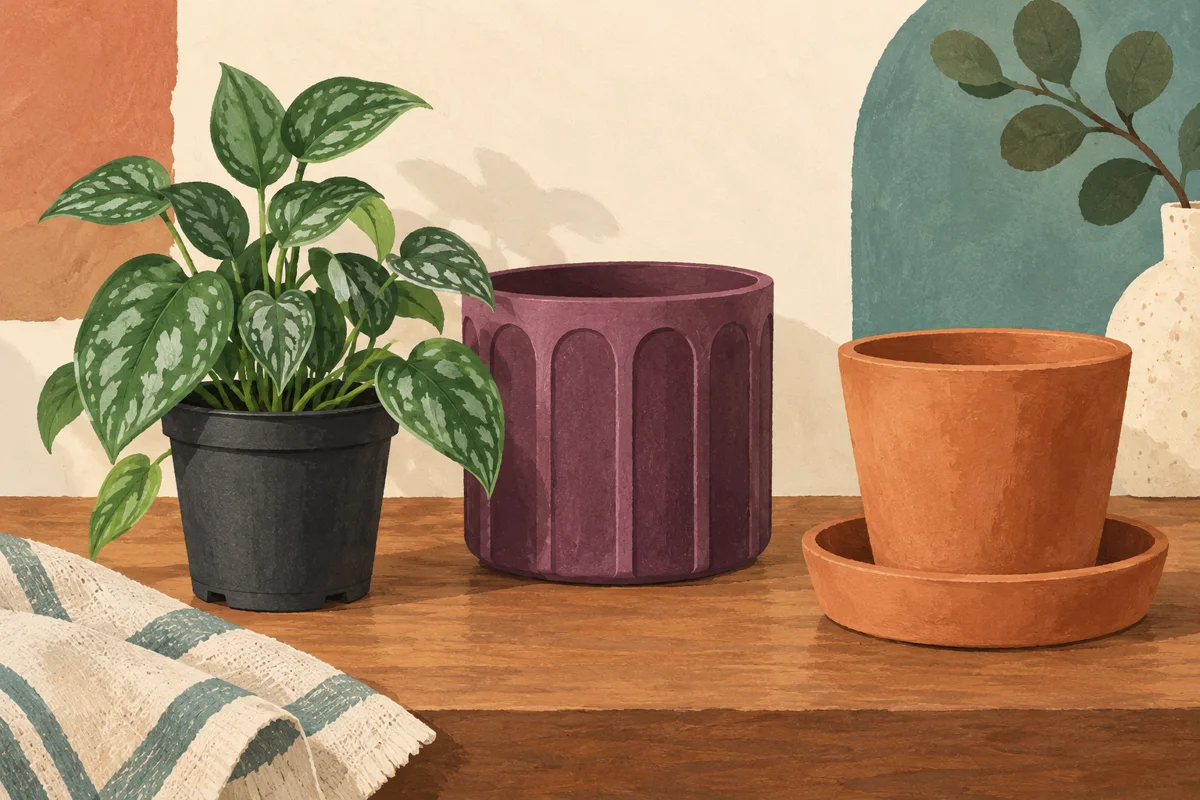
For an ordinary soil-grown desk plant, the pot holding the roots should drain. The branded outer pot does not necessarily need a hole. A decorative cover pot—or cachepot—can hold a removable nursery pot, while a directly planted pot needs a suitable drainage route and a saucer. Specify the whole arrangement, not just the ceramic shell.
That distinction matters when a property-management team, coworking space or employer orders small plant gifts. A handsome pot that leaves recipients guessing where excess water goes is an unfinished gift.
Choose the watering arrangement before the logo
The Royal Horticultural Society’s houseplant guide advises using drainage holes, letting watered plants drain and emptying water-filled saucers. It also recommends checking whether water is needed instead of watering by a fixed routine. Those principles apply to conventional soil-grown houseplants; they are not operating instructions for a purpose-designed hydroponic or self-watering system.
- Branded outer pot plus removable nursery pot: choose this when the recipient can lift out the inner pot, water it elsewhere, let it drain and return it. Check that the inner pot lifts out without pulling on the plant. Specify an outer container suitable for holding incidental water; appearance alone does not establish that it is watertight.
- Direct planting in a draining pot plus saucer: choose this when both pieces can be supplied and packed together. The saucer collects runoff; it is not a reason to leave roots standing in water. Check the saucer’s fit and the assembly’s desk footprint.
- A purpose-designed reservoir system: request the exact maker’s instructions, included parts and plant suitability. Do not treat an ordinary closed-bottom pot as self-watering simply because water can collect inside it.
For a concrete construction example, IKEA Netherlands describes KLOTLÖNN as a pot with drainage holes and an included saucer, suitable for direct planting. That is a manufacturer example of the two-piece arrangement—not a Brand Sauce catalog recommendation, a claim of customization availability or a delivery promise.
Ask for one assembled sample, not two measurements
A nominal pot diameter does not show whether the nursery pot’s rim catches, whether the plant sits too low or whether the saucer rocks under the finished piece. Ask the supplier to show the actual plant or inner pot inside the proposed outer pot. For empty-pot gifts, specify the compatible inner-pot dimensions rather than implying that any small plant will fit.
Keep the drainage opening and mating surfaces clear of decoration. Confirm the proposed print placement on the assembled object, including whether a saucer hides the bottom of the design. Before artwork approval, use the logo-file checklist to provide suitable source files.
Copy this planter approval card
Use this as a buyer’s release checklist. It is a proposed acceptance process, not a report of product testing performed by Brand Sauce.
- Contents: empty outer pot, planted nursery pot, directly planted pot or reservoir system? List every included piece.
- Water route: where does water leave the root container, and who empties the collected runoff?
- Fit: does the actual inner pot lift out freely, or does the directly planted pot sit securely in its supplied saucer?
- Desk protection: have the supplier confirm water containment and base protection. Check the sample on a protected surface for leaks, dampness, rough edges and instability; reject or resolve problems before release.
- Care handoff: include the plant’s identity and supplier-approved light and watering instructions. For the removable-pot arrangement, explain removal, draining and emptying the outer container.
- Packing: identify how the pot, saucer and plant are restrained. Review the difference between presentation and shipping packaging before approving a gift box.
- Supply: confirm decoration, destination-country availability, replacement parts and the delivered configuration in writing. Price remains quote-needed until that configuration is settled.
When an empty planter is the better brief
If you cannot verify the recipient’s growing conditions or arrange a reliable plant handoff, offer an empty planter with clear fit information—or a different gift choice. Do not promise that a particular plant will thrive on every desk.
The useful buying question is not “Does this pot have a hole?” It is “Can the recipient water the supplied plant, remove excess water and protect the desk using the pieces and instructions we actually include?” Approve that answer before approving the logo.
Image: AI-generated editorial illustration of planter arrangements, not a catalog photograph or product test.