Choose a baking mat against the tray's flat interior, not the dimensions across its outside rim. A flexible mat that is too large is still the wrong size: curling it up the sides or folding it to fit should not be your gift program's solution.
This matters for a bakery team's take-home holiday gifts, a cooking-class welcome pack or a company store's kitchen selection. Recipients may have very different trays. The sheet pan used in a professional kitchen is not evidence that the same mat fits everyone's home equipment.
The two measurements that settle the first question
Ask for the mat's actual length and width, then measure the usable flat base inside the intended tray. Keep both measurements in the same units. Do not measure over the rolled rim or include handles. Rounded corners and sloping walls mean a length-and-width check is only the first screen; the sample still needs to sit flat.
For a concrete specification example, OXO Australia's Silicone Baking Mat page gives dimensions of 30 × 42 cm and describes it as suitable for half-sheet pans. It also identifies a silicone-and-fiberglass construction. That regional description is useful evidence about that product, not a guarantee that every tray called “half sheet” has a matching interior.
The Matfer Bourgeat product sheet for Silpat 321000, dated June 25, 2026, specifies a different footprint: 40 × 30 cm. It instructs users to store it flat or rolled, not folded, and not to cut directly on its surface. These are specification examples, not a Brand Sauce catalog shortlist or a promise of stock, customization or delivery in any country.
A small difference can change the decision
Illustrative fit check—not a product test: suppose a recipient measures a tray's flat base at 41 × 31 cm. A 42 × 30 cm mat exceeds the long dimension by 1 cm. Rotating it does not solve the problem: the 42 cm edge would then face a 31 cm space. A 40 × 30 cm mat passes the rectangular dimension screen, leaving 1 cm total on each axis, or 0.5 cm at each opposite edge if centered.
That arithmetic does not establish a required clearance or prove the second mat fits. Corner shape, the actual sample and the manufacturer's use instructions still decide. It does establish that buying the larger mat and hoping its flexibility fixes the mismatch is not a sound approval method.
Pick the route that matches what you know
- Everyone uses the same supplied tray: approve the exact tray-and-mat pair. Put both model numbers on the purchase specification, including any allowable replacement pair.
- Recipients use their own trays: show actual mat dimensions before selection and offer another gift for people whose equipment does not match. A simple “fits your tray?” choice is more useful than asking everyone to disclose their kitchen setup.
- The gift must be a surprise: consider a matched tray-and-mat bundle, but check the tray's outside dimensions against intended oven space. Bundling resolves one fit relationship, not every one.
- The proposed mat needs alteration: pause the order. Do not authorize trimming merely because the listing says silicone. Obtain explicit instructions for that exact product or select a factory size that fits without modification.
A five-minute, unheated sample check
- Record tray model, flat-base dimensions and corner shape; record mat model and actual dimensions.
- Lay the mat in the clean, cool tray without stretching, folding or forcing it. Check all edges and corners for lifting or overlap.
- Read the exact mat instructions for permitted support, cooking modes, temperatures, cleaning and storage. Physical fit is not permission for every oven setting.
- Check the proposed gift packaging. If the instructions prohibit folding, the packer needs a flat or permitted rolled format, not a box that requires a crease.
- Retain a photo of the approved pair and its model labels. Reject substitutions that change either footprint until the fit check is repeated.
Keep the procurement record short: tray ___; flat base ___; mat ___; flat fit pass/fail ___; instructions retained ___; packaging format ___; destination and availability confirmed ___; price quoted/quote-needed ___. Mark a sample not yet checked as unverified, rather than treating a supplier's generic product photograph as approval.
If the gift includes a recipe card, also check whether the measuring tools and recipe use compatible units. For a larger kitchen bundle, use the single-gift versus bundle decision guide before adding components simply to fill the box.
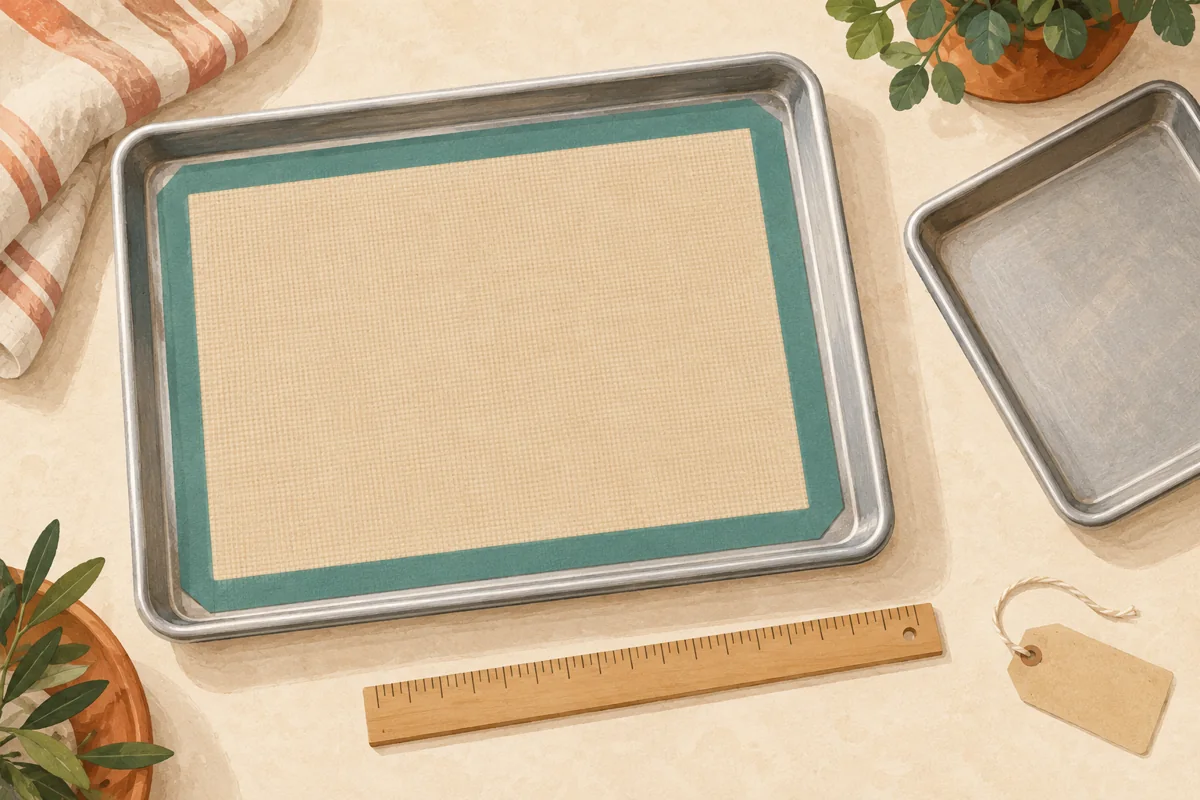
AI-generated editorial illustration; not a catalog photograph or evidence of product testing.