Before pairing branded measuring spoons with a recipe card, match the spoon’s stated milliliter capacity to the recipe—not just the word “tablespoon.” A set that looks right for a bakery’s holiday gift or a cooking-class welcome pack can still use a different tablespoon convention from the accompanying instructions.
The practical fix is to approve the utensils and the recipe as one item. Ask for the exact capacities of the supplied set, check the recipe author’s measurement convention, and keep those measurements readable after decoration. A country label on a storefront is not enough.
Primary sources checked October 12, 2026. The manufacturer examples below explain a specification difference; they are not a Brand Sauce product shortlist or a promise of custom decoration, stock or delivery. Any proposed branded order needs its own availability confirmation and quote.
Why “one tablespoon” needs a second look
NIST’s household measurement table gives approximately 15 mL for a tablespoon. That is useful context for U.S. cooking measures, not proof of the capacity of any particular promotional spoon.
There are also measuring sets explicitly made with a 20 mL tablespoon. For example, Avanti’s Melamine Ribbed Measuring Spoon set lists 1.25, 2.5 and 5 mL teaspoons alongside a 20 mL tablespoon and describes the set as using Australian measuring standards.
Here is the important exception: buying from an Australian site does not establish that every tablespoon offered there is 20 mL. OXO Australia’s four-piece stainless steel set explicitly lists its tablespoon as 15 mL. Read the exact product specification instead of assigning a measurement system from the delivery country.
A worked example: the same instruction, different quantities
Illustrative arithmetic, not a tested recipe: suppose your recipe developer specifies 30 mL of oil and writes “2 tablespoons,” using a 15 mL measure. Two level fills of a 20 mL spoon would deliver 40 mL instead. The difference is 10 mL; it is not a prediction about how a particular dish will turn out.
Do not fix that mismatch by simply replacing “15” with “20” in the card’s measurement key. Keep the developer’s intended ingredient quantity. Have them approve a compatible instruction, such as the intended mL amount with a clear method using the supplied utensils, or source a set that matches the original recipe. Any revised recipe should be checked by its author before printing.
Choose the route before approving artwork
- One recipe and one destination: choose the spoon specification that matches the approved recipe convention. Confirm every fractional spoon the recipe requires is actually included.
- One recipe across multiple countries: record the exact set offered in each destination. Keep the intended ingredient quantities consistent and have the recipe author approve the instructions for each set. A shared product name is not sufficient.
- Different regional recipes: treat each recipe-and-spoon pairing as a separate packing configuration. Label the packing instructions so a locally adapted card cannot be placed with the wrong utensil set.
- No recipe card: still request both spoon names and mL capacities in the product specification. Prefer markings that help recipients recognize the convention when using their own recipes.
This is a small example of why equivalent international gifts do not always mean identical products. The useful experience is the goal; the utensil and insert may need to differ.
Copy this recipe-and-spoon approval card
Attach the following to the purchase brief and ask the supplier and recipe owner to resolve every blank before production:
- Destination and exact SKU: country, supplier model and permitted substitution, if any.
- Contents: each supplied spoon’s fraction or name and stated mL capacity; photograph of its markings.
- Recipe convention: the recipe owner’s tablespoon and teaspoon definitions, plus the approved recipe version.
- Ingredient check: every spoon-based quantity can be measured using the supplied set and the printed instructions; no unexplained heaped or level measure.
- Decoration proof: logo placement leaves capacities legible; supplier confirms the proposed decoration location and care instructions for the finished item.
- Packing match: one approved recipe version assigned to each SKU and destination; substitutions require a new compatibility review.
- Release owner: named approver, dated sample photo and recipe-card proof stored together.
For the sample review, lay the actual decorated set next to the final-size printed card. Ask someone who did not write it to identify the utensils they would use for each quantity. Treat hesitation as a reason to clarify the instructions—not as a recipient problem. This is a proposed usability check, not a claim that Brand Sauce has tested these products.
If the gift also includes ingredients, the utensil check does not replace checking those contents and offering appropriate choice. Use our food-versus-nonfood gifting guide for that separate decision. For the spoon-and-card pairing itself, the release rule is simple: approve the intended quantity, the actual utensil and the printed instruction together.
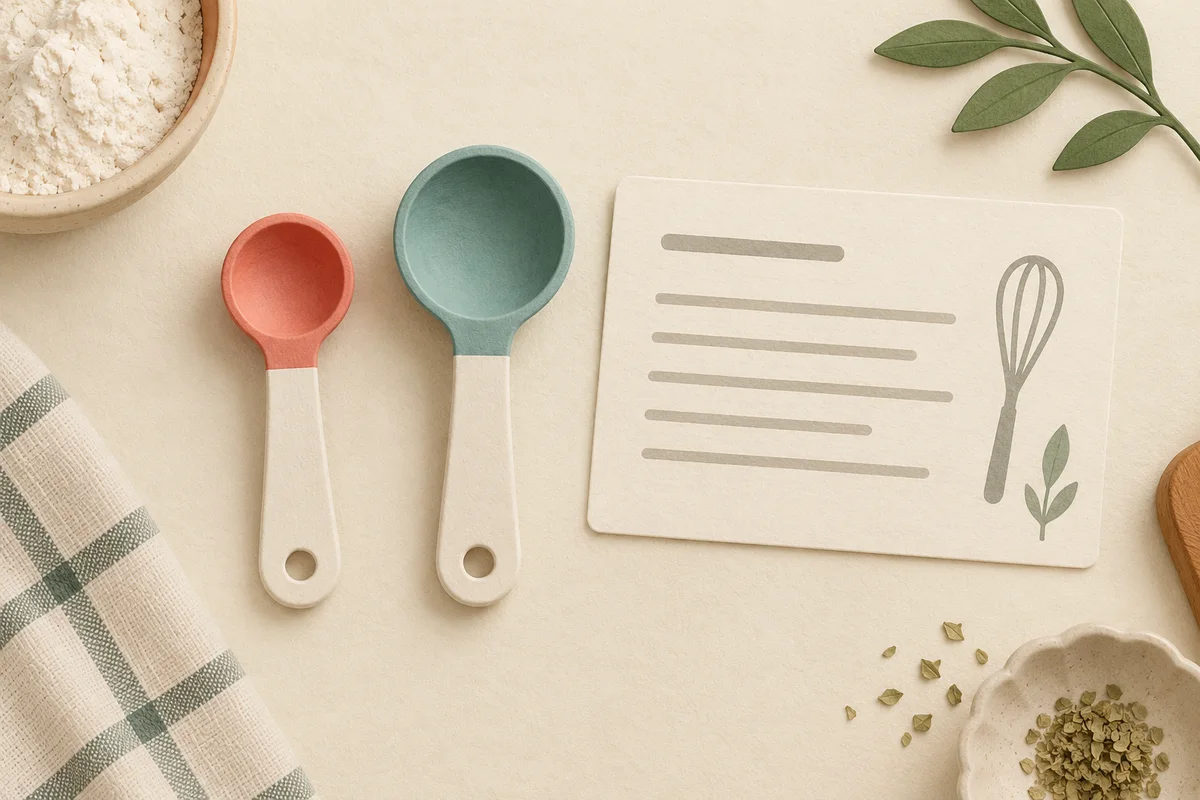
Hero image: AI-generated conceptual illustration; not a product photograph or capacity comparison drawn to scale.