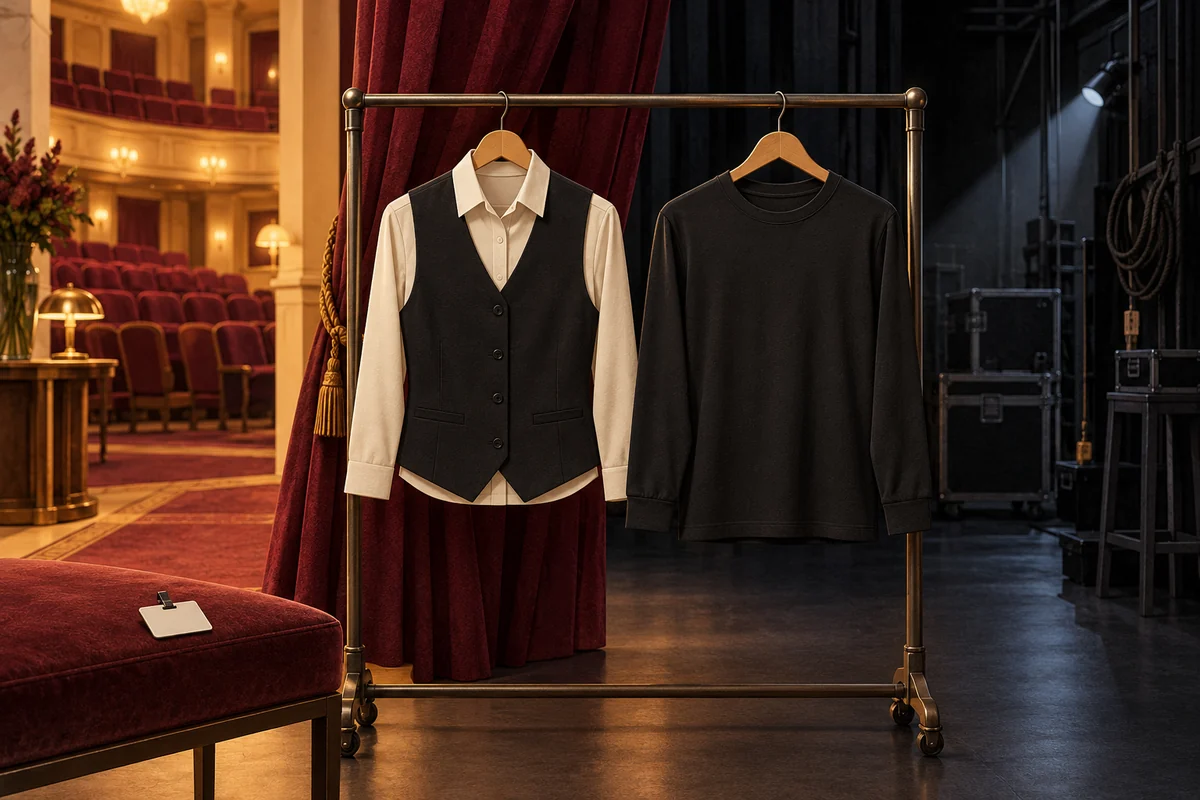
Build a theatre apparel program around the call, not one shirt for everyone. Front-of-house clothing must help patrons recognize available staff. Backstage show attire must meet the production’s visibility rules. Shop and load-in clothing needs separate task approval. Keep optional cast-and-crew merchandise outside all three requirements.
A black shirt with the theatre logo can look like a sensible universal choice. The problem arrives when someone wears it under stage lighting, covers their usher identification with a sweater, or assumes that being dressed for a performance also means being dressed for a work call.
This is Brand Sauce’s editorial buying framework for performing-arts venues, community theatres and campus performance programs. The official policies below illustrate differences between organizations; they are not a proposed universal theatre dress code. Product availability, decoration, quantities and delivery dates remain quote-needed for your actual program.
Start with the call, not the person’s job title
Write down where each person works during a typical event. A staff member might help patrons before curtain, move backstage during the performance and assist with a later changeover. Approving a garment for their job title does not establish that it suits every assignment.
UC San Diego’s production employee guidance distinguishes work and rehearsal calls from show calls, then specifies different show attire for different venues. Some of its show-call options include a department staff polo; another venue permits a department music T-shirt. That is a useful counterexample to the idea that every backstage assignment requires exactly the same unbranded outfit.
Our recommendation is to record the permitted combination for each call: garment, decoration, identification, outer layer and approving owner. A department name such as “production” is too broad to serve as the approval rule.
| Assignment | Primary apparel decision | Approval owner |
|---|---|---|
| Lobby greeting and ticket scanning | Recognizable staff presentation and visible identification | House manager |
| Ushering inside the auditorium | Identification plus the venue’s appearance rules during performances | House manager, coordinating with production |
| Backstage or onstage show call | Permitted color, coverage, decoration and layers for that production | Stage or production manager |
| Shop, load-in or changeover | Task-appropriate clothing and separately specified protective equipment | Technical director or designated work supervisor |
| Optional team appreciation merchandise | Recipient preference and brand expression | Program and brand owner |
Make front-of-house staff recognizable without inventing a uniform rule
There is no single front-of-house color scheme to copy. Studio Theatre’s usher page specifies black business-casual clothing and closed-toe shoes. In contrast, Theatre Memphis’s published 2025–26 usher guidelines describe white tops, black bottoms and a theatre-provided vest returned after the show. The Memphis document also addresses keeping ushers recognizable while seating patrons.
The purchasing question is therefore not “Which theatre uniform is correct?” It is “How will a patron identify our available help, in our space, under our lighting?” A venue can answer that with a consistent shirt, a supplied vest or another approved identifier. The house manager should own that answer before a merchandise supplier decorates anything.
Review the whole outfit rather than the logo proof alone. If the identifying element disappears beneath a cardigan, the ordering specification is incomplete. Decide whether a cold-lobby layer is permitted, whether it needs its own identification and where that identification remains visible. Include seated and standing staff in the review.
A shared vest can simplify the visible uniform, but it creates a check-out and cleaning operation. Assigned shirts avoid that particular handoff but require individual sizing and replacement decisions. For the underlying ownership tradeoff, see our guide to assigned versus pooled staff apparel; the allocation logic transfers, while the theatre’s dress rules do not.
Treat backstage branding as an approval question
Do not assume that a black blank makes every decoration acceptable. Send the production owner a finished sample with the proposed print or embroidery, manufacturer marks, closures and any contrasting trim visible. Ask which features are acceptable for the intended call. If the answer is undecided, keep the garment out of the approved show collection.
Our suggested review happens in the relevant performance environment, when production can safely arrange it. View the sample from the audience positions that matter and from the working area. Check the front, back and outer layer, not just a close-up of the chest logo. The goal is an explicit local decision, not a claim that an apparel sample can certify invisibility.
Keep “approved for this venue and call” separate from “approved everywhere.” A touring production, rental event or different stage configuration may impose a different requirement. Record the approval scope on the order sheet and give the production manager a route to change it before a new run.
When the requirement is plain clothing, do not force brand visibility into the garment to justify a merchandise purchase. Staff recognition can happen through an approved operational identifier, and appreciation branding can belong on a separate off-duty item. Neither a gift shirt nor a staff logo should be treated as proof of backstage access authorization.
Keep shop and work-call clothing outside the show-shirt shortcut
Radford University’s theatre guidance treats scene-shop clothing and running-crew blacks separately. Its shop instructions address clothing condition, footwear, jewelry and consultation with the instructor, technical director or shop supervisor. That supports a narrow but important procurement conclusion: appearance approval for a performance does not replace work-task approval.
Before including a garment in a shop collection, ask the responsible supervisor for the actual requirements. Do not select fabric, fit or accessories by borrowing a different theatre’s handbook. The proposed merchandise program should document the local requirements and route exceptions to the owner, not attempt to create a safety policy.
Keep protective equipment on its own approved purchasing path. Ordinary branded apparel should not be described as protective merely because crew members wear it. Likewise, a black hoodie approved for travel or a volunteer thank-you gift should not automatically appear as an authorized work-call option.
Build a small assortment with explicit permissions
Use a short ordering sheet or store collection with labels that describe permitted use. “Front-of-house vest,” “show-call shirt—approved venues listed,” and “off-duty appreciation sweatshirt” communicate more than “premium staff collection.” If an item has not cleared an assignment, say so.
Start with the minimum set needed to cover actual roles. Add alternatives when they solve a fit, temperature or care requirement, not merely to make the store look larger. For example, two cuts of the same approved top may be more useful than six unrelated fashion items.
Ask for measurements and a fit sample in the exact proposed style. Test ordinary movements relevant to the assignment, including reaching for a ticket scanner or sitting at the box office. Our company-apparel try-on kit guide explains how to gather size choices without confusing a fitting session with a final production order.
Keep required issue and optional gifting financially distinct. A person should not have to spend an appreciation allocation to obtain the clothing your program requires. Within the optional collection, offer genuine choice and identify any item that is not approved for duty. Have the appropriate internal owner settle required-uniform funding and employment-policy questions before launch.
Approve a complete sample, then its care cycle
A digital mockup can establish layout, but it cannot establish fit, the finished decoration’s appearance in your venue or the result of your intended laundering routine. Request a decorated sample before the main order, with the same garment style, color and decoration specification you intend to buy.
- House review: Can patrons recognize the intended staff role with approved layers on?
- Production review: Is the complete garment acceptable for the listed performance calls?
- Wearer review: Do fit, movement and pocket access work for the assignment?
- Care review: Do the garment and decorator’s instructions fit the actual cleaning arrangement?
- Post-care review: After an agreed trial following those instructions, are fit, appearance and decoration still acceptable?
- Replacement review: Is there a named approved substitute if the original style becomes unavailable?
Record what was checked and by whom. Do not report a short trial as proof of a guaranteed service life. The broader branded apparel sample-approval guide provides a useful record structure; add venue, call type and any layering restrictions to make it theatre-specific.
Choose bulk, on-demand or hybrid around the performance calendar
Bulk purchasing can make sense for a known opening roster, a stable uniform and a firm need-by date. It also gives the venue physical spares for last-minute cover. Its tradeoff is money and storage committed to particular garments and sizes, including stock that may no longer match a future dress policy.
On-demand ordering can suit later starters, low-frequency replacements or optional appreciation choices when production and delivery timing fit the need. It does not provide an instant spare before curtain, guarantee continued blank availability or establish a lower total cost. Confirm decoration minimums and replacement lead times for each proposed item.
A hybrid approach might combine an initial confirmed issue, a small locally held reserve and an approved reorder route. Obtain prices for the actual quantity breaks, decoration setups, shipping and replenishment process. Compare the cost of keeping garments available with the operational consequence of having none available—not just the per-shirt price.
Illustrative allocation, not a benchmark: suppose a venue has 18 recurring front-of-house staff, six people covering the busiest simultaneous usher call and eight production workers. If the local plan assigns two shirts to each recurring staff member, that starts at 36 shirts. A shared vest pool is based on simultaneous users, sizes and cleaning turnaround, not automatically all 18 people. Production quantities need their own call and laundry assumptions. These groups may overlap; do not add them and label the sum a unique headcount.
The example shows why “order one for everyone” is an unreliable brief. Build the count from assignment, units per person or concurrent user, fit range, care turnaround and reserve policy. Price that specification before choosing the fulfillment model.
Use a six-field release card before opening ordering
- Assignment and scope: the venue, call type and dates the approval covers.
- Exact specification: style, color, permitted sizes, decoration and allowed layers.
- Decision owners: house, production and work supervisor approvals where applicable.
- Issue model: assigned or shared, quantity basis, cleaning owner and return location.
- Delivery and exceptions: need-by date, spare route, fit exchange and approved substitution process.
- Change control: who can retire the item or revise its permitted use before the next production.
Test a late volunteer joining, a missing size and a last-minute role change before relying on the process. The store is ready when each case has an owner and a workable response—not simply when every product has a photo.
Frequently asked questions
Can the same black polo work front of house and backstage?
Possibly, if both responsible owners approve the exact garment and its use for those calls. Do not infer approval from the color alone. Keep the approved scope visible to staff and the ordering team.
Should ushers receive individual uniforms or borrow a vest?
Choose based on roster stability, fit coverage, simultaneous staffing and your ability to clean and return shared items. A borrowed identifier can work well only if an appropriate clean size is available when the shift starts.
Can an opening-night gift double as required crew apparel?
Only if it independently meets the required specification and issue process. Otherwise describe it as optional merchandise. A celebratory design does not become approved show attire because everyone received one.
What should happen when a supplier discontinues the approved shirt?
Route the replacement through sample and role approval rather than silently substituting another black style. Preserve the old specification, identify the affected orders and communicate any change in fit, care or permitted use.
The buying rule: make staff easy to identify where identification matters, follow production requirements where the show determines appearance, and give work-call clothing its own approval. One venue can have a coherent brand without making every assignment wear the same thing.