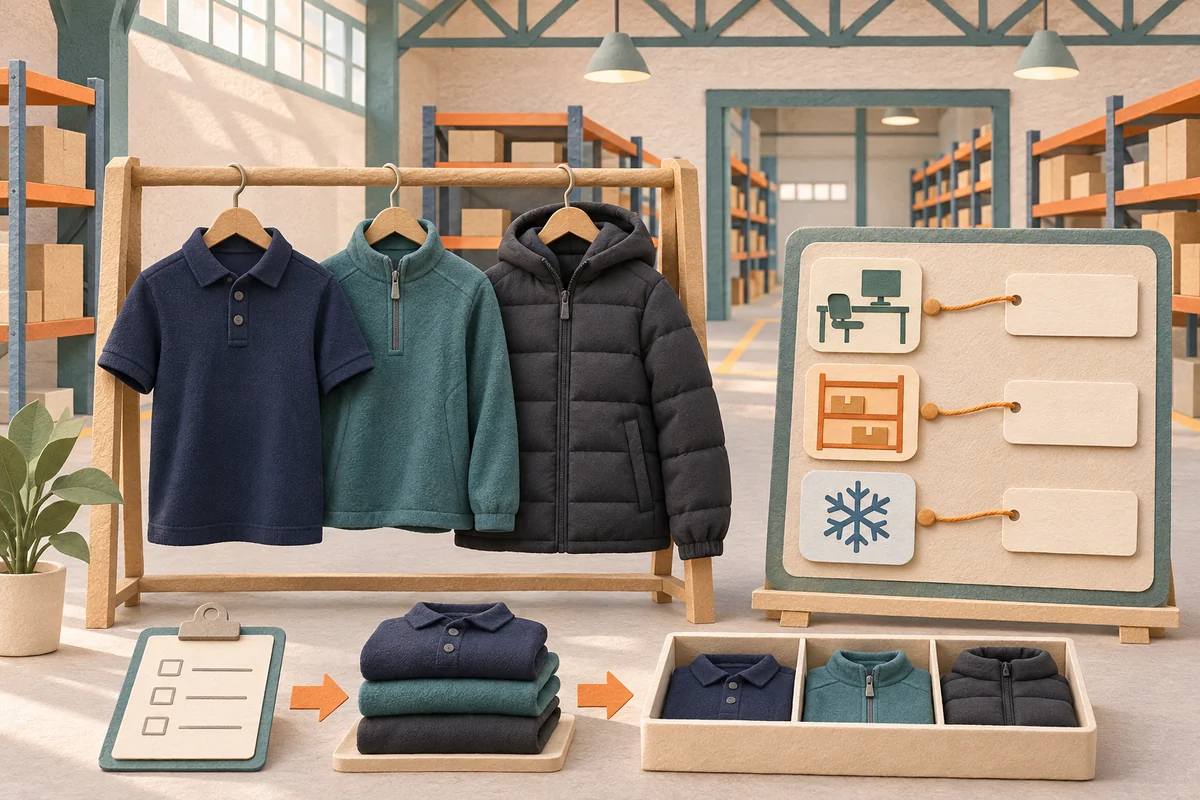
Build distribution-center apparel around work assignments, not one garment per employee. A person who moves from a dispatch desk to a loading area or cold room may need a different approved clothing combination. Start with a site-owned zone-and-task matrix, issue the required items before the assignment begins, and keep optional company gifts outside that process.
The buying decision is not simply whether everyone gets a polo or a jacket. It is which items must be available immediately, which can be ordered against a known assignment, and which employees may choose for themselves. A company store can support that workflow, but its product categories must not become a substitute for the site's safety decisions.
Publisher perspective: Brand Sauce publishes this guide for company merchandise buyers. The operating framework below is a proposed planning method, not a claim that a particular store includes these controls or that a pictured garment is approved protective equipment. Confirm service scope, exact products and pricing in a written quote.
Separate three apparel lanes before building the assortment
Give each item one primary purpose. That makes its funding, approval and replacement route easier to understand.
| Lane | Typical purpose | Release decision | What must not happen |
|---|---|---|---|
| Ordinary company uniform | Consistent appearance for dispatch, administration or approved warehouse tasks | Operations approves the exact style for the intended assignment | A logo or team color is treated as evidence of protection |
| Site-required protective equipment | Protection selected for assessed hazards | The site's responsible safety owner defines the specification and approved issue route | An employee substitutes a gift-store item because it looks similar |
| Optional employee merchandise | Recognition or off-duty use | The employee chooses within the gift offer | A required work item consumes the employee's recognition allowance |
For U.S. operations, OSHA's general PPE standard, 29 CFR 1910.132, addresses hazard assessment, selection, fit and training within its stated scope. Its payment provisions include exceptions, including specified ordinary clothing. Do not infer from a company-store budget that every garment has the same legal classification or payment rule; have the site's responsible team resolve the applicable requirements.
Our operational recommendation is to keep required issue and optional gifting in different records even if one supplier handles both. Employees should be able to see whether they are requesting work equipment, replacing an issued uniform or accepting a gift. Those are different transactions with different reasons for approval.
Use a zone-and-task matrix, not a department-wide jacket rule
A department label can hide several assignments. “Warehouse” might include seated dispatch work, active picking, receiving and entry into a temperature-controlled area. Ask the site owner to name the actual work and the expected transitions before asking a merchandise provider for a garment shortlist.
| Assignment to document | Question for the site owner | Apparel record to create |
|---|---|---|
| Dispatch or administration | Does this role enter operational areas, and under what conditions? | Ordinary uniform plus the approved route for occasional access |
| Picking and packing | What movement, equipment and site dress restrictions apply? | Approved style, fit range and restrictions for that task |
| Receiving or loading-area work | Which exposure and traffic controls apply at this location? | Required equipment specification and issue owner, separate from team color |
| Cold-room assignment | What exposure, activity and clothing system has the site approved? | Exact approved combination, sizing process, care and replacement route |
| Visitors or short-term reassignment | Who authorizes entry and verifies readiness? | Temporary issue, return and inspection process |
This is a purchasing worksheet, not a universal list of required garments. Add the site, task owner, effective date and approval reference to each row. If the facility changes its process, the matrix needs review before a buyer quietly adds another jacket to the assortment.
Do not use uniform color as access authorization. A person can borrow a shirt, change roles or keep an old garment. Keep training, access and assignment decisions in the site's existing systems; the clothing record should point to the approved assignment rather than attempt to prove it.
Do not let a bright shirt stand in for traffic controls
OSHA's forklift pedestrian-traffic guidance recommends separating forklift traffic from pedestrians where possible and discusses walkways, barriers and visibility limitations. A merchandise choice does not replace those controls.
For purchasing, the practical consequence is a firm handoff: if the site requires high-visibility clothing, request its exact approved specification, model and decoration restrictions. “Bright yellow” is not a complete buying brief. Do not replace an unavailable approved item with a visually similar promotional shirt without the responsible owner's approval.
Keep any team-identification scheme secondary. If navy means dispatch and teal means fulfillment, describe it as a local identification convention, not a safety classification. Ask how the convention works when an outer layer covers the shirt. A consistent company logo is useful; an unsupported promise about protection is not.
Approve cold-room clothing as a combination
The Canadian Centre for Occupational Health and Safety's cold-environment control guidance treats clothing alongside exposure, activity and other controls. It discusses layering and allowing space between layers rather than compressing the insulation. This is useful technical context, not a replacement for the requirements governing your facility.
Translate that into a purchasing review of the complete approved outfit. A jacket that fits over an office shirt may fit differently over the work layers specified for another assignment. Ask the site owner to arrange the appropriate fit review with the actual layers and equipment involved. Do not simply increase every jacket order by one size.
Record the garment combination and model identifiers together. If an inner layer changes, flag the combination for review instead of assuming the outer layer remains suitable. For nonprotective gift apparel, our company-jacket selection guide can help frame comfort and fit questions; it does not qualify a gift jacket for cold-storage work.
Also decide where issued layers are kept, who checks their condition and what happens when an item is unavailable. A promotional delivery estimate is not a readiness plan for a scheduled assignment.
Create an assignment-change transaction
The most useful control is a small record triggered when someone's work changes. A routine annual clothing allowance will not necessarily capture a transfer to another zone tomorrow.
- Open the request. Record the employee identifier, site, new assignment, start date and requesting supervisor. Avoid unnecessary personal information.
- Match the approved matrix. Identify the required items and exact versions. If no approved row covers the assignment, send the question to the site owner instead of improvising a shopping list.
- Check existing issue. Establish what the employee already has, whether it is suitable for the new assignment, and whether its condition or fit needs review.
- Allocate the missing items. Reserve the correct local stock or place the approved order. “Ordered” and “available for use” must remain different statuses.
- Confirm handoff. Record receipt, the required fit or condition checks, and the responsible person's readiness confirmation under site procedures.
- Close or escalate. If the items are not ready, escalate the assignment question to operations. Do not allow a store's shipping status to imply authorization to start work.
For example, an employee moving from dispatch to a recurring cold-room assignment should not receive a second generic welcome kit. The request should identify the difference between their existing issued items and the approved new combination. That difference drives the purchase.
For a temporary assignment, include an expected return date and a named receiving location. Reusable items need an inspection and care route before another issue; our returned-merchandise inspection guide explains the recordkeeping distinction between physically returned and ready to restock. Protective equipment remains subject to its own applicable inspection and serviceability requirements.
Choose stock by readiness risk, not an on-demand slogan
On-demand ordering can make sense for optional gifts and ordinary uniforms with a known lead time. Bulk purchasing can make sense for stable, frequently issued items that must be ready locally. A hybrid program can use planned orders for predictable demand and a controlled reserve for urgent needs.
Apply the decision at item-and-size level. An aggregate count of jackets does not reveal whether the needed size and approved model are available. Track serviceable local stock separately from items awaiting cleaning, inspection, repair or return. Do not promise the same unit to two people because one assignment has an expected end date.
Illustrative planning example, not a recommended safety-stock level: suppose a site's approved plan identifies 18 new issues of a particular item during the replenishment window, plus a six-unit reserve. The site has nine serviceable, unallocated units that match the required variants, and three confirmed matching units due before issue. The provisional purchase is 18 + 6 − 9 − 3 = 12 units.
That arithmetic works only after checking the size mix and dates. If the three inbound units will arrive too late, the provisional requirement becomes 15. If the nine local units are all the wrong size, they cannot offset this demand. Replace these assumptions with the facility's actual issue history and service requirements; this is not measured Brand Sauce performance.
Compare written quotes for product, approved decoration, freight, replenishment and any management service. The on-demand versus bulk decision guide provides a broader cost framework. A lower unit price does not resolve a missing size at the start of a shift, and buying everything in advance can create unused variants.
Give the supplier a usable release brief
Before releasing an order, complete this card. It keeps a merchandise provider from having to infer safety or operational requirements from an artwork file.
Distribution-center apparel release
Site and assignment:
Purpose: ordinary uniform / site-required equipment / optional gift
Approved model, version and size range:
Site approval reference and owner:
Permitted decoration and placement:
Quantity by variant:
Needed-at-site date and confirmed delivery basis:
Existing stock allocated to this request:
Allowed substitution: none, or named approved alternative
Issue, care, return and replacement owners:
Action if the order cannot be fulfilled:
Ask the supplier to return exceptions against the same card. An unavailable color, changed fabric or revised decoration process is a question to resolve, not an automatic equivalent. Obtain approval before changing the purchase order, and retain the final specification with the order record.
Run five desk checks before opening orders
- Role transfer: can a supervisor request only the additional approved items without issuing another optional gift?
- Missing size: does the process escalate instead of substituting a convenient size or unapproved model?
- Late arrival: does an order remain unresolved until the site confirms the required handoff?
- Returned item: can staff distinguish an item awaiting inspection from serviceable stock?
- Gift choice: can an employee choose an off-duty item without changing their required work issue?
These are proposed acceptance checks, not tests Brand Sauce has performed at a client facility. Assign an owner to every failed scenario before launch. Keep the first review focused on unresolved issues, variant shortages and assignment changes rather than simply counting orders shipped.
Frequently asked questions
Can one company store contain uniforms, protective equipment and gifts?
Potentially, if the provider can support the required separation of products, permissions, approvals and records. Verify the exact implementation. Separate ordering routes are preferable to an attractive storefront that lets employees accidentally substitute gifts for required issue.
Should every warehouse employee receive the same jacket?
Not automatically. Start with the actual assignments and the site's approved requirements. A shared style may work for a defined group; another group may need a different approved combination. Consistent branding does not require identical garments everywhere.
Should temporary workers use the employee gift allowance?
Do not use a recognition allowance as the default route for required work issue. Have the site and staffing partners establish who supplies, approves and records the relevant items. Optional recognition can then follow a separately defined eligibility policy.
What is the first thing to build?
Build the zone-and-task matrix and assignment-change record before the product page. Together, they tell a buyer what must be ready, who can approve it and which purchases can safely wait for ordinary replenishment.