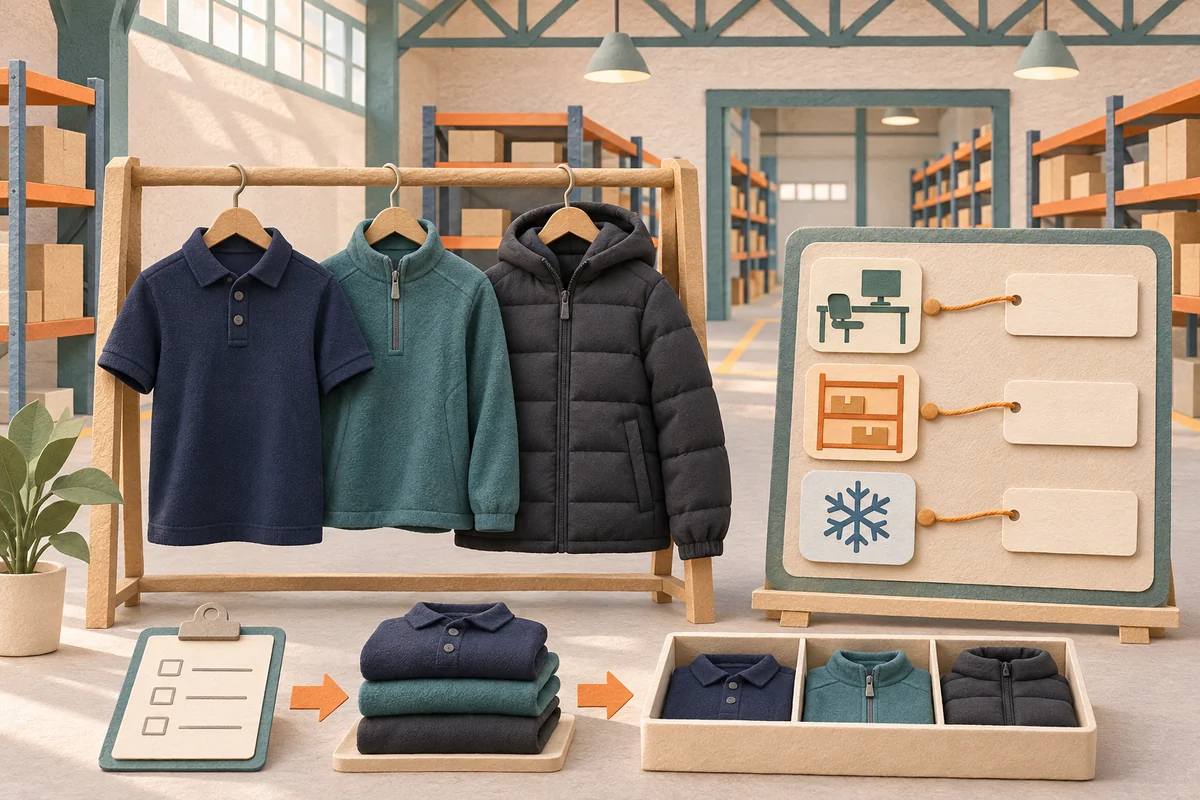

Before opening a company store with a partner’s logo, approve the intended use, the exact artwork, and the finished product separately. Then connect those approvals to the items people can actually order. A logo file in a shared folder is not a complete release record, and a proof approved for one campaign should not silently become an evergreen merchandise collection.
This guide is for marketing teams managing alliance gifts, joint-event apparel, customer-project merchandise and other two-brand programs. Its central decision is whether a co-branded item is ready for release—and what changes should stop a reorder. The operating framework is Brand Sauce’s editorial recommendation, not a description of controls included in every company-store platform.
Publisher perspective: Brand Sauce provides company-store services. We favor a documented approval process whether production is on demand, bulk or hybrid. The brand-owner examples below illustrate different published rules, not affiliations with Brand Sauce or a universal permission policy. Sources checked October 29, 2026.
Separate permission, design approval and production acceptance
A partner contact may say that a concept looks good while the decorator is waiting for a usable vector file. Meanwhile, the store administrator may interpret that message as permission to publish. All three people can be acting reasonably and still be working from different definitions of “approved.” Give each decision its own owner and evidence.
| Decision | Question it answers | Evidence to retain |
|---|---|---|
| Use approval | Does the brand owner authorize this merchandise use for this audience and campaign? | Applicable written authorization, scope, restrictions and named contact |
| Design approval | Is this combination of marks, wording, placement and colors acceptable? | Versioned proof identified in each required reviewer’s approval |
| Production acceptance | Can the approved design be reproduced acceptably on the selected item? | Supplier confirmation and, where needed, an accepted decorated sample |
Do not let a production vendor resolve a disagreement between brand owners by choosing whichever layout is easiest to make. Equally, do not send an attractive marketing mockup to production without confirming the physical decoration constraints. The release owner should collect the decisions, not substitute for them.
For example, Mozilla’s published guidelines distinguish certain permitted references from uses requiring prior written permission and include restrictions on merchandise for sale. That is a useful reminder that referencing a company in a presentation and putting its mark on products are different requests. Read the applicable owner’s policy rather than assuming a downloadable logo covers both. See the Mozilla Trademark Guidelines.
Write the campaign scope before requesting artwork
Start with a one-page brief that a partner reviewer can actually approve. “We would like swag” leaves too many decisions open. Specify whether the items are gifts, required staff apparel, retail products or event giveaways; who receives them; where they are distributed; and whether the store is public or limited to a defined audience.
Include the proposed product families and decoration locations. A small sleeve mark, two logos across the chest and a wraparound bottle design are materially different executions. If the program may expand later, list the expansion as a future request rather than burying it inside a broad phrase such as “and related merchandise.”
- Purpose: the campaign, relationship and message the merchandise should communicate.
- Audience and channel: recipients, gift versus sale, storefront access and distribution countries.
- Timing: ordering window, production window, delivery expectations and any approved repeat-order period.
- Assortment: product types, proposed colors, decoration methods and placements.
- Authority: the contact responsible for each brand’s approval and any escalation route.
- End state: instructions for remaining stock, outstanding orders and future use of the artwork.
Ask the relationship owner to resolve unclear permission scope before the designer invests in a full collection. This is especially important when the person who wants the merchandise is not the person authorized to approve brand use. Store access restrictions can control who orders; they do not answer the separate question of whether the merchandise use has been approved.
Agree on the relationship before arranging the logos
A lockup is the arrangement of two marks into a repeatable composition. It communicates who is leading and what kind of relationship exists. Before resizing artwork, decide whether the project is a joint campaign, a partner-led initiative or something else the brand owners recognize. Do not invent an “official partner” label to make a design feel complete.
Red Hat’s partner-led co-branding guidance provides a concrete example: it calls for the partner’s logo first when the partner leads, equal visual weight, adequate clear space and the current Red Hat logo. It also specifies parent-brand logos rather than product, program or event logos. Those are Red Hat’s rules—not a template to impose on every other brand. See Red Hat’s partner-led co-branding standards.
If two standards conflict, make that conflict visible. One owner may request a horizontal layout while another requires a separation that will not fit the available chest area. Practical options include a larger permitted decoration area, separate approved placements, a different product or removing the co-brand execution from that item. Compressing clear space until the logos fit is not an approval process.
Use supplied, current artwork and identify its source. Keep editable working files separate from released production files. A designer’s exploration should not be available under a filename that a fulfillment operator could mistake for the final version.
Approve the product execution, not only the flat graphic
A single artwork approval can conceal several production decisions. Put dimensions, garment or product color, placement and decoration method directly on the proof. Give every revision an identifier. If the proof changes after one reviewer signs off, send the changed version back to the affected reviewers rather than collecting approvals for different versions.
Ask the supplier what is feasible before promising a particular treatment. Small lettering, thin lines, seams, curved surfaces and limited decoration areas can all become questions to resolve with the actual product and method. Do not turn those questions into unsupported universal minimum dimensions; obtain the supplier’s requirements for the selected execution.
A sew-out, printed sample or other physical proof may be appropriate when reproduction is uncertain. Record what was accepted: not just “sample okay,” but the item, color, artwork revision and relevant observations. Our guide to approving a branded apparel sample covers the physical review in more detail. Co-brand approval adds another layer: both identities must remain within their approved use.
Variant scope also matters. A dark garment may need a different approved logo version than a light one. A bottle may require a different arrangement from a tote. Approve a defined family of executions or review them individually; do not assume that every color and product in the store inherits the first proof’s approval.
Give each orderable execution a release record
The useful unit of control is not “the partnership.” It is the orderable combination of product, artwork and approved use. One record can cover multiple sizes when the approved execution remains the same, but it should explain which variations are included. Keep a readable record even if the platform cannot store every field.
| Record field | What to capture |
|---|---|
| Release ID | A stable identifier referenced by the store item and production instruction |
| Approved scope | Campaign, audience, distribution locations and gift or sale status |
| Product execution | Supplier style, colors, sizes covered, method, dimensions and placement |
| Artwork evidence | Source assets, proof revision and approval records from the required owners |
| Timing rules | Order cutoff, production limits and conditions for repeat orders |
| Change owner | Who pauses ordering, requests reapproval and releases a revision |
| Closeout instructions | How to handle remaining goods and work already in progress |
Before launch, compare the storefront image and description with the supplier’s production instruction. Both should point to the same release. A correct product photo beside an obsolete production file is still a failed handoff. Conversely, an accurate production file does not excuse a storefront that promises the wrong logo arrangement.
This can be a manual control for a small program. Ask the provider which fields, restrictions and pause mechanisms are available; do not assume an automated permission-expiry feature exists. If a manual checkpoint is required, assign a person and an actual review date.
Define what stops a reorder
“Reorder the same shirt” is not precise enough when the original product has been discontinued, a partner has changed its logo or the event has ended. Before repeating an order, compare it with the release record. Treat changes in product, color, method, placement, artwork, audience, distribution country or campaign purpose as review triggers.
Not every trigger necessarily requires starting over. The brand owner may already have approved a bounded set of alternatives. The important point is to confirm that coverage rather than silently extending it. For substitutions, combine this record with a clear out-of-stock substitution process.
Illustrative scenario: a company approves 180 co-branded event totes for a two-day conference. Later, a team requests 60 more for customer visits. The total is now 240, but the key issue is not the arithmetic: the audience, purpose and timing have changed. The release owner checks whether the authorization covers those visits, then obtains a new approval if it does not. This is a hypothetical workflow example, not a client story or measured outcome.
For an expired or withdrawn execution, first prevent new orders and identify existing commitments. Separate unsubmitted carts, paid but unreleased orders, work in production and completed stock. Ask the relevant owners for disposition instructions. A checkout cutoff does not by itself resolve whether production or shipment may continue afterward.
Choose fulfillment around approval stability
On-demand production can limit the amount of finished co-branded stock purchased before demand is known. It does not make authorization evergreen. An always-on item needs someone to maintain its release record and disable it when the approved scope changes.
Bulk production can make sense for a known event audience with a firm delivery date and a stable, approved design. Review the exposure created by extra units and decide what happens to leftovers before ordering them. Do not assume they can be reassigned to a different campaign just because the products remain usable.
A hybrid may be appropriate when an event needs a fixed initial quantity and later orders are possible. Release the first run on its own terms, and define a separate repeat-order gate. Holding undecorated goods or other components is only useful if the supplier supports the arrangement and the later execution is still approved.
Compare current quotes for samples, setup, decoration, freight, storage and administration. Include the work required to maintain approvals, not just the unit price. The broader on-demand versus bulk decision guide can help frame that comparison; neither model eliminates the brand-review responsibility.
Run five checks before inviting recipients
- Scope check: can the release owner show the authorization covering this campaign and distribution?
- Version check: do all required approvals refer to the actual production proof?
- Variant check: are every visible color, placement and product execution covered?
- Handoff check: does a test order reach the supplier with the correct release reference and instructions?
- Stop check: can the responsible person pause the item and identify outstanding orders when approval changes?
If a check fails, hold that execution rather than publishing the whole assortment with a vague promise to fix it later. A smaller approved selection is more useful than a large collection whose production team cannot identify the current proof.
Co-branded merchandise FAQs
Is a partner sending us its logo enough to launch?
Use the file as an input, not as the entire release record. Confirm the approved use, required reviewers and applicable standards, then retain the proof and production details. The relevant owner’s authorization determines the scope.
Do free employee gifts avoid the approval process?
Do not use “free” as a substitute for checking the brand owner’s rules. State that the items are gifts in the request and confirm that the intended audience and distribution are covered.
Can two approved logos simply be placed side by side?
Not automatically. The combined arrangement, relative prominence, spacing and wording need to fit the applicable standards and approved relationship. Resolve conflicts before sending the design to production.
Can one approval cover future orders?
It can cover the repeat orders its terms actually permit. Record the covered execution, scope and timing, and recheck changes before release. Avoid treating an old email about one event as a permanent collection approval.
The practical standard: someone other than the original designer should be able to identify what is approved, what can be ordered and when to stop. If that requires reconstructing a long message thread, the merchandise is not yet ready for an always-on store.