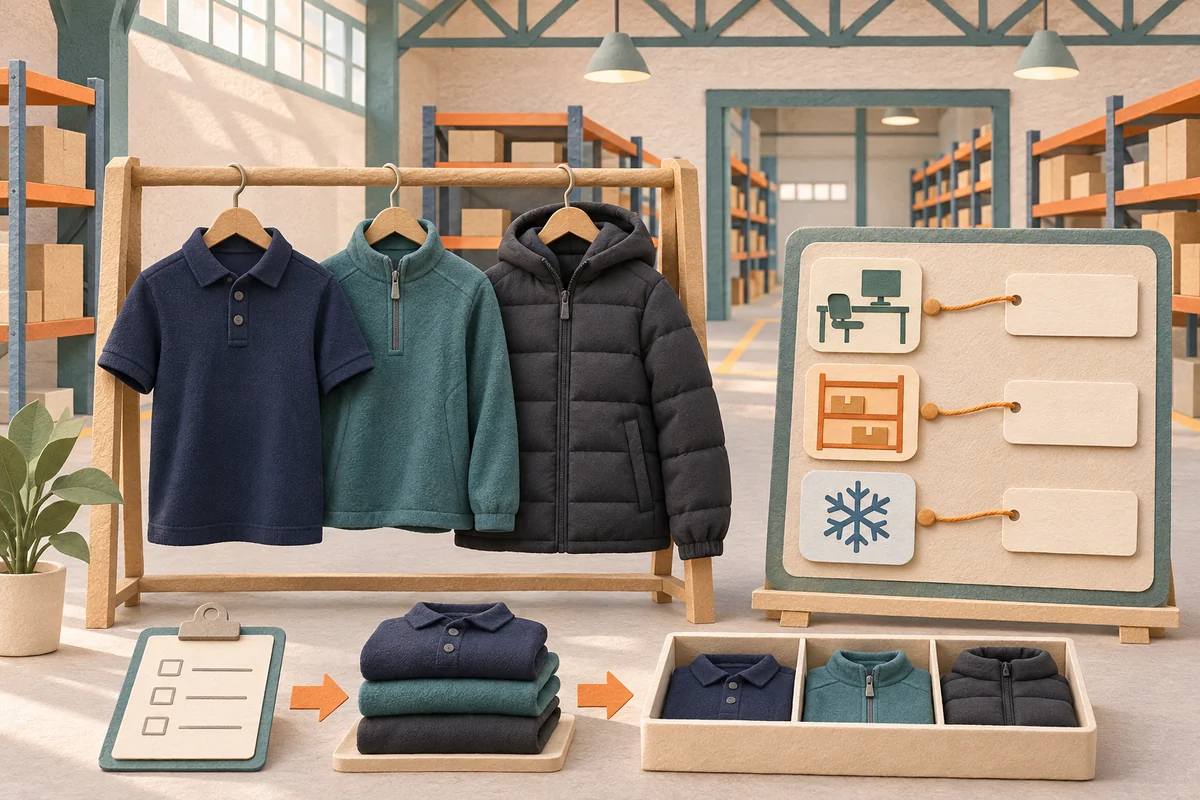
For a new commercial cleaning contract, buy uniforms against the first-shift roster, the relief-staff plan and the client’s approved appearance rules—not just the contract’s total headcount. Keep an employer-branded core where client requirements allow it, commit client-specific decoration only after approval, and make the first delivery a named handoff to the people working the site. An online order marked delivered is not proof that the night team has clothing that fits.
This guide answers a specific mobilization question: how should a cleaning contractor launch apparel for a new account while keeping replacement orders and staff transfers manageable? The operating unit is the contract and its shifts, not an annual employee-gift allowance. Optional recognition merchandise belongs in a different purchasing lane.
Publisher perspective: Brand Sauce publishes this operational buying framework as a company-store provider. The controls below are recommendations, not claims about included software features, industrial laundry services or protective-equipment supply. Exact garment, decoration, country availability, delivery and pricing are quote-needed. Primary sources checked November 3, 2026. The hero is an AI-generated conceptual illustration, not a customer facility.
Define the contract apparel brief before decorating
Start with the client’s actual requirements. A staffed daytime office, an overnight cleaning route and a specialist assignment may not accept the same appearance, identification or clothing arrangements. Do not turn the sales proposal’s mockup into a production order until someone has confirmed what the people doing the work must wear.
Create one versioned brief for each new contract. It should name the client approver, the contractor’s operations owner and the person who can resolve a disputed requirement. Record the first staffed shift, not merely the contract signature date. If different buildings start on different days, give each its own release date.
| Brief field | Decision to record | What it prevents |
|---|---|---|
| Employer and client identity | Permitted marks, artwork version and placement | Decorating stock with an unapproved client logo |
| Site and shift | Who starts where, when and with which supervisor | Sending every parcel to an unattended headquarters |
| Approved clothing | Exact styles, colors, fits, size range and alternatives | Assuming a similar-looking shirt is interchangeable |
| Care responsibility | Approved care route, turnaround and replacement contact | Issuing too few garments for the actual schedule |
| Relief coverage | Which people may cover the site and what they must wear | A substitute arriving with the wrong client identity |
| Contract exit | When ordering stops and who reviews remaining stock | Replenishing a design after the account has ended |
Employer-first decoration can preserve flexibility across accounts, but only where the client accepts it. A client-specific uniform can be the correct choice for a stable, dedicated team. Treat that choice as a commitment with a likely replacement and exit cost, not automatically as an error. Use the co-branded merchandise approval framework when two organizations’ marks share a garment.
Separate work uniforms, protective equipment and gifts
The ordinary uniform lane covers appearance and the approved clothing assortment. The protective-equipment lane follows the actual tasks and hazards. The gift lane covers voluntary items such as an off-duty sweatshirt. Different approval owners can share an ordering interface, but the three lanes should not share one unrestricted allowance.
The OSHA/NIOSH guidance for workers using cleaning chemicals explains that safety data sheets provide information including recommended protective equipment and spill procedures. It also emphasizes selecting appropriate equipment and training workers. For the apparel buyer, the implication is limited but important: a branded polo is not evidence of chemical protection. Route task-specific requirements to the employer’s safety owner before selecting or substituting clothing.
Do not let an apparel credit force someone to choose between required work clothing and an optional gift. Equally, do not allow a gift-code holder to order a restricted role-marked uniform simply because the design appears in search. Write down which purchases are initial issue, operational replacement or recognition. Have HR confirm payment and deduction arrangements for the applicable jurisdiction rather than importing another employer’s policy.
For specialized assignments, confirm the relevant site rules separately. This guide is not a healthcare laundry protocol, a spill-response procedure or a specification for protective clothing. A contract’s safety review can change the approved assortment and care route; purchasing should reflect that review rather than improvise around it.
Build a first-shift issue list, not a generic size survey
Use a restricted operational roster with only the details needed to issue clothing: employee identifier, site, first shift, approved style and size, required quantity, handoff point and issue status. Keep measurements and individual fit discussions out of client-facing order reports unless there is a specific authorized need.
Separate confirmed staff from vacancies and anticipated hires. Confirmed people can select an approved fit. Vacancies create a planning reserve, not a reason to guess a future employee’s size or print a name. Record relief workers explicitly, including whether their existing employer-branded uniform is accepted at the new site. Count each person’s issue once even if they cover several buildings.
A useful real-world example is Dalhousie University’s published 2025 uniform process: it describes shirt samples available for try-on, online ordering assistance and distribution through named campus locations. It also distinguishes branded-shirt return handling from other exchanges. That is a specific university program, not a commercial-cleaning standard or a supplier promise. The transferable lesson is to connect selection, assistance and physical distribution before ordering.
Offer a fitting opportunity that reaches the actual shift. A sample rail available only during daytime office hours may not serve an overnight crew. Agree a supervised alternate window or a documented remote-fit process. Do not substitute public chat messages containing everyone’s sizes for a controlled issue list. Our company-apparel try-on kit guide covers the sample logistics in more detail.
Calculate launch stock by assignment and timing
Use this planning equation for each approved style and size: confirmed initial issue + approved relief/reserve requirement − verified usable stock = new purchase requirement. Usable stock must match the approved specification and be available in time. Inventory committed to another account is not free stock for this launch.
Set the per-person issue quantity around the work schedule and approved care turnaround. Do not copy a universal “five shirts per employee” rule. Someone working two shifts between care opportunities and someone working five may need different arrangements. A same-shift replacement also needs a physical location; a future online order does not cover tonight’s problem.
Illustrative calculation—not a recommended standard or measured client result: a contractor starts an office account with 18 assigned cleaners. Operations approves three ordinary uniform tops per assigned employee, creating 54 issued tops. Four relief staff already have accepted employer-branded tops, so this contract does not buy their full wardrobes again. Operations separately approves six clean reserve tops in confirmed sizes at an accessible local issue point. Eight matching, uncommitted tops are already available. The purchase requirement is 54 + 6 − 8 = 52 tops.
That arithmetic only works after the size-level check. If all eight existing tops are the wrong size, they cannot reduce this purchase requirement. If the client instead requires its own logo, relief coverage may need additional client-approved pieces. Recalculate rather than assuming the original total survives a branding change.
Keep the reserve visible as an operating commitment. Name its custodian, permitted issue reasons and replenishment trigger. Avoid calling everything “spares”: a new-hire fitting reserve, a clean emergency replacement and stock awaiting inspection are different things. Review the first few weeks of actual issues before enlarging the reserve.
Make delivery a shift-level handoff
Choose delivery destinations around who can receive, check and distribute the order. Central delivery can simplify checking and consolidation, but adds a last-mile task to each site. Direct-to-site delivery can remove that transfer, but fails if a parcel arrives at a locked building or a client reception desk that cannot identify its owner.
Before dispatch, obtain a named receiver, accepted delivery window, storage location and backup contact. The operations owner should confirm that these arrangements cover the shift being launched. Do not put access codes or sensitive building instructions into a broadly shared apparel spreadsheet.
- Receive: reconcile parcel contents against the approved order, including size and decoration.
- Stage: separate named employee issue from local reserve; keep both in an appropriate clean storage location.
- Issue: record that the person received the correct items, not merely that a parcel reached the building.
- Resolve: give wrong-size, missing and damaged items a named owner and an approved interim arrangement.
Define “ready for the first shift” as every scheduled person having the approved issue or a documented acceptable alternative. Report exceptions by action needed: awaiting size confirmation, production incomplete, parcel unreceived or issue unresolved. A single green “order placed” status hides the work that remains.
Choose the buying model around mobilization risk
| Model | Strong fit | Tradeoff to price and plan |
|---|---|---|
| Bulk launch order | Stable roster, approved artwork and a common start date | Size changes, storage and stranded client-specific stock |
| On-demand replenishment | Small later orders with enough production and delivery time | It does not supply an immediate shift replacement |
| Hybrid | Planned launch issue plus a controlled local reserve and later individual orders | Someone must reconcile reserve use against subsequent requests |
| Uniform rental/service route | An operation seeking a contracted garment-care and exchange arrangement | Route timing, replacement terms and contract responsibilities need separate evaluation |
Request complete quotes for the same specification and timing. Include decoration, freight, any setup, storage or service charges, replacement orders and the treatment of unused stock. On-demand is not automatically cheaper; a coordinated launch can justify a bulk order. Rental is not simply another way to buy the same shirt. Our uniform rental versus company-store comparison explains that service-model distinction.
Do not release a bulk order while major fit or client-artwork questions remain unresolved merely to protect a unit price. Conversely, do not promise a no-stock launch when there is no time to produce replacements. Obtain a confirmed plan for the actual start date, including what happens if one size or decorated batch is late.
Make transfers and contract exits explicit events
When a worker transfers, review the receiving contract’s assortment before issuing more clothing. Accepted employer-core pieces may travel with the person; client-specific pieces require a separate decision. Move future ordering eligibility and cost allocation without rewriting the history of what was issued under the previous account.
When a contract ends, set an ordering cutoff, inspect open orders and remove the expired client artwork from new purchasing routes. Decide what happens to usable employer-core stock, restricted client-branded stock and items awaiting care or review. Obtain approval before redecorating or reusing client-marked pieces. Do not assume that covering one logo creates permission to reuse the garment.
Apparel recovery and building-access revocation are separate tasks. A collected shirt does not cancel a credential, and an account closure does not automatically collect clothing. Assign each handoff to its responsible owner. Keep the closeout record concise: remaining quantities, open-order decisions, artwork status and final stock disposition.
Use a seven-point launch release check
- The client-approved specification and artwork version are recorded.
- The confirmed roster includes relief coverage and all launch shifts.
- Every person has a fit decision or a named unresolved exception.
- The safety owner has resolved task-specific clothing and equipment requirements.
- The purchase calculation reconciles usable stock by style and size.
- A receiver, issue owner and accessible replacement route exist at launch.
- The contract’s reorder rules, transfer process and exit cutoff have owners.
After launch, review incomplete issues, emergency requests and wrong-size exchanges as operational signals, not as evidence of employee engagement. Correct the smallest broken part of the process: fitting access, roster accuracy, receiving hours or reserve composition. The objective is a workable clothing program for the account, not a larger merchandise order.
Frequently asked questions
Should every client get a separate uniform design?
Only when the client’s requirements and operating model justify it. An approved employer-core design is easier to move across accounts; client-specific designs can suit dedicated assignments. Confirm relief coverage before choosing.
Can a company store replace the local uniform reserve?
It can organize approved selection and replenishment, subject to verified capabilities. It cannot make a produced-and-shipped item immediately available. Keep the reserve or alternative needed for your actual response window.
Can we use a gift allowance for required uniforms?
Keep operational issue and optional gifting distinct so the required clothing is not competing with a voluntary benefit. Have HR confirm funding and local requirements; do not rely on generic gifting rules.
What is the best first purchase?
The smallest fully approved order that covers the confirmed launch issue and the agreed contingency. Expand it when the roster, client requirements or care cycle justify more—not because a stock photograph makes a large matching wardrobe look simple.