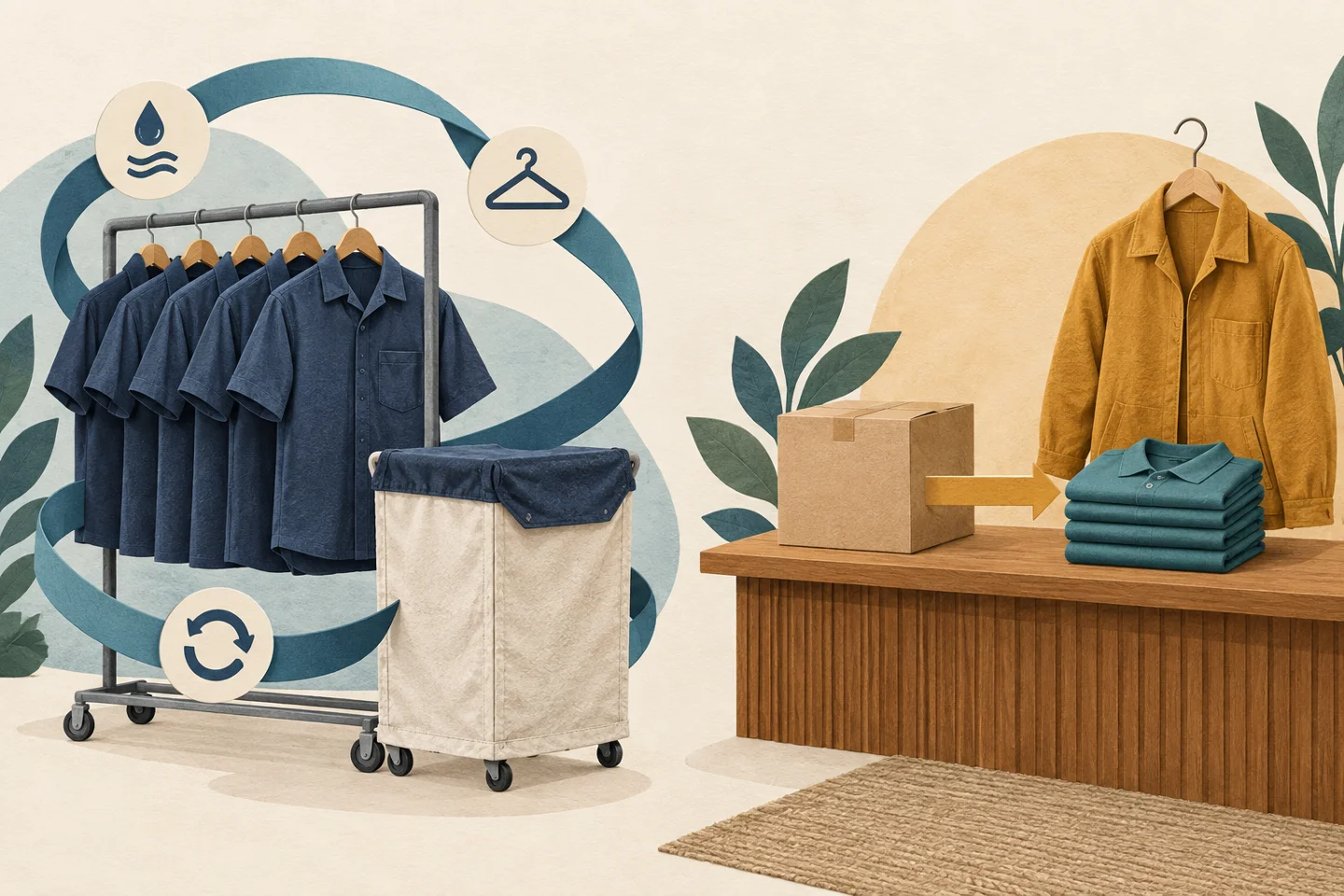
Choose uniform rental when the recurring service—collection, laundering, inspection and return—is central to keeping people outfitted. Choose purchased apparel through a company store when approved ordering and replenishment are the main problems, and you already have a workable care arrangement. For a mixed workforce, split the program by role instead of forcing every employee into the same model.
A weekly rental charge and the price of an embroidered polo buy different things. Comparing them without specifying who cleans, replaces and tracks the garments can produce an attractive spreadsheet and an unworkable uniform program. The useful question is not simply “rent or buy?” It is “which responsibilities should we own, and which should we contract out?”
Publisher perspective: Brand Sauce provides managed company merch stores. This is our decision framework, not an independent provider ranking. Rental can be the stronger choice when ongoing garment care is the primary need. Provider descriptions below were checked against official sources on October 2, 2026; exact products, country and route coverage, service terms and pricing require a quote.
1. Separate the ordering system from the care service
A company store is an ordering channel. A rental-and-laundry program is a recurring garment service. Either can help standardize appearance, but they solve different operational problems.
Manufacturer Red Kap’s uniform program guide distinguishes laundry-provider arrangements from direct purchase and employee purchase. With owned garments, the company or wearer still needs to manage cleaning. That responsibility does not disappear because checkout becomes easier.
For current service examples, Cintas describes Apparel+ as a weekly pickup, laundering, inspection and return cycle, with repairs and replacements included in its published program description. UniFirst describes its rental workflow as assessment and sizing followed by pickup, laundering, inspection and delivery. These descriptions establish the service model, not your local quote or every contractual exception.
Brand Sauce’s managed company-store offering covers curation, setup, branded apparel ordering, fulfillment support and direct shipping. Do not interpret that as an industrial laundry commitment. Confirm any care service separately rather than assuming two providers mean the same thing by “managed.”
2. Choose by role and location, not company-wide habit
| Operating situation | Model to investigate first | Question that can change the answer |
|---|---|---|
| Daily uniforms with a recurring need for centralized cleaning | Rental with laundry | Can the proposed route and garment allocation keep every shift supplied? |
| Office or customer-facing polos with an established care arrangement | Purchased apparel through an approved store | Who authorizes and funds worn-out replacements? |
| One opening, conference or seasonal cohort with a fixed need-by date | Scheduled bulk purchase | Are fit selections and quantities confirmed before production? |
| Service teams plus office staff and occasional event apparel | Hybrid by role or garment | Can everyone identify which items must be returned and which are owned? |
| Small teams spread across distant sites | Compare local rental coverage with direct-shipped purchases | What service is actually available at each address? |
This guide concerns the sourcing and care model for everyday work apparel. Role-specific protective clothing or controlled cleaning requirements need their own qualified suitability review before a buying model is chosen. Do not replace specified workwear with an ordinary branded polo because it is easier to order.
Build one row per role and location. Record required garments per shift, weekly wear frequency, care owner, available storage, first-wear date and emergency fallback. Two departments sharing a logo may need entirely different arrangements.
3. Run the clean-garment test
Ask the provider and location manager to walk through a real week: what is available on Monday, what gets collected, what remains with the wearer, and when clean items return? Include overnight shifts, time away and a missed collection. The useful unit is a usable garment available when needed—not a garment somewhere in the system.
Illustrative planning example, not a provider allocation: a person needs five fresh shirts during a workweek. If five are away for cleaning while five cover the next working cycle, ten shirts are already committed before considering collection-day timing or a spare. Changing the pickup day can change the required allocation. Do not turn this sketch into a universal ten-shirt rule.
For purchased apparel, perform the same exercise using the actual care arrangement. If the employer supplies two shirts but requires a fresh one every workday, the plan implicitly depends on frequent washing. Decide whether that expectation is practical before approving the issue quantity.
For rental, ask how missing pieces are reported, how repair requests are identified, when a replacement enters circulation and what happens if a wearer has no usable item. For owned apparel, assign those same decisions internally or explicitly buy support for them. Neither model is complete without an exception path.
4. Compare equivalent costs over the same period
Use the same roster, garment standard and evaluation period for both quotes. List included work beside the price. A low purchase price is not evidence of a lower-cost uniform service; a predictable weekly bill is not evidence that every possible expense is included.
| Cost line | Rental question | Purchase/store question |
|---|---|---|
| Initial setup and personalization | What is included, and what is separately charged? | What do samples, decoration and setup cost? |
| Recurring supply | What is the billing unit and how does headcount change it? | How many initial and replacement garments are needed? |
| Care | Which cleaning and handling services are included? | Who pays for and performs cleaning? |
| Exceptions | How are loss, damage, size changes and unused allocations treated? | Who pays for remakes, replacements and urgent freight? |
| Administration | Who reconciles issued, collected, missing and billed items? | Who manages approvals, receiving, reserve stock and care issues? |
| End of arrangement | What return, notice and settlement terms apply? | What happens to remaining usable and obsolete stock? |
Illustrative arithmetic only: suppose 30 wearers receive five purchased shirts each at an invented decorated price of $32. Initial garments cost $4,800. Assume another 30 replacement shirts during the year: $960. Add hypothetical combined setup and freight of $540, and the purchase-side subtotal is $6,300.
That is not an all-in annual uniform cost. It excludes cleaning, administration, applicable taxes and any costs not included in those assumptions. An invented rental rate of $9 per wearer per week produces $14,040 over 52 weeks for 30 wearers, before any additional quoted charges. Neither number is a Brand Sauce, Cintas or UniFirst price.
The $7,740 difference is the amount available to cover the omitted purchase-side responsibilities before the two illustrative totals converge, assuming the rental scope covers equivalent needs. It is not a savings claim. Replace every input with quotes and your actual care workload; compare garment availability as well as spend. Keep initial-year purchases separate from later replenishment rather than pretending the same cash outlay repeats every year.
Bulk purchasing may make sense for a stable, confirmed cohort. On-demand replenishment may reduce speculative extra orders but introduces production and delivery waiting time. A small reserve plus scheduled bulk issues and individual replenishment can be more practical than either extreme. Our on-demand versus bulk guide addresses that production decision separately.
5. Approve the garment and decoration for the actual care process
“Work shirt” does not specify a wash process. Ask for the exact style’s care instructions and confirmation that the finished decoration is compatible with the proposed laundering. Do not apply one product’s suitability to every garment from the same manufacturer.
For example, Red Kap identifies its KT30 shop coat as industrial-laundry-friendly while also publishing specific care instructions. That is a manufacturer example of product-level documentation, not a recommendation for every role or a claim that Brand Sauce stocks that exact item.
Send the proposed garment, logo method and care process to the responsible suppliers together. An approval for an undecorated garment does not answer what happens to a patch, transfer or embroidered mark. Ask who resolves a disagreement if the garment remains sound but the decoration fails.
Use a finished sample for a wearer trial and the intended care cycle. Record appearance, fit, shrinkage concerns, comfort, closures and logo condition against agreed acceptance criteria. The branded apparel sample approval guide provides a more detailed inspection sequence. A single sample check is a launch gate, not proof of lifetime durability.
6. Make a hybrid program easy to understand
A hybrid should divide responsibility clearly, not create two places to ask the same question. One illustrative arrangement is rented daily service uniforms, purchased front-office polos and a separate optional merchandise collection. Another is owned uniforms with a separately contracted laundry service. Obtain explicit scope and pricing for each component.
Keep a simple issue record with employee identifier, garment category, quantity, ownership, care route and return requirement. Tell wearers which items go into the collection bin, which stay with them and where to report a problem. Do not mix optional gifts into a required uniform allowance without explaining the distinction.
Assign a program owner who can see both systems. A shirt replacement should not be ordered through the store merely because an open rental repair request is hard to find. Likewise, a purchased jacket should not silently enter a rental return count.
For multi-location implementation, pair this decision with our franchise uniform rollout guide. The addition here is a care-and-ownership boundary, not another storefront launch checklist.
7. Request a scenario-based proposal before committing
Give every shortlisted provider the same role/location brief and ask for written answers to these operational scenarios. Treat unanswered items as unresolved scope, not as proof that a provider lacks the capability.
- A new person starts next week: explain sizing, first issue, temporary fallback and billing start.
- A wearer changes size: explain the exchange path, timing, charges and treatment of decorated items.
- A delivery or cleaning cycle is missed: name the escalation owner and immediate supply remedy.
- A department shrinks: show how counts, garments and charges are adjusted.
- A shirt or logo fails: distinguish ordinary wear, damage, decoration failure and the replacement decision.
- The program ends: explain garment ownership, returns, outstanding orders and final reconciliation.
Pilot through a full issue, wear, care, return or reorder, and billing cycle. Have the location manager count usable items and resolve one documented exception. Approve expansion only when the physical service and administrative records match the proposed responsibilities.
Uniform rental versus company-store FAQs
Is a company store a direct replacement for uniform rental?
Only if the services you still need are covered elsewhere. A store can organize approved apparel orders; it does not by itself collect soiled garments or return clean ones. Map those duties before switching.
Is buying always cheaper?
No. Compare equivalent garments, care, replacements, administration and timing using actual quotes. Do not compare a shirt-only price with a service-inclusive bill and label the difference savings.
Can a business use rental and purchased apparel together?
Yes, as a program design. Confirm supplier scope and identify each garment’s owner, care route and return rule. Divide by role or garment purpose so the boundary is understandable.
Should every employee receive the same number of uniforms?
Not automatically. Base the allocation on required wear frequency and the cleaning turnaround. Equal quantities can leave one shift short while another holds unused garments.
Buy the responsibilities you need—not the label that sounds simplest. If clean uniforms on a recurring schedule are the central requirement, evaluate the laundry service first. If controlled selection and repeat ordering are the problem, a managed store may fit. If both are true, define a hybrid that makes ownership and care unmistakable.