Specify ripstop for a company bag when limiting the spread of a fabric tear is a meaningful part of the brief—not because a visible grid looks more durable. Then qualify the finished bag separately for rubbing wear, load, closures, decoration and weather exposure. Ripstop is a construction feature, not a promise that the bag cannot rip or that every ripstop option outlasts every non-ripstop option.
The practical decision is whether the reinforcement solves a problem your recipients actually have. A lightweight backup tote, a daily commuter backpack and a bag repeatedly set on rough floors need different evidence. This guide provides a failure-mode worksheet and an approval process for deciding whether to require ripstop, accept it as optional, or prioritize another feature.
Publisher perspective: Brand Sauce provides company-store services. The selection process below is our editorial recommendation. Manufacturer examples explain material specifications; they are not claims that those brands or configurations are available through Brand Sauce. Exact product, decoration, destination-country availability and pricing need confirmation and, where unpublished, a quote.
What does ripstop actually tell a buyer?
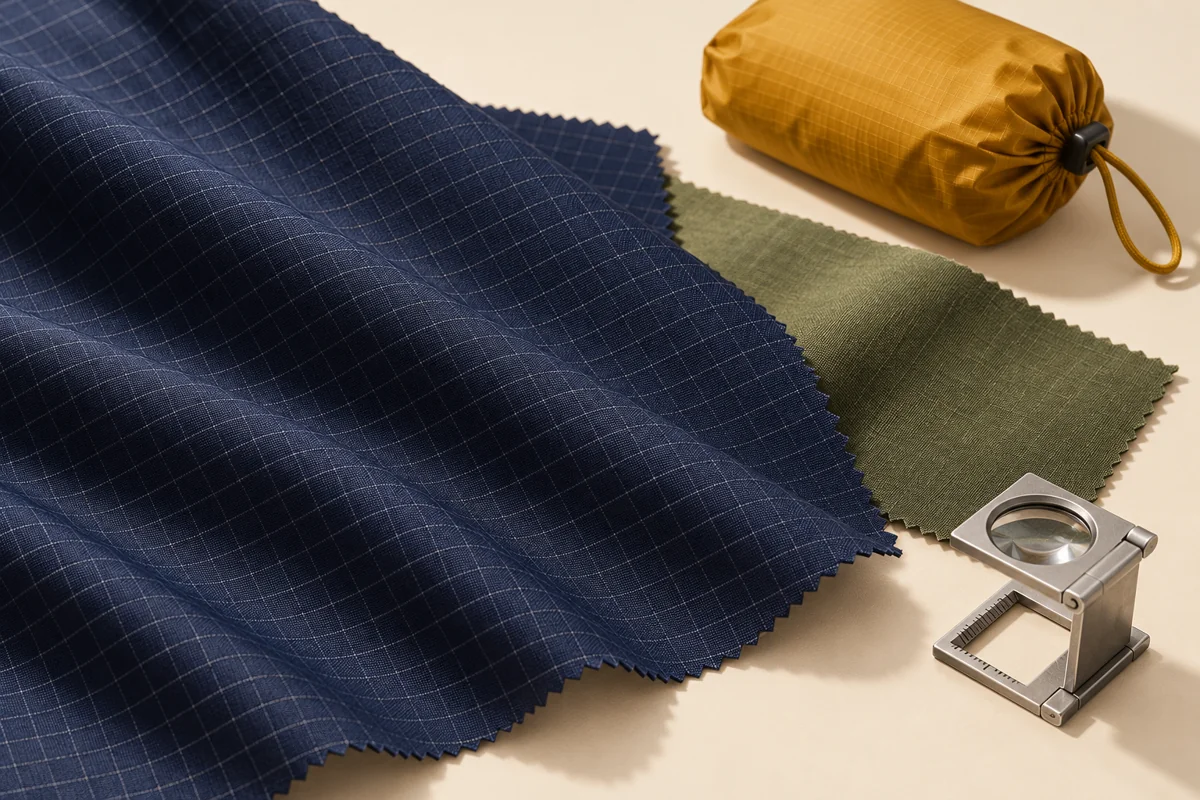
Ripstop uses reinforcing yarns within the fabric construction to help resist a tear spreading. In its materials guide, Tatonka describes its 210-denier nylon ripstop as incorporating thicker threads at regular intervals. That explains the familiar grid, but it does not establish the performance of an unrelated bag carrying the same generic label.
Ask the supplier to identify the fabric, not just the visual pattern: fiber composition, reinforcement construction, finish or coating, and which panels use it. A bag may have a ripstop main body but a different base, pocket or lining. A grid visible on the front does not tell you what supports the contents underneath.
Nor is “ripstop versus nylon” a useful comparison. One term describes construction and the other identifies a fiber family; a material can be both. Likewise, a denier number does not replace tear-performance evidence. Our company-backpack denier guide covers that separate yarn-specification question.
Be precise about the purchasing consequence. “Ripstop preferred” leaves room for a qualified alternative. “Ripstop required” can exclude suitable products before the supplier understands the job. Reserve a mandatory requirement for a reason you can explain, supported by the intended use or comparable evidence.
Start with a failure map, not a fabric ranking
Walk through how the bag will be carried, opened, stored and put down. Name the failure you want to avoid before collecting supplier adjectives. The following is a planning worksheet, not a laboratory classification or a claim about any specific product.
| Observed or expected problem | Question to investigate | Evidence worth requesting |
|---|---|---|
| A small snag becomes a longer opening | How does this fabric resist tear propagation? | Exact fabric identification and comparable tear-test information |
| The bottom wears thin from repeated rubbing | What protects the contact panel? | Base construction and abrasion evidence for that material |
| A handle or strap attachment pulls away | How is the load transferred into the bag? | Finished-bag load guidance and attachment construction |
| Contents get wet | What protection does the whole bag provide? | Model-specific claims covering fabric, seams and closures |
| The logo panel looks distorted | Is the decoration approved on this configuration? | A decorated sample in the selected fabric and placement |
| The bag is left at home because it is cumbersome | Does the carrying experience fit the recipient? | A representative loaded-use and packing trial |
This prevents one feature from absorbing the entire quality budget. If the recurring complaint is an uncomfortable strap, paying for a different body fabric may leave the complaint untouched. If the problem is worn corners, inspect those corners rather than accepting a tear-resistance statement about another panel.
Read tear and abrasion evidence separately
Manufacturers themselves distinguish these properties. CORDURA’s Classic Fabric page describes tear strength and abrasion resistance separately, and identifies finished, coated and laminated options. Treat that as a reminder to specify the actual material configuration—not as a numerical comparison with every fabric called ripstop.
ULA Equipment’s fabric guide likewise describes its 400 Robic fabric as ripstop-reinforced, while listing coatings separately. Its page also reports distinct tear-strength and abrasion figures for several other materials. Those manufacturer examples show why a single “durability” column is too vague; they do not prove a universal winner for corporate merchandise.
If two suppliers provide test results, ask whether the method, units, sample condition, direction and endpoint match. A tear result in one direction should not silently become an all-direction promise. A fabric report should not silently become a finished-bag load rating. Where the reports are not comparable, record that limitation instead of turning the larger number into a score.
Many ordinary gift orders will not justify commissioning new laboratory work. In that case, narrow the claim: approve the bag for the observed use and documented supplier limits, without advertising a measured durability advantage. A handling sample can reveal practical shortcomings; it cannot establish years of service life.
Three briefs that lead to different decisions
1. A packable extra bag for occasional overflow
The priority might be that the bag folds away easily and is convenient enough to keep available. Put packed size, opening, handle comfort and an appropriate load recommendation ahead of a heavyweight aesthetic. Ripstop can be a relevant feature to investigate, but the actual approval should show that the bag carries the intended items and packs away without an awkward ritual.
Ask a tester unfamiliar with the product to fold it using the supplied instructions. Record whether a separate pouch must be kept. Do not approve a compact-looking studio photo as evidence of an easy recipient experience.
2. A daily commuter bag
Start with contents, carrying comfort and contact points. A grid-pattern body is not compensation for a laptop compartment that does not fit or an opening that makes daily access difficult. Inspect the base, shoulder-strap attachment, zipper path and lining as distinct parts of the product.
Here, ripstop may be optional rather than mandatory. Keep both a ripstop candidate and a non-ripstop candidate if each meets the brief, then compare the complete bags. Do not infer protection from rain from either fabric name; see our water-resistant versus waterproof bag guide for that separate decision.
3. A bag issued for repeated operational use
For a team carrying equipment between locations, write the contents and working conditions into the brief. Confirm any weight or use limits with the supplier. Pay particular attention to the base and attachment points if those are the likely problem areas. A stronger-looking face fabric alone is not an equipment qualification.
If a bag is required for the job, do not make access depend on an employee spending a recognition allowance. Separate the equipment decision from optional gifts, and use the organization’s relevant equipment-approval process. A merchandise sample review is not a safety certification.
Run a sample review without staging a fake durability test
Use the same intended contents and tasks for each candidate. Document the product code, color and sample configuration so the approved item is identifiable later. Photograph the base, handles, seams, closure and proposed decoration panel before the trial.
- Load and access: pack the normal contents within supplier guidance, close the bag and retrieve the items used most often. Record fit and handling problems.
- Carry: have representative users try the expected carrying modes. Ask about comfort and usability rather than whether the fabric feels “premium.”
- Set down and store: observe which parts contact the usual surfaces and whether the bag fits its normal storage space. Do not create abusive conditions and call the result a standardized test.
- Inspect decoration: review the actual logo treatment, placement and fabric appearance. Obtain supplier approval for the method; a blank sample does not settle decoration feasibility.
- Review after use: note visible changes and follow the stated care instructions. Keep the duration and conditions attached to the observations.
Avoid cutting competing bags and pulling the openings by hand to claim one is “twice as strong.” Without a controlled method, the result is a demonstration of your improvised procedure, not reliable comparative evidence. If a quantified tear requirement matters to the purchase, request suitable supplier documentation or qualified testing.
Make the upgrade decision explicit
Use an incremental cost question: what verified benefit are we buying, and for whom? Compare delivered, decorated configurations, including samples and any differences in fulfillment. Do not attribute the entire price difference between two different bags to ripstop if they also differ in size, pockets, straps or branding method.
Illustrative calculation—not a quote or measured result: suppose two qualified candidates differ by $6 per bag and the program needs 120 bags. The additional purchase cost is $720 before any other differing charges. That arithmetic does not predict $720 in avoided replacements. To justify such a claim, you would need relevant failure rates and costs that this example does not supply.
The decision could still favor the higher-priced bag for a documented handling benefit, or the lower-priced bag because both meet the need. Record the reason. “Selected for easier packing at an acceptable delivered cost” is more useful than “selected because ripstop is best.”
On-demand ordering can suit uncertain recipient demand if the exact approved product and decoration are available one at a time. Bulk may make more sense for a known group, a common deadline or a configuration that requires a production run. A hybrid can cover planned equipment issues with approved stock while keeping optional employee gifts separate. None of these models establishes a material-performance advantage; verify quotes, replenishment and substitution rules for each.
Keep a ripstop decision card with the order
- Use: intended contents, carrying pattern, surfaces and supplier limits.
- Decision: ripstop required, preferred or optional, with the reason.
- Identity: exact bag, color, body/base materials and reinforcement description.
- Evidence: source documents, comparable reports if available, and sample observations with their limits.
- Decoration: approved method, placement, sample and responsible supplier confirmation.
- Commercial scope: destination, quantity, delivered quote, lead time and replenishment arrangement.
- Change control: who approves a different fabric, panel construction or replacement model.
A substitute should satisfy the original functional brief, not merely contain the word ripstop. Conversely, do not reject a documented equivalent solely because its pattern looks different. Reopen the affected checks and keep the reason for acceptance or rejection. Our gift substitution guide explains how to manage the recipient side of that change.
Frequently asked questions
Is ripstop tear-proof?
No. Treat it as reinforcement intended to resist tear propagation, not immunity to damage. Require evidence for any stronger performance claim.
Does a visible square grid prove the specification?
No. Use the supplier’s material description and exact product identity. Appearance alone does not establish composition, test performance or which other panels use the same fabric.
Is ripstop automatically waterproof?
No. Weather protection needs its own model-specific evidence, including relevant coatings, seams and closures. Do not convert a construction term into a whole-bag claim.
Should every employee get the same ripstop bag?
Only if one approved bag fits the program’s actual purpose. For optional gifting, a suitable alternative can be more useful than requiring everyone to accept a feature they do not need.
Primary manufacturer references checked October 31, 2026. The hero image is a conceptual textile illustration, not a photograph of a tested product.