Do not choose a company backpack just because its fabric is labeled 1,680D instead of 600D. Denier describes yarn mass per unit length, not a finished bag’s strength, weight, weather protection or useful life. Choose the backpack that passes your actual carry requirements, then use its fabric specification to document what you approved and prevent unsuitable substitutions.
For a buyer comparing employee gifts, the real question is not “Which number is highest?” It is “What evidence would justify paying more for this particular bag?” A material upgrade is valuable when it solves a defined problem. A larger number alone does not establish that it does.
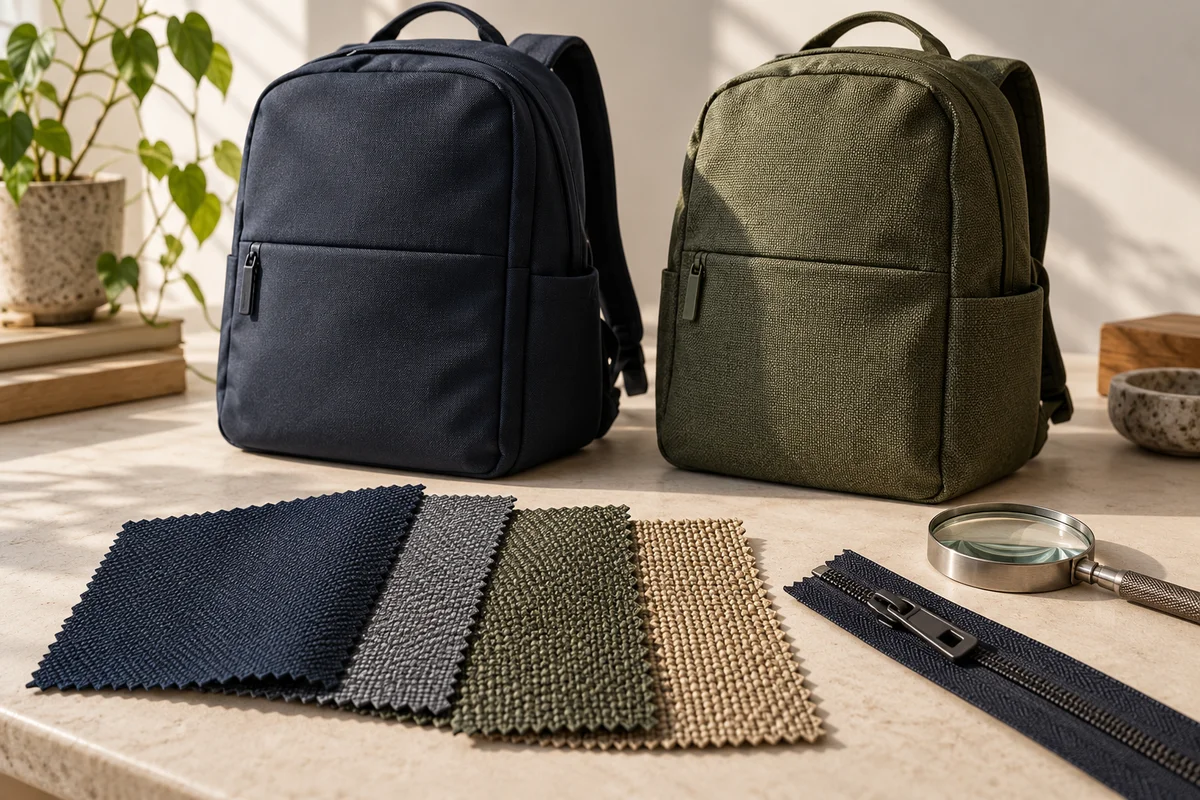
This is Brand Sauce’s purchasing framework, informed by the manufacturer and textile references linked below. The named products illustrate how specifications work; they are not a tested ranking, a current inventory promise or confirmation of branded availability in every country. The editorial image is a conceptual sample arrangement, not a photograph of those named products.
What 600D and 1,680D actually tell you
Cotton Incorporated’s Textile Yarns technical reference defines denier using the mass in grams of 9,000 meters of yarn. That makes it a yarn specification. It is not the fabric’s grams per square meter, the empty backpack’s weight or a maximum carrying load.
In an illustrative calculation, 1,680 divided by 600 equals 2.8. That means the specified yarn has 2.8 times the mass for the same length. It does not mean the finished backpack is 2.8 times stronger, heavier or longer-lasting. Those conclusions would require evidence about the fabric and assembled product.
Use the number alongside fiber, construction, coating and panel location. “600D polyester body” is more informative than “600D.” A specification that distinguishes the body, bottom and lining is more useful still. If a supplier cannot identify which component a prominent material claim describes, keep that claim out of your purchase justification.
Read three real specifications without turning them into a ranking
These examples show why a single-number comparison leaves important information out:
| Official reference | What it specifies | What a buyer should not infer |
|---|---|---|
| Port Authority Value Backpack BG203 | 600 denier polyester canvas; a front pocket intended for embellishment access | That every 600D bag has the same construction or decoration access |
| Port Authority Xtreme Backpack BG207 | 1,680 denier polyester with 600 denier polyester canvas accents | That every exterior panel uses the higher-denier material |
| X-Pac VX21 fabric | A layered construction including a 210D nylon face, polyester film and polyester backing | That its face-yarn number describes the whole laminate or any finished backpack |
The first two are finished-bag specifications. The third is a fabric specification. They are deliberately not an apples-to-apples performance comparison. The useful lesson is to ask what the number belongs to before using it to choose a product.
Likewise, “canvas” is not sufficient evidence that a bag is cotton: both Port Authority examples explicitly describe polyester canvas. Read the fiber description rather than supplying an assumption based on the fabric’s appearance or name.
Write the carry requirement before selecting a material
Start with a short description of the intended workday. An employee carrying a laptop between home and an office has a different requirement from someone repeatedly loading equipment into a vehicle. Neither person automatically needs the highest-denier option.
Record the contents, how the bag is carried, the surfaces it normally touches and how recipients are expected to clean it. Keep work equipment separate from an optional employee gift: a branded commuter bag should not silently become an approved tool carrier merely because someone calls its fabric heavy-duty.
- Office carry: prioritize usable organization, manageable empty weight and comfortable loaded carrying.
- Frequent travel: include repeated opening, lifting, packing and attachment to other luggage in the sample review.
- Vehicle-based work: examine the bottom panel, handle attachments and access to frequently used contents.
- Occasional event use: question whether a more elaborate, heavier bag adds enough usefulness to justify the additional commitment.
These are review priorities, not material prescriptions. A suitable design can use different materials in different places. For the separate question of device dimensions and compartment access, use our company backpack laptop-fit guide.
Compare evidence, not material adjectives
| Purchase question | Evidence to request | Reason to pause approval |
|---|---|---|
| Will the surface tolerate the intended use? | Exact fabric identity and relevant abrasion or tear information, if available | A denier number presented as a durability guarantee |
| Is it comfortable with the usual contents? | Empty product weight and a loaded sample review | A comfortable empty demonstration only |
| Are the vulnerable areas suitable? | Bottom, seams, handle and strap-attachment inspection | The main fabric is documented but other components are unspecified |
| Can the company mark be applied as intended? | Approved decorated sample of the selected color and location | A flat swatch proof that bypasses the actual pocket construction |
| Can recipients care for it reasonably? | Manufacturer instructions for the complete bag | Care advice inferred from the outer fiber alone |
| Will repeat orders match? | Style, color and material revision recorded in the approval | Permission to substitute any bag with an equal or higher denier |
If a supplier provides laboratory results, ask which material was tested, which method was used, the test conditions and the endpoint. Two isolated cycle counts are not a reliable comparison unless their methods and conditions are comparable. Do not convert a fabric test into a claimed number of years of employee use.
Missing test data is not proof of poor quality. It means the buyer has less evidence for a particular performance claim. For routine gifting, a documented sample review may be proportionate. For demanding operational use, obtain suitable technical evidence or choose a product specifically intended for that task.
Run a side-by-side sample review
Request the actual shortlisted styles, not two anonymous swatches. Keep the sample labels and take reference photographs before reviewing them. Use the same contents for each bag so a lightly packed candidate does not seem more comfortable simply because it carries less.
- Record the baseline. Note the style, color, material description, empty weight and manufacturer care instructions. Mark anything unknown instead of estimating it from appearance.
- Pack the normal load. Check whether the contents fit without forcing the closure or distorting a pocket. Use nonvaluable stand-ins where appropriate.
- Try the normal tasks. Have intended users put it on, adjust it, retrieve an item and lift it by the handle. Record specific objections rather than a single unexplained “premium feel” score.
- Inspect the assembled details. Look at attachment points, zipper operation, lining access and the base. Note loose threads or obvious inconsistencies for supplier review; visual inspection is not a strength certification.
- Review a decorated version. Confirm placement, legibility and whether pockets still operate correctly. Do not assume the decoration result transfers unchanged between different surface textures.
- Make a release decision. Approve, request a correction or reject against the written requirement. Retain the approved sample and its record for later reorders.
This is a proposed purchasing check, not a claim that Brand Sauce has run these tests on the examples above. It does not replace standardized testing where the use requires it. Do not improvise destructive load tests or put a real laptop into a water demonstration.
Keep weather, care and decoration claims separate
A material’s denier does not establish whether a completed bag protects contents from rain. A fabric specification can describe a waterproof layer while the finished product still has seams, closures and other construction details requiring separate evaluation. Our water-resistant versus waterproof bag guide addresses that purchasing decision in detail.
Care is another product-level question. The BG203 instructions specify wiping with a damp cloth and mild soap, then air drying if required. That is useful evidence for that model—not permission to put every polyester backpack into a washing machine. Put the approved product’s care instructions in the recipient information, especially if the design combines multiple materials.
Ask the decorator to review the actual bag, artwork, location and finish. Obtain confirmation of the permitted process and production access before promising a large front logo. A strong fabric specification does not solve a blocked embroidery area, a pocket caught in stitching or artwork that becomes hard to read against a textured surface.
An illustrative decision: the lower number can still win
Imagine a company comparing two unnamed backpacks for an optional welcome gift. Candidate A lists a 600D polyester body. Candidate B lists a 1,680D polyester body. Both accommodate the required contents. During a proposed pilot, users would assess carrying comfort, access and presentation; procurement would compare fully decorated, delivered quotes.
If A meets the written requirement and B supplies no demonstrated improvement that matters to the recipients, there is no reason to select B solely for its number. Conversely, if B has a more suitable base, better access or a handle design that works better in the intended routine, those are defensible reasons to prefer it. Document the actual advantage, not “higher denier equals higher quality.”
This is a hypothetical decision framework, not measured product performance or a savings claim. Prices, outcomes and availability are deliberately unspecified. Obtain current quotes for the exact style, color, decoration, quantity and destination.
Match the ordering model after approving the product
For ongoing employee choice, on-demand ordering can avoid committing to a finished backpack for every future recipient. Confirm that the selected style, decoration and destination are actually eligible; a sample on a desk does not establish one-unit fulfillment availability.
Bulk can make sense for a known group, a fixed distribution date or a customization process that requires a production run. Compare complete costs, storage responsibilities and the risk of unused bags. A hybrid approach might hold a modest approved quantity for scheduled onboarding while letting later recipients choose from a separately verified ongoing assortment.
None of these models guarantees the same bag will remain available forever. Make the replacement rule explicit: a substitute must meet the original functional and decoration requirements, not merely match or exceed the denier. See our employee-gift substitution playbook for handling that change without surprising recipients.
Keep a one-page material approval record
Copy these fields into the purchase brief: intended use; required contents; exact product and color; body, base and lining specifications; empty weight; care instructions; decoration method and position; sample observations; approved exceptions; destination; order quantity; quote date; and substitution approval owner.
Add one sentence that explains the selection: “Approved because it met the carry requirement, decoration review and delivered budget.” If paying for an upgrade, name the verified benefit. Keep the record alongside the sample so the next buyer can tell the difference between a considered choice and a product selected for a large number.
Brand Sauce can discuss a shortlist against that brief. Bring the use case and approval criteria to a product-planning conversation; request confirmation of current availability, decoration feasibility and price before committing the program.
Backpack fabric questions
Is 1,680D always better than 600D?
No. It identifies a different yarn mass, not a complete-bag quality grade. Compare the same intended tasks, product construction and documented evidence.
Can I compare nylon and polyester using denier alone?
No. Fiber identity and the rest of the construction remain part of the specification. Do not use a shared number as proof that two fabrics will behave identically.
Does polyester canvas mean the bag contains cotton?
No. Read the stated composition. The manufacturer examples in this guide specifically identify polyester canvas.
What if the supplier does not publish denier?
Ask for the available material specification, but do not reject an otherwise suitable product solely because that number is absent. Finished-product evidence and a representative sample are more useful than filling a spreadsheet cell with an unsupported estimate.
Primary references checked October 27, 2026. Product and material examples explain specifications; current branded supply, country coverage and pricing require confirmation.