Choose water-resistant employee bags for ordinary carry needs only when their stated protection matches the commute. Choose a bag with a documented waterproof rating when the requirement is more demanding, and verify exactly which compartment, closure and conditions that rating covers. A coated fabric, a roll-top shape or the word “outdoor” is not enough to establish protection for the finished bag.
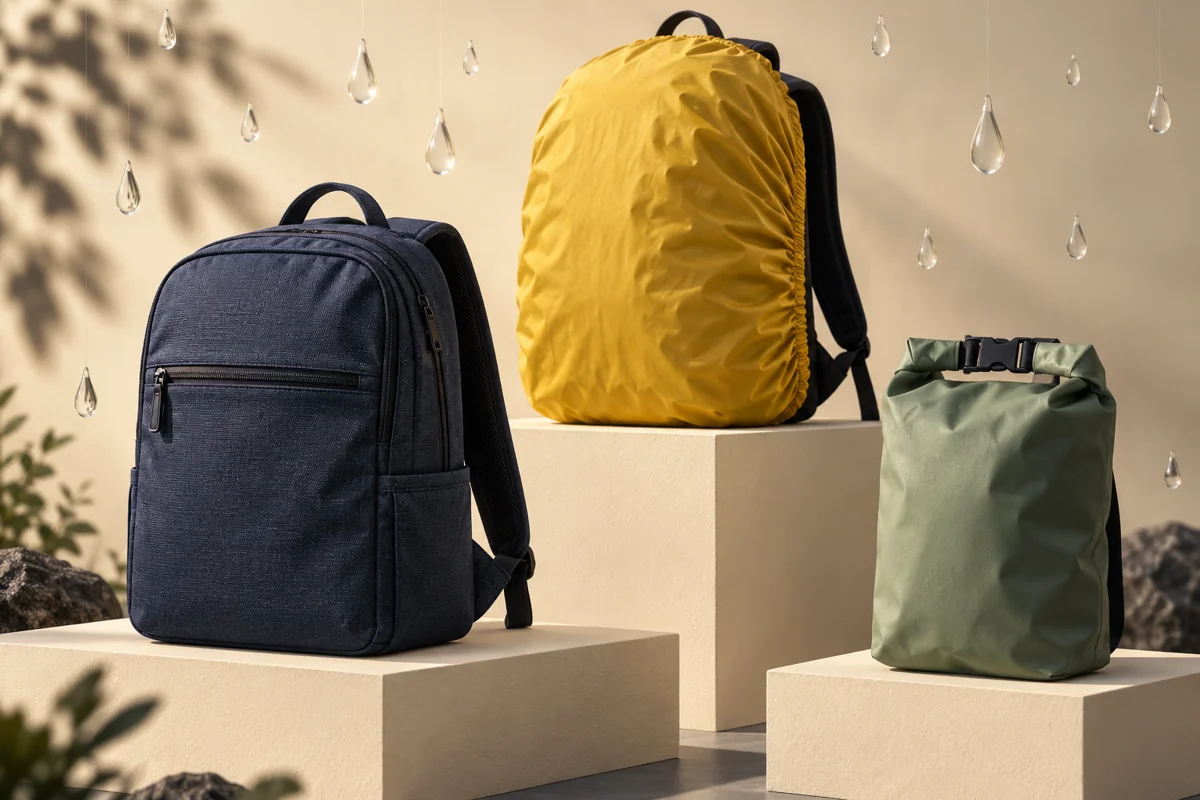
The buying decision is not simply whether to spend more on a better backpack. It is whether to select an everyday bag, add a compatible raincover or inner protective bag, or move to a purpose-built waterproof design. Each approach changes access, packing habits, decoration and the instructions employees need.
Publisher perspective: Brand Sauce publishes this merchandise-buying framework. Manufacturer examples illustrate evidence to request, not a tested ranking or a promise that these products are available for decoration through Brand Sauce. Official sources were checked October 10, 2026. Exact style, country availability, decoration permission and pricing need confirmation; program pricing is quote-needed.
Define the exposure before choosing the bag
Start with three questions: where will the bag travel, what must stay dry, and what would happen if it got wet? A short walk from a parking garage is a different requirement from an extended bicycle commute. Carrying a change of clothes is different from carrying company electronics or paper records.
Do not label every employee in a rainy city a waterproof-bag buyer. Ask about actual use and offer choices where possible. Equally, do not describe an ordinary promotional backpack as suitable for wet fieldwork just because its fabric feels substantial. If the bag is required work equipment, have the responsible equipment owner define the requirement before the merchandise team chooses a logo location.
| Intended use | Approach to evaluate | Unresolved question before approval |
|---|---|---|
| Occasional brief exposure during an office commute | Everyday water-resistant bag | What does the manufacturer actually claim about the whole bag? |
| Regular travel in rain with a preferred existing backpack | Compatible raincover and, where appropriate, inner protection | Can the recipient fit, carry and use the protection correctly? |
| Frequent wet-weather carry | Purpose-built bag with documented water-protection scope | Does the evidence apply to the selected compartment and closure? |
| Possible immersion or specialized equipment transport | Equipment-owner-approved protective system | Is the exact exposure covered, rather than inferred from “waterproof”? |
These are screening routes, not performance promises. Keep ordinary gift preference separate from required equipment: someone declining a gift should not lose access to protection they need for work.
Separate fabric claims from finished-bag claims
A product page may describe the fabric, the assembled bag or only one compartment. Those are different scopes. Copy the exact claim into your approval record and identify its subject before converting it into store language.
For example, Patagonia describes the Black Hole Pack 25L with a weather-resistant TPU-film laminate. That material description is useful evidence about the specified fabric; it is not permission for your company store to advertise an immersion-proof laptop compartment. The product page also describes zippered compartments, which should prompt a separate question about the assembled product's protection.
Ask the supplier to identify the role of the seams, openings and closure. Do not assume that a waterproof material produces a waterproof bag, or that a waterproof main compartment gives an exterior pocket the same protection. The approval record should say where employees may place items that must stay dry, not merely repeat an adjective next to the product title.
A useful evidence hierarchy is: exact model documentation first, clarification from the manufacturer or authorized supplier second, and your own usage observations as a separate category. An attractive sample and a casual splash demonstration are not substitutes for product evidence.
Read the rating and closure instructions together
ORTLIEB's Dry-Bag product information identifies IP64 protection as dust-tight and protected against splashing water from all directions. The same page distinguishes IP67, which it describes as protection against temporary immersion up to one meter for 30 minutes. These are not interchangeable claims.
The practical point is not to insist that every employee bag carry an IP rating. It is to avoid upgrading a splash-protection claim into an immersion claim. If a supplier advertises “waterproof” without explaining the conditions, ask for the missing detail before deciding whether the bag meets your requirement.
Closure technique can be part of the specification. ORTLIEB's Dry-Bag datasheet requires the closure to be rolled at least three to four times to achieve its stated IP64 protection. Follow the instructions for the exact item; that roll count is not a universal rule for every roll-top bag.
For buying purposes, that creates a capacity question: can the recipient pack the intended load and still close the bag as directed? A volume label alone does not answer it. Ask a sample user to pack representative nonvaluable contents, close the bag using the instructions and reopen it. Record usability, not an invented water-resistance certification.
Compare three protection models, not just two adjectives
1. An everyday bag with no separate accessory
This is the simplest system for the recipient: one item to select, carry and maintain. It can fit a program where access, organization and everyday comfort matter more than demanding weather exposure, provided the published claims and recipient expectations remain aligned.
The limitation is that the bag's convenience does not establish its protection. If you cannot substantiate a claim about keeping electronics dry, do not write it. For device dimensions and loaded comfort, use our separate employee backpack fit guide; weather approval does not replace those checks.
2. An everyday bag plus raincover or inner bag
This approach lets the employee keep a preferred carry format while adding a protection layer. It also introduces another item to fit, store and use. A raincover should be evaluated on the loaded pack, while an inner bag needs enough usable space and an opening that accommodates the intended contents.
As a specification example, Osprey's Ultralight Raincover Medium lists taped seams, a drawcord and a stated fit range of 30–50-liter packs. Those details illustrate why a cover is not a one-size accessory. They do not establish fit on an arbitrary company backpack, and they do not transfer an immersion rating to it.
Evaluate the routine, not just the purchase: where will the cover live when dry, can the employee deploy it without emptying the pack, and where will it go afterward? If an inner bag protects the contents, identify which items belong inside it. Avoid a system whose instructions depend on employees guessing which layer does what.
3. A purpose-built waterproof bag
This can be the cleaner choice when documented protection is central to the use case. However, you still need to assess the opening, closure effort, internal organization and ability to carry the actual load. A stronger protection specification does not automatically make a bag a better everyday laptop organizer.
Compare the exact options on those dimensions. Do not declare all waterproof bags heavier, less comfortable or harder to use; those are model-specific questions for the sample review. Likewise, do not treat a premium brand as proof that any style within its range meets the same requirement.
Treat decoration as a separate approval gate
The item you distribute is the decorated product, not the untouched sample used in the manufacturer's documentation. Before applying a logo, ask the manufacturer or authorized supplier whether the proposed method and location are permitted and whether the original water-protection claim remains applicable.
Do not choose embroidery, heat application or a patch solely because it looks good in a mockup. Give the supplier the exact style, panel, artwork size and process. Ask whether any additional treatment, restriction or revised care instruction is required. If the answer is unknown, record it as unresolved rather than assuming that a different decoration method automatically solves the problem.
Sometimes the sensible branding decision is less decoration, another approved location or a different product. A card accompanying an unmodified bag can communicate the program without changing its construction. Confirm any brand's corporate-use and distribution terms before committing; retail availability is not evidence of decoration authorization.
Also distinguish a product defect from a promise to replace damaged contents. Our branded-gift warranty guide explains why the support owner and coverage should be clear before distribution. Do not imply that a bag warranty insures a laptop.
Use a six-field approval card
Keep a short decision record that survives a staff handoff or reorder. The following is a proposed purchasing tool, not a laboratory protocol.
- Intended exposure: describe the commute or work task and the contents requiring protection.
- Exact product: record style, size, revision where available, source page and check date.
- Claim scope: identify fabric versus assembled bag, protected compartments, rating if provided and stated exclusions.
- Required user actions: attach closure, packing, care and accessory instructions for that model.
- Decoration approval: save written confirmation of the permitted method, placement and applicable finished-product claims.
- Release decision: name the approver, outstanding questions and the store wording actually approved.
Run a dry usability review with representative contents: pack, close, carry, retrieve and repack. Include the accessory if the system depends on one. Do not put company electronics through an improvised hose or immersion test. If formal performance validation is necessary, define it with the manufacturer or an appropriate testing provider before making claims.
For a hypothetical mixed-commute team, the decision might be to offer an everyday bag and a separately qualified wet-weather option. The evidence should explain the difference without ranking employees into “basic” and “premium” groups. That is an illustrative program design, not a measured Brand Sauce client outcome.
Match ordering and store copy to the approved system
On-demand ordering can suit uncertain individual preferences if the exact approved bag and decoration are supported. It does not guarantee that the same style will remain available. Bulk can be appropriate when a defined group needs a qualified configuration by a shared date and the buyer can manage receiving and remaining stock. A hybrid can reserve a confirmed work-equipment allocation while keeping optional gifts separate.
Compare actual quotes including bags, accessories, decoration, samples, shipping and replacement arrangements. Do not assume the lower bag-only price is the lower system cost. Conversely, do not add a raincover to every order if the requirement and fit review do not justify it. Our on-demand versus bulk guide covers the broader inventory decision.
Write the product page around approved facts: intended use, exact protection language, what is included, closure instructions and meaningful limitations. Avoid “keeps everything dry in any weather.” A useful page lets the recipient decide whether the configuration fits their day without decoding supplier terminology.
Frequently asked questions
Is a roll-top backpack automatically waterproof?
No. Check the exact model's construction and documented protection. A closure shape is not a rating, and its performance may depend on packing and closing it as instructed.
Does IP64 mean a bag can be submerged?
No. In the ORTLIEB documentation cited above, IP64 describes protection against splashing water, not immersion. Match the model's stated scope to the planned exposure.
Can we add a logo without changing the claim?
Only use the claim once the responsible supplier has confirmed its applicability to the proposed decorated configuration. Do not infer approval from a blank product's specification.
Should every employee receive the waterproof option?
Not necessarily. Choose around the actual carry requirement and recipient preference. Where protection is needed for work, qualify it as equipment; where the bag is a gift, a suitable alternative may be more useful.