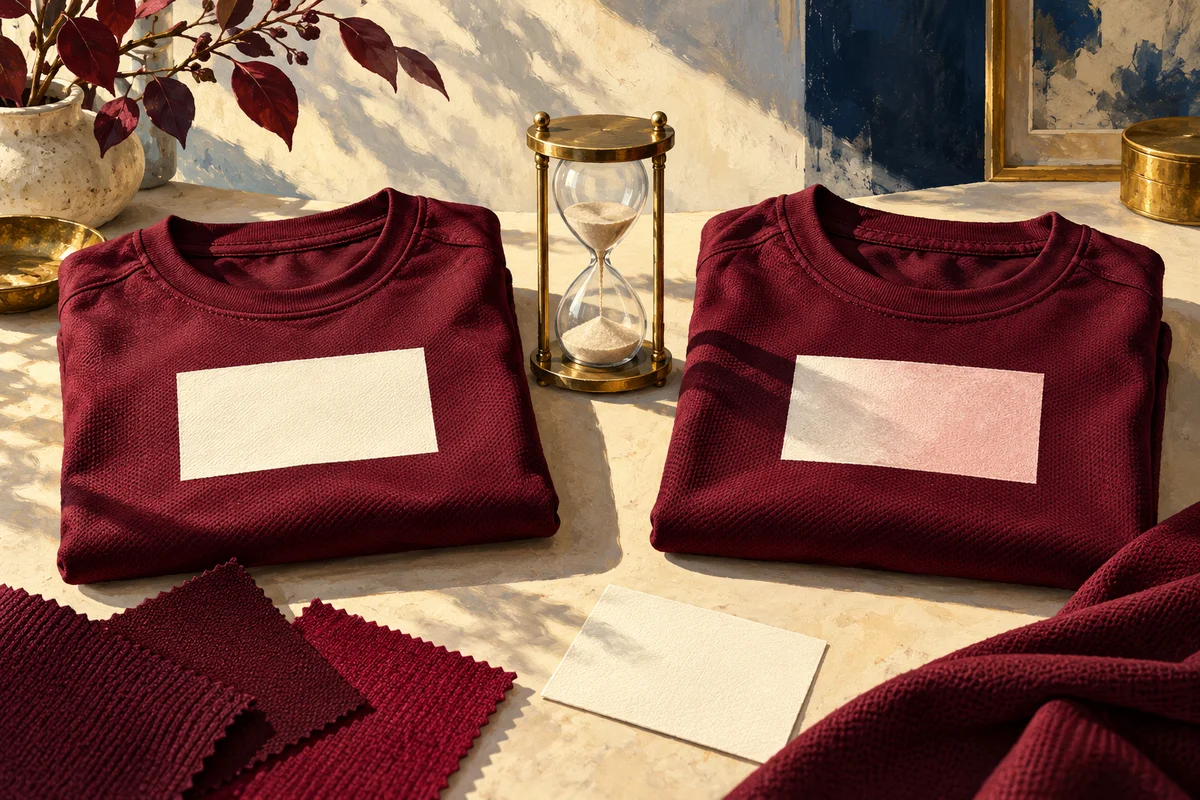
A white company logo that looks right immediately after printing can change color later. Before releasing printed polyester apparel, approve the exact garment color and decoration system after an agreed observation period—not just at the press. If the sample develops an unwanted tint, pause that combination and have the decorator resolve it before producing employee orders.
This is the buying problem behind dye migration: a good-looking first impression may not be a stable finished product. For company-store owners, the useful question is not “Can you print polyester?” It is “What evidence lets us release this particular shirt, color and logo for repeat ordering?”
Publisher perspective: this is Brand Sauce’s buyer-side approval framework, not a laboratory test or a universal production recipe. Primary supplier references were checked October 19, 2026. Named materials are technical examples, not confirmation of Brand Sauce assortment availability. The AI-generated illustration is conceptual, not a photograph of tested shirts.
Distinguish dye migration from a weak white print
SanMar describes dye migration in polyester printing as garment dye contaminating the printed color. It notes that the change can appear hours or days after printing. An immediate photo therefore cannot settle the release decision.
The STAHLS’ Dye Migration Handbook, printed pages 3–4 separates migration from opacity. Opacity is the print’s ability to conceal the underlying garment color; migration involves dye entering the decoration. The handbook also identifies variation between fabrics and dye lots, with dark garments and light decoration deserving particular attention.
For buyers, these are reasons to ask for a diagnosis, not to diagnose a production problem from a phone image. Keep the undecorated garment, original sample and later sample observations available to the decorator. A screen rendering of the logo cannot distinguish the two issues.
| What you observe | Question for the decorator | Buyer’s release decision |
|---|---|---|
| White looks gray or translucent from the first inspection | Is the print insufficiently opaque, or is another issue present? | Do not accept an unexplained mismatch to the approved appearance. |
| A light print develops a pink or colored tint later | Has garment dye migrated into the decoration? | Hold the affected combination pending diagnosis and a replacement sample. |
| Fabric around the print has a visible rectangle or changed sheen | Is the fabric reacting to the application process? | Record this separately; a color-stable logo does not approve surrounding damage. |
| The print lifts or changes after the agreed care check | Does the application or care specification need correction? | Do not trade adhesion or wear performance for an apparently cleaner color. |
Low-temperature application and dye blocking are different questions
A supplier’s “low temperature” description is not, by itself, a dye-blocking specification. Transfer Express’s current transfer comparison chart distinguishes ordinary full-color transfers from a version with a blocker for sublimated polyester. Its UltraColor Stretch with Blocker product page identifies an added blocker intended to prevent migration and describes its application requirements.
Those references support a narrow conclusion: name the actual decoration product and its intended fabric use. “DTF,” “transfer” or “polyester-compatible” is not enough detail to establish which system you are approving. A manufacturer’s component claim also does not prove that your finished garment has passed inspection.
Leave temperature, dwell time, pressure, curing and equipment setup to the decorator using the applicable manufacturer instructions. Do not ask someone to keep lowering the temperature until the white looks better. Require a combination that meets the application requirements and the finished-item acceptance criteria together.
If your decision is still about the broad printing process, our DTG versus DTF company-shirt guide covers that comparison. The decision here comes afterward: whether a selected garment-decoration combination is ready to release.
Define what one sample can—and cannot—approve
Make the approval unit explicit: garment style, garment color, fiber composition, decoration material, artwork version, finished dimensions and placement. Record a production or dye-lot identifier where the supplier can provide it. Do not invent traceability that the supplier does not maintain.
A white logo on a pale shirt should not automatically approve the same logo on a burgundy performance shirt. Nor should a solid-color blank automatically approve a patterned, sublimated version. Ask the decorator which combinations require separate checks and how that choice was made.
Use a small assortment to make this manageable. Instead of launching every available color and treating one sample as universal approval, launch the combinations with completed evidence. Keep the rest unavailable until reviewed. This is a merchandising decision as much as a quality decision: fewer approved choices can be more useful than a larger range with unresolved production questions.
Have the supplier identify the approval’s boundaries in writing. For example: “This sample approves style A in burgundy with artwork version 4 and decoration system B. Additional colors require review.” That is suggested wording, not a claim about any particular supplier’s policy.
Build elapsed time into the sample approval plan
Agree on the observation schedule before the sample is made. The STAHLS’ handbook notes that migration may emerge immediately or 72-plus hours later. That is a reason to include a delayed review, not a promise that every shirt passing at 72 hours is permanently safe.
- Document the starting point. Label the sample and record when decoration finished. Obtain the production specification from the decorator.
- Review the cooled sample. Check logo color, opacity, detail and the surrounding fabric. Keep a dated reference photograph and, where practical, a physical reference.
- Repeat at agreed times. Let the decorator recommend the observation interval for the actual materials. Use consistent lighting and viewing conditions so an apparent change is not simply a different camera exposure.
- Complete a separate care check. Follow the finished garment’s agreed instructions, including any wait before washing. Record what was done and compare appearance afterward.
- Make a named release decision. Approve, request another sample, or change the garment-decoration combination. Record remaining limitations rather than treating silence as approval.
These are proposed buyer acceptance steps, not a certified testing method. A handful of samples does not establish a failure rate, lifetime, or guaranteed performance under every shipping and storage condition. If your program needs a formal test result, agree on the relevant method and evidence with the supplier instead of describing an office check as laboratory testing.
Also ask how finished garments are cooled and packed. SanMar specifically includes cooling between stacking as a production consideration. The buyer does not need to prescribe a factory workflow, but should ask whether the approved sample and the production order will follow the same controlled process.
Copy this delayed-color approval card
Attach this record to the product’s store setup and purchasing file. It supplements the broader branded apparel sample approval record.
- Garment: manufacturer, style, color, composition and available lot reference.
- Decoration: named system, blocker if specified, artwork version, dimensions and placement.
- Production owner: decorator and contact responsible for compatibility.
- Sample completion: date and time; reference sample identifier.
- Observation plan: review times, storage conditions and comparison reference.
- Acceptance criteria: agreed logo appearance, fabric appearance, feel and care-check outcome.
- Evidence: dated observations, photographs, care steps and physical sample location.
- Decision: approved combination, exclusions, approver and date.
- Change triggers: which material, color, process or supplier changes reopen approval.
- Commercial resolution: who handles failed samples, affected stock and replacements under the order terms.
For a tightly controlled brand color, agree on a physical reference and an appropriate evaluation method with the decorator. Do not invent a numerical color tolerance without knowing how it will be measured. Our brand-color consistency guide addresses that wider cross-product decision.
If the sample fails, compare remedies—not just another press attempt
| Possible route | What must be reviewed again | Tradeoff to resolve |
|---|---|---|
| Use a compatible dye-blocking decoration system | Delayed appearance, detail, feel, care and application compatibility | Finished-garment quote and any material-order conditions |
| Change garment style or color | Fit, fabric, palette, size availability and new decorated sample | The replacement may no longer satisfy the original wearer brief |
| Change decoration method | Actual artwork reproduction, garment suitability and wearer comfort | A different finish is a new product decision, not an invisible substitution |
| Reduce the initial assortment | Only combinations already approved for release | Less choice now, with a clear route to add options later |
Ask for a finished-item quote for each viable remedy. Include sample charges, setup, minimums, packing, delivery and ongoing reorder costs. Price remains quote-needed until the actual configuration and destination are confirmed. A transfer-sheet price is not the price of a decorated shirt delivered to an employee.
Illustrative scenario—not a client result: a company plans three shirt colors with a white chest mark. Two combinations complete their agreed checks; one develops a tint. The team launches the two approved combinations and samples a different system for the third. It does not approve the failed color because the other two worked, and it does not advertise the delayed option as orderable.
Keep the same release rule for bulk and on-demand orders
On-demand production can limit how many finished garments exist before demand is known. It does not remove the compatibility question. An always-on store needs an approved specification that survives individual reorders, plus notification when the blank, color, material or process changes.
Bulk can be a sensible choice for a known event quantity when the combination is approved and the schedule includes observation time. It also makes the consequence of releasing an unresolved combination larger. A hybrid approach may use an approved bulk event shirt and a narrower individually ordered assortment for ongoing employees.
For either model, ask what happens when a later lot differs or a recipient reports discoloration. Retain the affected order details, photos and garment information; pause the affected combination while the supplier investigates. Separate reporting the problem from promising a remedy that the order terms have not established.
Frequently asked questions
Does every polyester shirt have this problem?
No. The manufacturer guidance describes variation, not inevitable failure. That is why approval should be specific enough to distinguish the actual combinations being offered.
Can we approve from a same-day photo?
A photo can approve artwork placement or document initial appearance. It should not replace the agreed delayed-color review for a combination where migration is a concern.
Is waiting 72 hours a guarantee?
No. Treat timing as part of a supplier-agreed evaluation, not a universal safe cutoff. Retain the observation conditions and avoid turning a limited sample check into a durability claim.
Should we change the white logo to a darker color?
Only with brand approval and a new sample. Making a tint less visible is not the same as establishing compatibility, and the alternative still needs to meet readability and appearance requirements.
The practical release rule: the orderable product is the approved garment, color and decoration together. Preserve that combination in the store specification, give delayed changes time to appear, and reopen approval when something material changes.