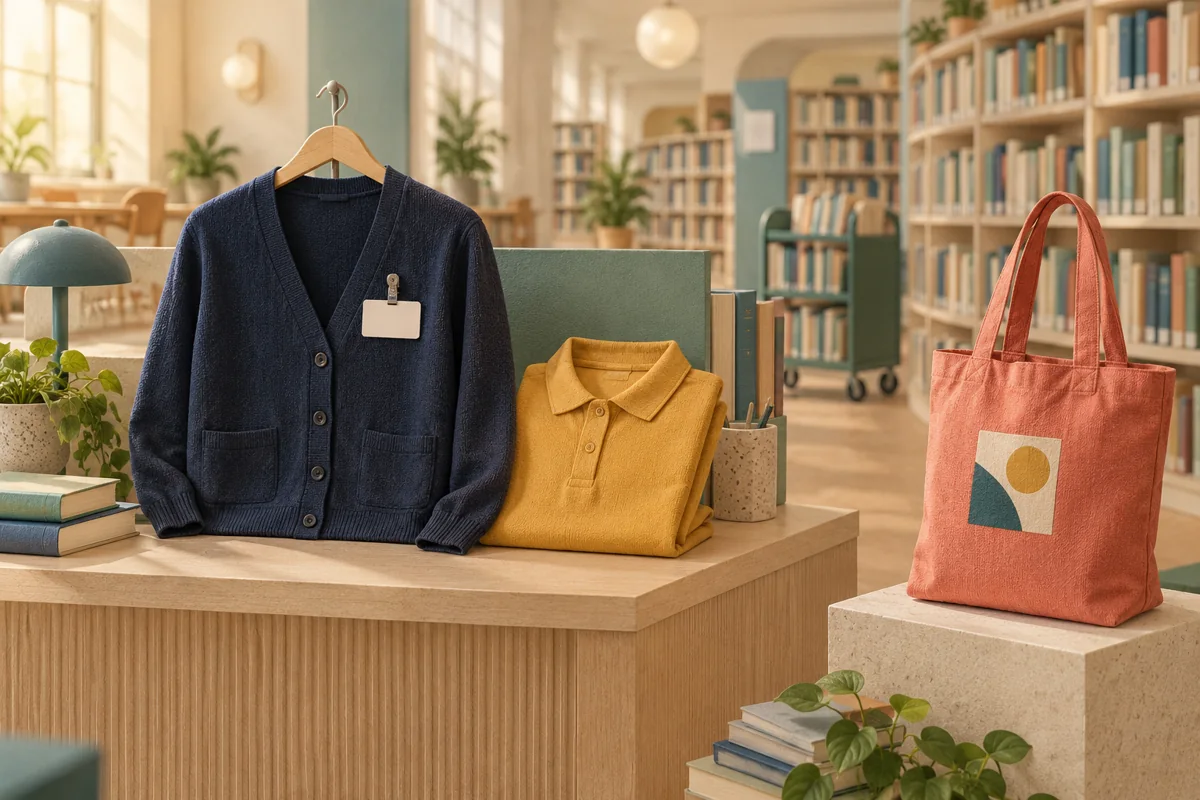
A library apparel program should make staff recognizable without assuming every employee needs the same shirt—or that a shirt replaces an identification badge. Start with the library’s own identification policy, distinguish staff-only clothing from public merchandise, and give employees a choice among approved fits and layers. A shared visual identity can work across circulation, shelving, storytime and outreach while leaving room for different working conditions.
The purchasing decision is whether you need a badge-led system, a coordinated apparel collection, or a combination. This guide provides a practical way to choose, test the result in real service situations and manage orders across branches. It is not a proposed universal dress code.
Publisher perspective: Brand Sauce provides company-store services. The operating framework below is our recommendation, not a claim that the libraries cited are customers or use our services. Public library policies are examples of different local decisions, not rules for other institutions. Sources checked October 8, 2026. Confirm product availability, decoration, fulfillment, store controls and quote-needed pricing for your actual program.
Decide what identifies staff before buying apparel
Write down what a visitor should be able to determine: “This person works here and can direct me to help.” Then decide which approved identifier carries that message. A logo shirt may provide a useful cue, but it cannot automatically supply the information or access function of a staff badge.
Vancouver Public Library’s staff identification policy requires visible photo identification and describes different name-display arrangements for management and other staff, plus a request process for name-related exemptions. It also says staff identification does not require a legal name. That is a concrete example of why names should follow an institution’s identification process rather than a merchandise order form’s default.
Before ordering, ask the policy owner to approve a short identification specification: badge requirement, permitted apparel identifiers, approved name format, role wording, and who handles exceptions. Keep reasons for a personal exception outside the supplier’s production file. The supplier generally needs approved production text, not the private discussion that led to it.
| Model | When to consider it | What must be resolved |
|---|---|---|
| Badge-led, ordinary approved clothing | Staff prefer varied clothing and existing badges provide a clear identifier | Badge visibility with different necklines, layers and working positions |
| Coordinated shirts plus required badges | The library wants a stronger shared visual cue during public service | Fit range, care, replacement and whether layers hide either identifier |
| Optional branded layer plus required badges | Work spaces or personal comfort needs vary | Which layers are approved and how identification remains visible when removed |
| Event apparel plus the normal identification process | Outreach or a seasonal reading program needs a distinct appearance | Where and when the design may be worn, and what happens after the event |
These are starting models, not a hierarchy of professionalism. Choose the least complicated arrangement that meets the library’s actual service and identification needs.
Keep staff identification distinct from supporter merchandise
A library may also sell shirts, give volunteers event apparel or offer a tote to supporters. If all those products look identical to staff clothing, the logo alone stops being a reliable cue for finding an employee. This is a design problem even when every product looks good individually.
Map the audiences before approving art: employees, volunteers, visiting presenters and the public. Decide which words, placement or other visible cues are reserved for each group. Do not rely only on a subtle color difference. A clear role label, where the library approves one, can do work that an extra shade of blue cannot.
A practical approach is to share the library identity but separate the function. Public merchandise can use a campaign illustration; staff apparel can use an approved service identifier; volunteer pieces can use approved volunteer wording. None of these garments should be treated as an access credential. Keep building-access permissions within the library’s established process.
Also plan how a design leaves circulation. If a former staff member keeps a shirt, decide whether its wording creates a problem and whether a removable identifier would have been a better choice. This is a reason to settle ownership and return expectations before issuing apparel, not a reason to presume misconduct by former employees.
Test the clothing during library work, not only at a fitting table
Hancock County Library System’s employee dress policy, section 19, explicitly connects clothing to assigned tasks and coverage while bending, reaching and sitting. It requires name tags and encourages library-branded clothing at outreach programs. The purchasing lesson is to evaluate movement and context, not just a standing photograph.
Invite a small cross-section of staff to try the proposed finished garments, including the decoration and intended badge attachment. Use their actual tasks where appropriate: reaching a normal shelf, sitting at the service desk, moving a book cart and setting up an activity. Include both a base garment and an approved outer layer. A logo covered by a cardigan is not useful in that moment.
- Service desk: Can the identifier be seen from the visitor’s side when the employee is seated?
- Shelving: Does ordinary reaching pull the garment uncomfortably or move the badge out of place?
- Children’s programming: Can the wearer sit, stand and demonstrate the planned activity comfortably?
- Outreach: Does identification remain clear with the outerwear actually needed?
- Equipment-based activities: Has the responsible supervisor approved garment and accessory suitability for that specific task?
This is a proposed wear trial, not a claim that Brand Sauce has tested a particular garment in a library. It also does not establish protective performance. Facilities work or equipment-specific activities may need a separate approval route; a general merch collection should not imply that every item is suitable everywhere.
Record outcomes as specific changes: “badge rotates behind the lapel when seated” is actionable; “not professional enough” is not a useful production instruction. For material and care tradeoffs, our cotton versus performance polo guide can help narrow the samples before this trial.
Offer approved choice without multiplying every branch’s catalog
Start with a small collection that covers the required functions, then test whether it offers usable fits. Two approved cuts of a shirt may solve more problems than six colors of one cut. An optional layer may be valuable, but it should not become the only way a person can display the library identity.
Give staff a private fit-selection route using the exact garment’s size information. Avoid making employees explain a medical condition or other personal circumstances in a general order note. The program owner should be able to authorize an alternate approved product without forwarding the reason to every person handling production.
Palos Verdes Library District’s represented-employee policies, sections 11.12–11.14, distinguish general dress, maintenance uniforms and name badges. Its dress section includes an exception for district-provided T-shirts, while its badge section makes a specific exception for maintenance staff in uniform. The useful lesson is that a library can define role-specific arrangements rather than treating one product as universally approved.
For a multi-branch system, define one core specification and a controlled exception list. Record the exact style, color, decoration and approved substitute. If branch-specific names are unnecessary for visitors, a system-level design may also be easier to use when staff cover another location. If branch wording serves a real purpose, document what happens during cross-branch assignments.
Match the ordering model to the promise
On-demand ordering can be useful for individual replacements, gradual hiring or optional items without a fixed wear date. It is less helpful when a new employee must have an approved identifier tomorrow. A bulk purchase can fit a confirmed rollout, while a hybrid can combine an initial issue with later individual reorders.
| Need | Practical starting route | Tradeoff to price and manage |
|---|---|---|
| All branches begin a new look on one date | Collect confirmed selections, then place a coordinated batch | Receiving, sorting, fit exchanges and size-specific contingency stock |
| Occasional hires and replacements | Individual ordering with an approved temporary identification arrangement | Per-order delivery cost and lead time; no assumed rush capability |
| Daily apparel requirement with unpredictable starts | Small approved local reserve plus replenishment | Inventory by usable style and size, storage and a named stock owner |
| Optional appreciation gifts | Separate choice-based invitation | Do not count gift selections as coverage for required work apparel |
Ask for quotes against the same brief: garments, size mix, decoration, setup, delivery destinations, packing, taxes where applicable, exchanges and replenishment. Do not compare a bulk product-only price with an individually delivered decorated price. Our on-demand versus bulk analysis explains the broader cost decision.
Keep required apparel and appreciation budgets separate in the program records. Whether a particular funding source can pay for either is a decision for the library’s purchasing and finance owners. Do not describe a recognition allowance as the solution to a required-uniform shortfall.
Allocate by person and delivery point, not by shift count
Cross-branch coverage creates an easy ordering mistake: counting the same employee on two branch rosters. Assign each person a single ordering reference and receiving location for the rollout. Branch managers can validate the roster without each placing a duplicate order.
Illustrative planning example, not a client result: four branches submit 18 staff assignments each, totaling 72 assignments. Twelve of those entries are duplicate appearances by employees working across branches, leaving 60 distinct people. If the approved allocation is two garments per person, the initial issue requires 120 garments. Adding eight deliberately selected reserve garments makes 128—not 144 plus reserve.
The example does not prescribe two garments or an eight-piece reserve. Set quantities from the wearing schedule, care arrangements, confirmed fit selections and reorder lead time. Break the reserve into actual style-and-size combinations; eight unusable sizes are not eight useful contingencies.
Send each branch a receiving list with order references, item specifications and counts. Track received, handed over, exchange pending and replacement pending separately. A parcel delivered to the main library is not proof that the correct employee at a satellite branch received a usable garment.
Use a six-case acceptance check before opening the collection
Run these cases with the branch coordinator, policy owner and supplier contact. A documented manual workaround is acceptable if everyone understands it; do not claim the store automatically enforces rules it cannot enforce.
- Public and staff apparel side by side: Can the approved identification method still distinguish who is working?
- A staff member changes branches: Do the garment, badge and delivery records remain correct without a duplicate allocation?
- The preferred size is unavailable: Can an approved alternate be selected without exposing a private fit discussion?
- A hire starts before production finishes: Is there a policy-approved temporary identification arrangement?
- An outer layer covers the shirt: Does the required identifier remain visible in the actual service position?
- A name display changes: Can the badge process handle it without automatically reordering every garment?
Keep the release record short: approved collection, audience, identification policy reference, samples reviewed, unresolved exceptions, receiving owner and reorder contact. Freeze the approved artwork version so an event design does not quietly replace the everyday staff design.
Frequently asked questions
Should every library employee wear the same polo?
Not necessarily. A consistent identification system can coexist with approved shirts, layers and fits. Choose identical apparel only if it serves the library’s tasks and local policy, not because it is easier to photograph.
Does a library-logo shirt replace a name badge?
Only if the library’s own policy expressly permits that arrangement. The cited institutions use different rules. Have the policy owner answer before removing badges from the purchasing plan.
Should staff names be embroidered on clothing?
Permanent names can make changes and reassignment harder. Consider keeping the approved name display on a separate identifier, subject to local policy. Our employee-name personalization guide covers the production and approval tradeoffs.
Can the public buy the same library clothing?
They can if the library chooses, but then that clothing alone cannot reliably identify staff. Reserve a clear staff identifier and decide how volunteer and supporter designs differ before releasing them.
What belongs in a supplier brief?
Include the audience, required wear date, approved identification arrangement, styles and fit range, artwork, quantities by size, delivery points, care expectations, exchange route and reorder needs. Ask for exact availability and a complete quote. The best starting point is a clear service requirement—not a large collection of logo products.