Put employee names on company gifts when the recipient wants the name, the product will remain theirs, and your ordering process can verify the exact text before production. For shared equipment, uncertain apparel sizing or a fixed-date handout with a changing roster, company-logo-only merchandise or a removable personal touch is often the better choice.
A name is not just another version of the logo. It turns a standard product into an item intended for one person. That changes how you collect information, approve artwork, match packages and handle replacements. The useful buying question is not “Can we add names?” It is “Which gifts deserve permanent names, and can we deliver those names correctly?”
Publisher perspective: Brand Sauce publishes this guide for employee-merchandise buyers. The decision framework is our editorial recommendation, not a claim that every Brand Sauce product or store supports individual personalization. Confirm the exact product, decoration method, destination, workflow and quote before offering it.
1. Choose the right level of personalization
Separate three decisions: letting someone select the product, adding your company identity, and adding their personal identity. They can work together, but none requires the others. Someone can choose a company-branded sweatshirt without wanting their name across its chest. Our guide to letting employees choose their gifts covers the broader assortment decision.
| Approach | Good fit | Main tradeoff |
|---|---|---|
| Company logo only | Shared supplies, event extras, apparel with uncertain fit | Less individual identification; easier to reassign if unused and suitable |
| Permanent employee name | A chosen keepsake or personal-use item with confirmed wording | Requires recipient-specific production and a correction plan |
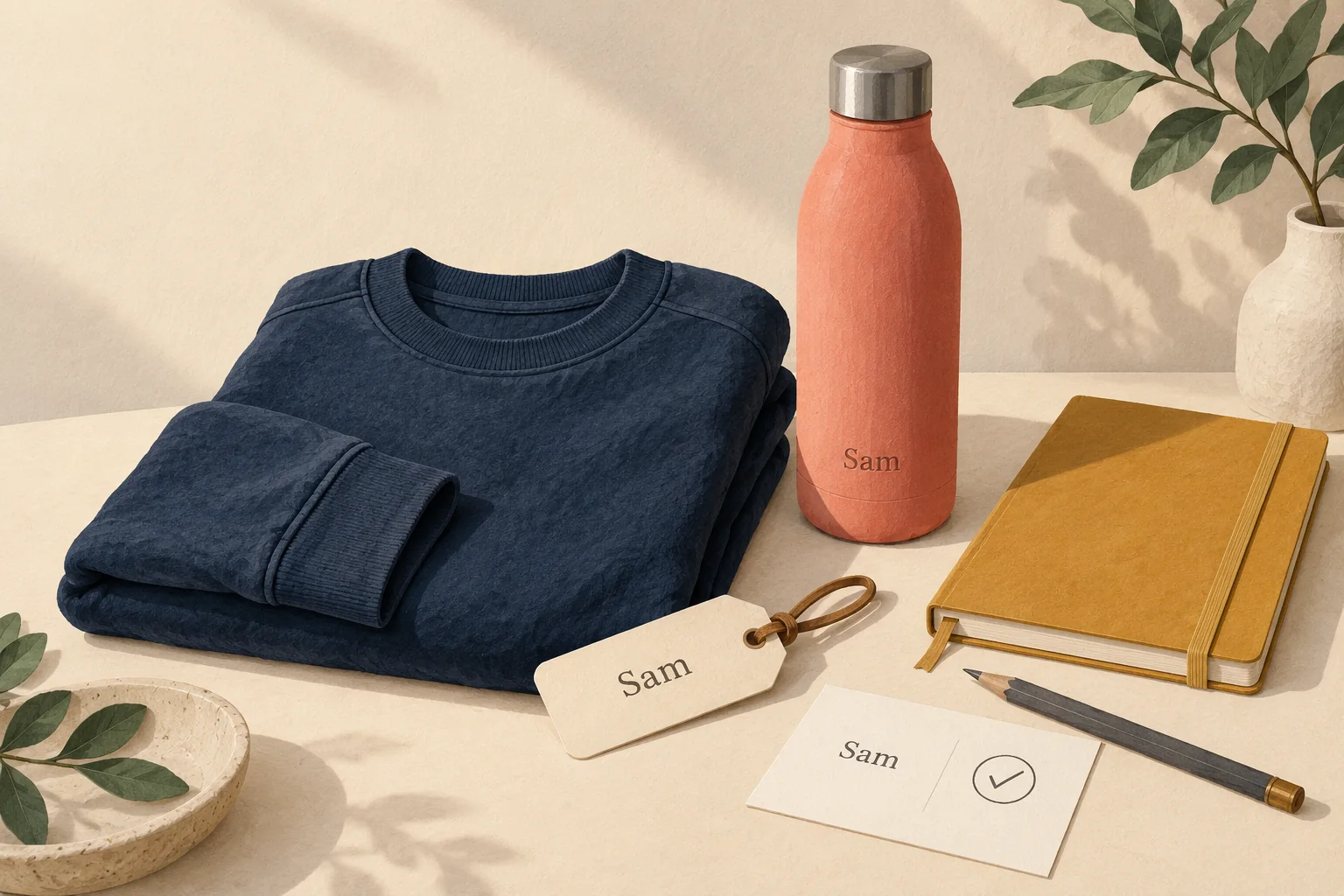
| Removable name tag or separate card | A personal welcome without permanently changing the main gift | Tag or card may be separated from the item; still needs accurate matching |
| Initials chosen by the recipient | Someone who prefers a less explicit personal mark | Initial order and styling still need approval; initials are not unique identifiers |
Use permanent names for a reason the recipient can recognize: identifying their bottle in a shared kitchen, marking a meaningful milestone, or making a selected notebook feel specifically theirs. If the only reason is that the customization box exists, keep the main item simpler and put the appreciation in a thoughtful note.
2. Ask for the name to display, not the name in payroll
Make the choice explicit: “Add a name” or “No personal name.” If names are optional, a blank field should not silently trigger a lookup in an employee directory. Nor should choosing no name remove the employee's access to the gift.
Label the entry field “Name or text to appear on your gift,” then state the actual approved limits. A shipping name and decorative text serve different purposes. Keep them separate so a person can receive a parcel under the appropriate delivery details while choosing a different display name.
The W3C's guidance on personal names explains why forms should not assume everyone has a first-and-last-name structure. It also advises preserving capitalization, allowing punctuation and spaces, and considering non-Latin characters. Applied here, ask recipients for the exact display text instead of automatically constructing it from HR fields.
Do not silently shorten a name, remove an accent or substitute a different script to fit a decoration system. Ask the recipient to approve an alternative, offer another supported product, or supply the logo-only version. Treat a limitation as a production constraint to resolve, not a problem with the person's name.
For an optional gift, let the recipient decide whether they want their identity visible on something they carry or wear outside work. A discreet name on the underside of a suitable item and a large name across a bag are different experiences. Show the location before collecting approval.
3. Approve the whole personalization envelope
One attractive sample with a short name does not establish that every submitted name will look good. Ask the decorator for the supported range: available fonts, scripts, line count, placement, maximum usable width and minimum readable lettering. A character limit by itself does not settle physical fit; different letter combinations occupy different widths.
Build a small test set using fictional text: a short name, a long name, a hyphenated name and the accented or non-Latin characters relevant to the offered service. Review the output on the exact product and method. This is a practical acceptance check, not a claim of formal laboratory testing.
For a manufacturer-specific example, YETI's US customization FAQ lists different minimum sizes for monograms and text in its Artboard tool, and says text wraps within the marking area. Those are rules for that service, not universal engraving specifications. Get the equivalent constraints for your actual supplier instead of copying another brand's limits.
Decide what happens at the boundary. Will a long name move to two lines, use an approved alternate layout, or require manual review? Avoid an unchecked “shrink to fit” rule that makes the longest names practically unreadable. Give the reviewer authority to pause the individual item without delaying unrelated, approved orders.
For apparel, check how the personal name and company logo work together on the finished garment. Placement, backing and garment construction deserve the same attention as the main decoration. The branded apparel sample approval guide explains what a physical sample can establish that a digital preview cannot.
4. Make each approved name travel with its order
A store's ability to accept custom text does not establish that production receives it automatically. In its current Shopify personalization documentation, Printful describes text-based personalized orders importing as drafts. The merchant must arrange customer input, manually add the requested text and submit the order after review. That is a useful example of why buyers should verify the complete workflow, not just a feature label.
Use one release record per personalized line item. An order containing two gifts needs two explicit text assignments, even if both are for the same recipient. Do not rely on a general order note that leaves the decorator guessing which item gets which name.
| Release field | What must be unambiguous |
|---|---|
| Order and item reference | The exact line item, product variant and quantity |
| Approved personal text | Exact spelling, capitalization, punctuation and line breaks |
| Decoration configuration | Method, font, position, dimensions and company-artwork version |
| Approval evidence | The specific proof version approved and when |
| Production release | Who released it, when, and the supplier's confirmed change cutoff |
| Package match | How the finished item will be linked to the correct recipient |
Keep the approval language narrow: “I confirm this is the text and layout I want.” It should not suggest the employee has waived remedies for a supplier producing something different. If an approved name changes before release, create a new version and retire the old one. After release, check production status before promising an edit.
At packing, compare the personalized item with its order reference and delivery assignment, not simply with the next row in a spreadsheet. A correctly engraved bottle in the wrong person's package is still a failed delivery. For office handouts, use an accountable collection process rather than leaving all named items in an unattended pile.
5. Price the exception work as well as the decoration
Request a quote for the exact configuration. Ask about per-item name charges, additional decoration locations, artwork or digitization work, proof handling, recipient matching, shipping and remake costs. State the destination countries and order pattern. Support for a standard company logo does not establish support for variable names on every product or in every country.
Separate the cost of a standard gift from the incremental cost of individualization. If you are already paying for company-logo decoration, do not count that same expense again as a name-personalization charge.
Illustrative calculation, not a supplier quote: suppose 80 recipients choose names, the added decoration costs $7 each, proof review takes three minutes per item at an assumed internal labor cost of $30 per hour, and the company reserves $100 for corrections. The incremental planning amount is $560 + $120 + $100 = $780. It excludes the base gifts, ordinary shipping, taxes and any setup charge. The reserve is a budget decision, not a predicted error rate.
Then choose the fulfillment model:
- On demand: useful when recipients arrive throughout the year and approve names individually. It still needs a functioning approval queue and realistic delivery expectations.
- Bulk personalized run: reasonable when the roster is stable, text can be frozen and a coordinated presentation matters. Every unique item still needs correct matching.
- Hybrid: buy standard logo items for a known event, then add approved names later through a confirmed process, or personalize only a removable component. Verify that the second-stage decorator accepts the supplied goods.
Do not promise a lower cost simply because an order is on demand, or an easier process simply because it is bulk. Compare complete quotes against the same approval, handling and delivery scope.
6. Agree what happens when a name is wrong
Distinguish an incorrectly produced name, an approved typo, a later name change and a correctly personalized item that does not fit. These cases may have different supplier remedies, while the employer may choose to fund a consistent recipient experience.
Ask for written answers: who investigates, what evidence is needed, who pays for a remake, and whether the original should be returned, retained or otherwise handled. Do not assume a name can be removed cleanly from engraving, printing or embroidery; get the decorator's assessment before offering alteration as a remedy.
For apparel, resolve the broader company swag size-exchange policy before adding permanent names. If fit remains uncertain, a logo-only garment with a separate personalized note may be the stronger gift. Do not personalize replacement apparel until the replacement size and text have both been reconfirmed.
A practical decision: one event, two different treatments
Hypothetical example: a company is preparing a team gathering. It wants a welcome gift for everyone and a keepsake for a smaller milestone group. Attendance is still changing, and several employees have not chosen apparel sizes.
The buyer selects logo-only sweatshirts for the general collection and offers the milestone group optional names on a separately approved non-apparel item. Unconfirmed milestone orders stay out of production; no response does not become permission to use the directory name. The buyer arranges an approved fallback for anyone whose preferred text cannot be produced.
This is not a claim that non-apparel always makes the better personalized gift. It is a decision to put permanent names where the recipients, specifications and approval process are ready, while keeping the changing part of the event flexible.
Frequently asked questions
Should every employee gift include a name?
No. Offer it where individual identification or a keepsake matters. A useful product, genuine choice and a specific thank-you can provide a personal experience without permanent name decoration.
Can we use initials to avoid proofreading?
No. Ask recipients for the exact initials and order they want, and approve the layout. Do not generate a monogram automatically from a directory record.
Does “no minimum order” mean every item can have a different name?
No. Minimum quantity and variable personalization are separate capabilities. Confirm the supported product, method, text rules, destination and price for different names within the same campaign.
What should we ask a provider to demonstrate?
Ask for one test order from name entry through proof approval, production release and package matching, plus one correction before release. Review the finished sample and the written remake policy before opening the option to employees.
The buying rule: personalize the item only when you can honor the person's choice and preserve the approved text all the way to delivery. Otherwise, personalize the message and keep the merchandise flexible.