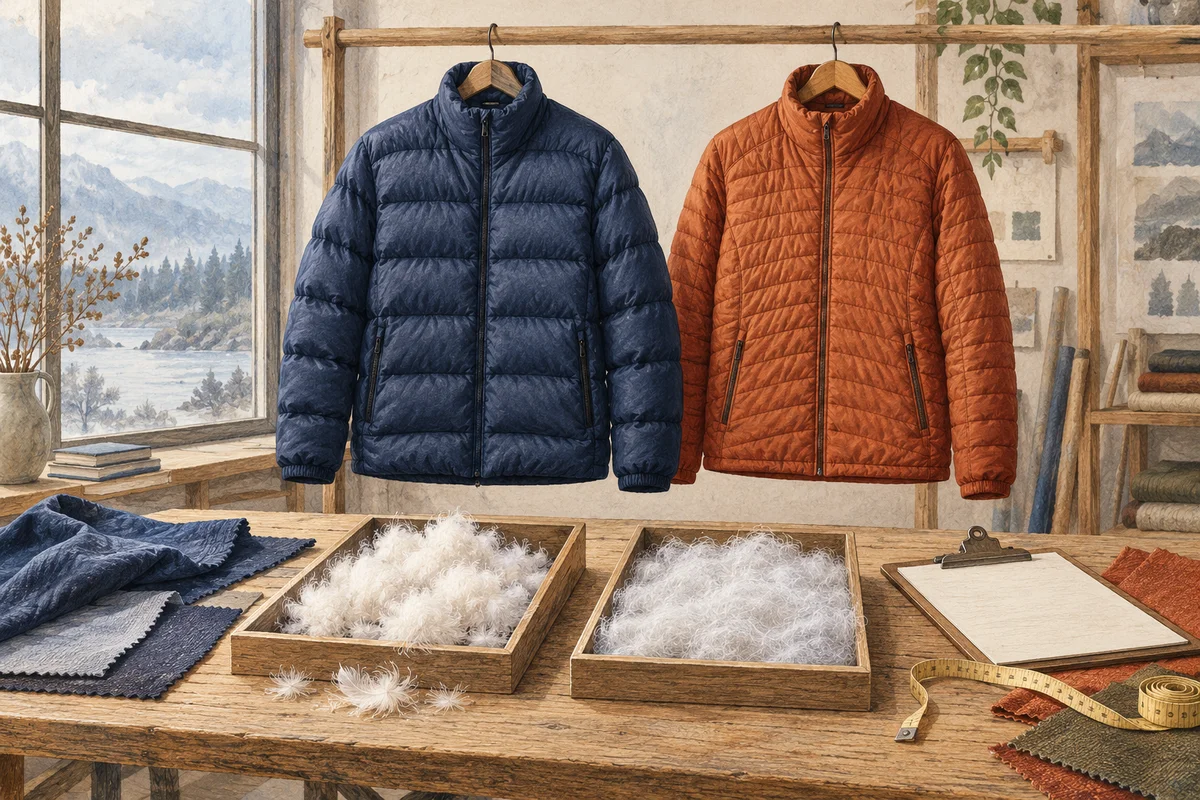
Choose down when low packed bulk and warmth for weight matter in mostly dry use; shortlist synthetic insulation when damp conditions and drying are more important. Then compare the finished jackets—not just the insulation labels. For a company gift, the best choice also has to work with the employee’s layers, your decoration, the available size range and the care they can realistically provide.
A higher fill-power number is not a reliable way to declare one finished jacket warmer than another. Nor does synthetic insulation make a jacket waterproof. These two shortcuts can turn a seemingly premium outerwear program into an expensive mismatch.
Publisher perspective: Brand Sauce publishes this buying framework for company merchandise programs. The approval tools below are editorial recommendations, not results from a comparative garment test. Manufacturer references explain materials; they do not establish that Brand Sauce supplies a particular style, size or country.
Start with the missing function, not a premium label
Before asking for quotes, finish this sentence: “This jacket should help employees ___ while wearing ___, and it will usually be carried or stored ___.” A layer for a traveling account team is a different brief from a coat worn while waiting outside at an evening celebration. Both may look like a request for a branded puffer.
Separate time spent standing from time spent moving. Ask whether the jacket will normally sit beneath a rain shell, over a sweater or directly over a light shirt. Record whether recipients actually need another insulated garment. A lightweight layer may be more useful than the warmest-looking option in the presentation.
Our broader guide to choosing company jackets for climate and fit covers the overall assortment. This guide addresses the narrower decision once insulation is on the shortlist: which construction should the program fund, and what evidence is needed to compare candidates fairly?
Down and synthetic: two useful routes, not a prestige ladder
Patagonia’s insulation guide describes natural down’s warmth-to-weight and packing advantages in dry conditions, and synthetic insulation’s ability to retain useful warmth when wet. Natural down comes from birds; synthetic insulation uses manufactured fibers. Those material differences inform a shortlist, but they are not a complete garment specification.
| Program need | Route to investigate first | Question before approval |
|---|---|---|
| Compact layer for mostly dry travel | Down | Does the actual sample pack conveniently and fit beneath the intended outer layer? |
| Frequent damp exposure or a wet commute | Synthetic, with an appropriate weather-protection plan | What protects against rain, and what does the garment maker claim about the shell? |
| Employees prefer to avoid down | Synthetic | Is the entire garment consistent with the recipient’s preference, including trims? |
| Mixed climates and personal needs | Two clearly differentiated choices | Can both be offered with comparable funding, fit coverage and delivery expectations? |
| One known event and a confirmed roster | Compare exact finished samples in either material | Which meets the event brief without unnecessary bulk or unmanageable leftovers? |
Do not make the employee justify a material preference to a manager. Describe the fill plainly and offer a private selection route. “Synthetic fill” also should not become a blanket claim that every component is animal-free; request product-level confirmation if that is a selection requirement.
A mixed-fill jacket needs its own explanation. Ask where each material is used instead of listing it under whichever category sounds more premium. Avoid a menu that treats down as the reward and synthetic as the consolation prize. The useful distinction is intended use.
Read fill power, fill weight and jacket weight separately
Patagonia’s explanation of down fill power distinguishes the volume occupied by an ounce of down from the quantity of down inside a garment. Higher fill power describes greater loft for a given weight of down; it is not the same as a whole-jacket warmth rating. Fill quantity, distribution, materials and construction also matter.
Build a comparison sheet with separate fields. If a supplier cannot provide a field, write “not supplied,” not zero. An empty specification is a reason to ask a question, not permission to invent an equivalent.
- Fill type: exact insulation description, including any blended or zoned construction.
- Down fill power: retain the manufacturer’s stated value and terminology where applicable.
- Fill quantity: ask which garment size the stated weight represents.
- Finished garment weight: record the reference size; this includes more than insulation.
- Shell and lining: retain their separate material and weather-protection descriptions.
- Coverage: compare hem length, collar, hood and fit over the intended layers.
For an illustrative comparison, suppose jacket A lists 800-fill-power down and jacket B lists 650-fill-power down. If neither quote supplies fill quantity or comparable construction information, the sheet cannot support “A is warmer.” It supports only the stated difference in down fill power. Do not convert that difference into a percentage warmth gain, a temperature promise or an employee-value score.
Similarly, do not put a synthetic insulation weight into the fill-power column. Ask what the supplier’s number measures and what comparison it supports. Two numbers printed beside “insulation” may describe different properties.
Keep insulation and rain protection in different columns
A synthetic puffer can be a sensible damp-weather candidate without being a rain jacket. REI’s insulated-jacket guide treats insulation, activity and outerwear features as related decisions; it notes synthetic insulation’s damp-performance and drying advantages and down’s packability. For a company buyer, the practical next step is to ask separately what the shell does.
Copy the manufacturer’s exact weather claim into the approval record. If the page says water-resistant, keep that wording. If the intended use needs a waterproof outer layer, identify that layer explicitly rather than assuming the puffer replaces it.
Also avoid turning a casual gift into an implied work-protection solution. If the organization is specifying clothing for a controlled work task, route that requirement through its responsible workwear owner. This comparison is about choosing merchandise, not certifying an outfit for occupational exposure.
Use a side-by-side sample review with a stop rule
Request the exact garments in the proposed colors, then review them over the same intended underlayer. Include different sizes and cuts where the program needs them. Record observations rather than awarding vague “premium feel” points.
| Check | What to record | Stop or revise when |
|---|---|---|
| Layering and movement | Seated comfort, reaching, collar clearance and sleeve movement | The intended underlayer cannot be worn comfortably |
| Carry and storage | How the sample fits the actual bag or storage space | The program’s packing requirement is not met |
| Finished branding | Placement, visible puckering, interior finish and approved method | The decorator has not approved this exact construction |
| Care | Garment label, decoration instructions and recipient-facing guidance | Instructions conflict or depend on unavailable care facilities |
| Supply coverage | Confirmed style, color, sizes, destination and ordering window | The advertised choice cannot actually be fulfilled |
For decoration, ask how the proposed application interacts with the jacket’s panels, lining and fill compartments. Do not prescribe a universal logo position from a flat mockup. Require the decorator to confirm the method and placement for the specific style, including any effect on care or manufacturer terms. Our decorated apparel sample approval guide provides a fuller sign-off process.
A short office try-on is useful for fit and handling, but it is not a controlled thermal test. Keep the conclusion proportionate: “fits over the team’s usual sweater” is supportable from that review; “warmer than every alternative” is not.
Compare delivered programs, not only jacket unit prices
Ask for an itemized quote covering garment, decoration, setup, sample approval, shipping, destination-specific charges and any program service fees. Pricing is quote-needed until those inputs and the order route are confirmed. Do not assume synthetic is always cheaper or that a recognizable down brand is automatically better value.
For an ongoing store with uncertain demand, individual ordering can reduce the need to guess each size in advance—if the selected jacket and decoration are genuinely available on that basis. Ask what happens when a color or size disappears between invitation and order.
Bulk can make sense for a known roster, a coordinated deadline or a decoration process that benefits from a production run. A hybrid can reserve a defined event quantity while leaving later recognition orders to another route. Compare actual minimums, setup costs, stock commitments and replacement terms; do not assume either material requires one fulfillment model.
Consider an illustrative two-office program: one group wants a packable dry-weather travel layer, while another wants an everyday damp-commute option. Instead of assigning one jacket by office, offer two approved choices with clear descriptions and a common funding rule. Let employees select, because their personal use may differ from their work address. This is a planning example, not a measured client outcome.
The employee-choice gifting approach is particularly useful here: preserve a coherent brand treatment while allowing different constructions. If one choice requires a personal contribution, disclose that before selection, not as a surprise at checkout.
Copyable insulation approval record
Use one record per finished garment, not one per brand. Retain source links or dated specification files so the next buyer can understand what was approved.
- Use brief: likely weather, activity, underlayer and carry requirement.
- Exact item: manufacturer, style, color, fit, size range and destination.
- Insulation evidence: fill description, applicable fill power, supplied fill quantity and reference size.
- Whole-garment evidence: shell claim, coverage, finished weight if supplied, care label and sample observations.
- Decoration: method, placement, artwork version and approved sample date.
- Commercial route: quote date, inclusions, minimums, lead-time basis and substitution approval owner.
- Employee explanation: choose-this-if description, limitations, funding and help route.
- Decision: approved, revise or reject, with the reason and named internal owner.
Reopen the record when a supplier substitutes a style or changes the insulation specification. “Same color and same brand” is not enough to inherit approval. Ask which requirements still hold and which need a new sample.
Down versus synthetic company jacket FAQs
Is higher-fill-power down always the better corporate gift?
No. It may be relevant when weight and packed bulk matter, but it does not settle fit, whole-garment warmth, care, decoration or recipient preference. Pay for a requirement, not an isolated number.
Does recycled down count as a synthetic alternative?
No. Recycled down is still down, not synthetic fiber. Patagonia’s material guide describes reclaimed down from used products. If an employee wants to avoid down, recycled content does not resolve that preference.
Can we promise a comfortable temperature range?
Do not invent one from fill power or a supplier’s photograph. Use any manufacturer guidance within its stated conditions, and explain intended layering and activity. A merchandising description should not imply a universal personal comfort guarantee.
Should we buy both types?
Only when they serve distinct needs and both can be supported operationally. One well-verified style plus a meaningful alternative gift can be better than two nearly identical jackets with incomplete size coverage. Approve the employee experience as carefully as the insulation.
Primary material references reviewed October 22, 2026. Confirm current specifications, decoration permission, supply and delivered pricing for the exact proposed garments before purchase.